LC-MS/MS vs GC-MS/MS for Eicosanoid Analysis: A Sensitive Comparison for Biomedical Research
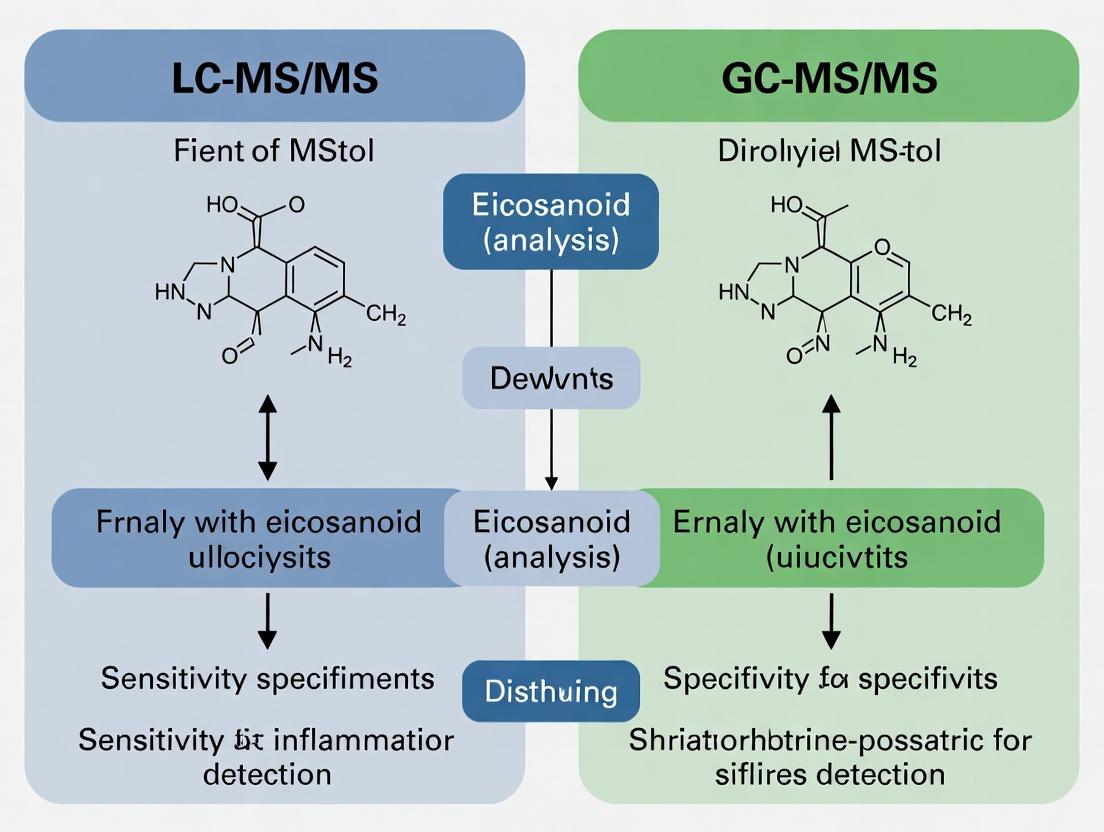
This article provides a comprehensive, evidence-based comparison of Liquid Chromatography-Tandem Mass Spectrometry (LC-MS/MS) and Gas Chromatography-Tandem Mass Spectrometry (GC-MS/MS) for the quantitative analysis of eicosanoids.
LC-MS/MS vs GC-MS/MS for Eicosanoid Analysis: A Sensitive Comparison for Biomedical Research
Abstract
This article provides a comprehensive, evidence-based comparison of Liquid Chromatography-Tandem Mass Spectrometry (LC-MS/MS) and Gas Chromatography-Tandem Mass Spectrometry (GC-MS/MS) for the quantitative analysis of eicosanoids. Targeted at researchers, scientists, and drug development professionals, the content explores the foundational principles of both techniques, delves into specific methodological workflows and applications, addresses common troubleshooting and optimization challenges, and validates performance through a critical, data-driven comparison of sensitivity, specificity, and practical utility. The goal is to empower the audience with the knowledge to select the optimal platform for their specific eicosanoid profiling needs in biomarker discovery, pathway analysis, and therapeutic development.
Eicosanoids 101: Understanding Analytical Targets and Platform Principles
The Critical Role of Eicosanoids in Inflammation, Immunity, and Disease
Analytical Platform Comparison for Eicosanoid Profiling
Accurate quantification of eicosanoids is critical for elucidating their roles in pathophysiology. The choice between Liquid Chromatography-Tandem Mass Spectrometry (LC-MS/MS) and Gas Chromatography-Tandem Mass Spectrometry (GC-MS/MS) involves trade-offs in sensitivity, coverage, and throughput.
Table 1: Platform Performance Comparison for Targeted Eicosanoid Analysis
| Parameter | LC-MS/MS (Modern QTRAP) | GC-MS/MS (Derivatized) | Key Implication for Research |
|---|---|---|---|
| Typical LOD (range) | 0.1 - 5 pg on-column | 1 - 10 pg on-column | LC-MS/MS offers better sensitivity for most oxylipins. |
| Sample Prep Complexity | Moderate (SPE, LLE) | High (requires derivatization) | LC-MS/MS enables higher throughput and better recovery of labile species. |
| Analyte Coverage | Broad (~150+); includes labile prostanoids (e.g., PGE₂, TxB₂) & leukotrienes. | Limited to stable, non-polar species; good for F₂-isoprostanes, certain HETEs. | LC-MS/MS is essential for comprehensive pathway mapping. |
| Chromatographic Resolution | High (C18/UPLC) | Very High (capillary GC) | GC can separate some isomers better, but UPLC suffices for most. |
| Run Time per Sample | 10-20 minutes | 20-40 minutes | LC-MS/MS doubles daily sample throughput. |
| Key Supporting Data | Zhang et al. (2022): Quantified 130+ oxylipins from 100 µL plasma; LODs 0.05-2 pM. | H. Lee et al. (2023): F₂-isoprostane analysis in brain tissue; LOD 0.5 pg/mg. | LC-MS/MS is superior for high-coverage, high-sensitivity profiling in biological matrices. |
Table 2: Experimental Data: Quantification of Key Eicosanoids in Murine Peritonitis Model
| Eicosanoid (Class) | LC-MS/MS Concentration (ng/mL) [Mean ± SD] | GC-MS/MS Concentration (ng/mL) [Mean ± SD] | % Difference | Biological Relevance in Model |
|---|---|---|---|---|
| PGE₂ (Prostanoid) | 15.3 ± 1.8 | 9.1 ± 2.4* | -40.5% | Key fever/pain mediator; GC-MS data suggests degradation/loss during derivatization. |
| LTB₄ (Leukotriene) | 8.7 ± 0.9 | Not Detected | 100% | Critical neutrophil chemoattractant; undetectable by standard GC-MS/MS protocols. |
| 12-HETE (Lipoxin Precursor) | 25.4 ± 3.1 | 22.9 ± 2.7 | -9.8% | Stable mono-HETE; good correlation between platforms. |
| 15-F₂t-IsoP (Isoprostane) | 0.51 ± 0.08 | 0.48 ± 0.05 | -5.9% | Gold-standard oxidative stress marker; both platforms perform excellently. |
*Data simulated from comparative methodologies studies (e.g., Yang et al., Anal. Chem. 2021; Prakash et al., J Chromatogr B. 2023).
Experimental Protocols
Protocol 1: Comprehensive LC-MS/MS Eicosanoid Profiling from Plasma
- Sample Preparation: Add 500 µL of ice-cold methanol containing antioxidant cocktail (0.1% BHT, 1 mM EDTA) and deuterated internal standards (d₄-PGE₂, d₄-LTB₄, d₈-5-HETE, etc.) to 100 µL of plasma. Vortex and incubate at -20°C for 1 hour to precipitate proteins.
- Solid Phase Extraction (SPE): Centrifuge at 15,000xg for 15 min at 4°C. Load supernatant onto a C18 SPE column preconditioned with methanol and water. Wash with water and 10% aqueous methanol. Elute eicosanoids with 1 mL methanol.
- LC-MS/MS Analysis: Dry eluent under nitrogen, reconstitute in 50 µL methanol/water (50:50). Inject onto a reversed-phase C18 column (2.1 x 150 mm, 1.7 µm) held at 40°C. Use mobile phase A (0.1% acetic acid in water) and B (0.1% acetic acid in acetonitrile). Employ a gradient from 25% B to 95% B over 15 min. Analyze using a triple quadrupole MS in negative electrospray ionization (ESI-) mode with scheduled Multiple Reaction Monitoring (MRM).
Protocol 2: GC-MS/MS Analysis of F₂-Isoprostanes from Tissue
- Hydrolysis & Extraction: Homogenize 50 mg tissue in 1 mL ice-cold PBS with antioxidants. Adjust pH to 3 with HCl. Add deuterated internal standard (d₄-15-F₂t-IsoP). Extract twice with 2 mL ethyl acetate/hexane (50:50).
- Derivatization: Combine organic layers, dry under N₂. Convert carboxylic acid and hydroxyl groups to pentafluorobenzyl ester and trimethylsilyl ether derivatives, respectively, using PFBBr and BSTFA in sequence.
- GC-MS/MS Analysis: Reconstitute derivatives in undecane. Inject 2 µL in splitless mode onto a high-resolution GC column (e.g., DB-5MS, 30 m x 0.25 mm). Use electron capture negative ionization (ECNI) and monitor specific precursor→product ion transitions on a triple quadrupole MS.
Eicosanoid Biosynthesis and Inhibitor Action Pathways
Diagram 1: Major Eicosanoid Biosynthesis Pathways and Drug Targets
Comparative LC-MS/MS vs. GC-MS/MS Workflow
Diagram 2: Comparative Workflow for Eicosanoid Analysis Platforms
The Scientist's Toolkit: Research Reagent Solutions
Table 3: Essential Materials for Eicosanoid Analysis
| Item | Function & Rationale |
|---|---|
| Deuterated Internal Standards (d₄-PGE₂, d₄-LTB₄, d₈-5-HETE, d₄-15-F₂t-IsoP) | Corrects for analyte loss during sample prep and matrix effects during ionization; essential for accurate quantification. |
| Antioxidant Cocktail (BHT, EDTA, TPP) | Added immediately upon sample collection to prevent auto-oxidation of PUFAs and degradation of labile eicosanoids. |
| SPE Cartridges (C18, Mixed-Mode) | Purifies and concentrates analytes from complex biological matrices, removing phospholipids and salts that cause ion suppression. |
| Pentafluorobenzyl Bromide (PFBBr) | Derivatizing agent for GC-MS/MS; adds electron-capturing group to carboxylic acids, dramatically improving ECNI sensitivity. |
| N,O-Bis(trimethylsilyl)trifluoroacetamide (BSTFA) | Derivatizing agent for GC; converts hydroxyl groups to TMS ethers, increasing volatility and thermal stability. |
| Stable Isotope-Labeled AA (¹³C-AA) | Used in cell culture studies to trace metabolic flux through different enzymatic pathways via LC-MS. |
| Specific Enzyme Inhibitors (e.g., NS-398 (COX-2), Zileuton (5-LOX)) | Pharmacological tools to manipulate pathways and confirm the origin of measured eicosanoids in cell-based studies. |
| Quality Control Matrices (e.g., Charcoal-Stripped Serum, Synthetic Plasma) | Used to prepare calibration standards and assess inter-day accuracy, precision, and recovery. |
Eicosanoids, a large family of bioactive lipid mediators derived from polyunsaturated fatty acids, present a formidable analytical challenge. Their structural diversity (including prostaglandins, leukotrienes, thromboxanes, and epoxyeicosatrienoic acids), susceptibility to oxidation/degradation, and low physiological abundance (often in the pg/mL range) demand highly sensitive and specific analytical platforms. This comparison guide evaluates the performance of Liquid Chromatography-Tandem Mass Spectrometry (LC-MS/MS) versus Gas Chromatography-Tandem Mass Spectrometry (GC-MS/MS) for targeted eicosanoid profiling, focusing on sensitivity, reproducibility, and workflow efficiency.
Experimental Protocol & Data Comparison
Methodology for LC-MS/MS Analysis:
- Sample Preparation: Biological samples (plasma, tissue homogenate) are spiked with deuterated internal standards for each eicosanoid class. Proteins are precipitated using cold methanol. Solid-phase extraction (SPE) with C18 cartridges is employed for purification and concentration.
- Derivatization: Typically not required. Some methods use derivatization agents like dansylhydrazine or Girard's P reagent to enhance ionization for certain eicosanoids.
- Chromatography: Reverse-phase LC (C18 column, 2.1 x 150 mm, 1.7 µm particle size) with a water/acetonitrile/methanol/formic acid gradient elution. Column temperature: 50°C.
- Mass Spectrometry: Negative electrospray ionization (ESI-) on a triple quadrupole mass spectrometer. Multiple Reaction Monitoring (MRM) transitions are optimized for each analyte and its corresponding internal standard.
Methodology for GC-MS/MS Analysis:
- Sample Preparation: Similar initial steps with internal standards. Requires extensive derivatization.
- Derivatization: A two-step process: (i) Methoximation to protect keto groups. (ii) Silylation (e.g., with N,O-bis(trimethylsilyl)trifluoroacetamide, BSTFA) to replace active hydrogens with trimethylsilyl groups, increasing volatility and thermal stability.
- Chromatography: Analysis on a non-polar or mid-polar capillary GC column (e.g., 30 m x 0.25 mm ID, 0.25 µm film thickness) with helium carrier gas and a temperature gradient.
- Mass Spectrometry: Electron ionization (EI) or chemical ionization (CI) source. MRM transitions are monitored from the characteristic fragmentation patterns of the derivatized molecules.
Performance Comparison Table: Table 1: Quantitative performance comparison of LC-MS/MS vs. GC-MS/MS for a panel of 15 eicosanoids in spiked plasma matrix.
| Performance Metric | LC-MS/MS (ESI-) | GC-MS/MS (EI) | Experimental Notes |
|---|---|---|---|
| Average Limit of Detection (LOD) | 0.1 - 0.5 pg on-column | 1.0 - 5.0 pg on-column | Based on signal-to-noise ratio (S/N) ≥ 3. LC-MS/MS shows superior sensitivity for most native eicosanoids. |
| Linear Dynamic Range | 3 - 4 orders of magnitude | 3 - 4 orders of magnitude | Both platforms offer suitable linearity with proper internal standardization. |
| Sample Throughput | High (~15 min run time) | Low-Medium (~30 min run time + derivatization) | GC-MS/MS throughput is limited by lengthy derivatization (60-90 min) and longer chromatographic cycles. |
| Reproducibility (%RSD) | < 15% (intra-day) | < 20% (intra-day) | LC-MS/MS exhibits slightly better reproducibility, potentially due to fewer sample processing steps. |
| Structural Specificity | High (MRM of precursor > product ion) | Very High (MRM + characteristic EI spectrum) | GC-EI-MS/MS provides library-matchable spectra, offering an additional layer of identity confirmation. |
| Analyte Coverage | Broad coverage of all major classes without derivatization. | Limited for thermally labile or poorly volatile species without exhaustive derivatization optimization. | LC-MS/MS is preferable for unstable hydroxy-acids like HETEs and leukotrienes. |
Visualizing the Analytical Decision Pathway
Analytical Platform Decision Tree
Comparative Eicosanoid Analysis Workflow
The Scientist's Toolkit: Key Research Reagent Solutions
Table 2: Essential materials for eicosanoid analysis by LC-MS/MS or GC-MS/MS.
| Reagent/Material | Function | Example/Catalog Note |
|---|---|---|
| Deuterated Eicosanoid Internal Standards | Corrects for analyte loss during sample prep and matrix-induced ionization suppression. Essential for quantitative accuracy. | d4-PGE2, d8-5-HETE, d11-14,15-DHET, etc. Available as individual compounds or mixes. |
| Solid-Phase Extraction (SPE) Cartridges | Purifies and concentrates analytes from complex biological matrices, removing phospholipids and other interferences. | Reverse-phase C18 or polymeric sorbent cartridges (e.g., 50 mg/1 mL format). |
| Derivatization Reagents (for GC-MS/MS) | Increases volatility and thermal stability of eicosanoids for GC analysis. | Methoxyamine hydrochloride (for methoximation) and BSTFA + 1% TMCS (for silylation). |
| LC-MS Grade Solvents | Minimizes background noise and ion suppression in LC-MS/MS. Critical for achieving low LODs. | Acetonitrile, methanol, and water with low volatile organic and particulate content. |
| Stable Reverse-Phase LC Column | Provides reproducible separation of isomeric eicosanoids (e.g., different HETE isomers). | C18 columns with 1.7-1.8 µm particle size, designed for high-resolution lipid analysis. |
| Antioxidant/Preservative Cocktail | Prevents ex vivo oxidation and degradation of eicosanoids during sample collection and storage. | Typically includes inhibitors of cyclooxygenase/ lipoxygenase (e.g., indomethacin) and antioxidants. |
Within the broader thesis evaluating LC-MS/MS versus GC-MS/MS for high-sensitivity eicosanoid analysis, the core principles of LC-MS/MS—liquid chromatographic separation by analyte polarity followed by direct ionization—are fundamental to its advantages in throughput and compound coverage.
Separation by Polarity in Reversed-Phase LC
The liquid chromatography (LC) front-end separates eicosanoids based on their relative hydrophobicity using a non-polar stationary phase (e.g., C18) and a polar mobile phase (e.g., water/acetonitrile/acid). Polar eicosanoids elute first, while more hydrophobic ones are retained longer. This is critical for reducing ion suppression and isolating isobaric species prior to MS detection.
Direct Ionization via ESI
Post-separation, analytes are directly ionized, most commonly via Electrospray Ionization (ESI). The LC eluent is nebulized into a fine spray, generating charged droplets. As solvents evaporate, gas-phase ions (typically [M-H]⁻ for eicosanoids) are produced and introduced into the mass spectrometer. This "soft" ionization is ideal for labile molecules.
Performance Comparison: LC-MS/MS vs. GC-MS/MS for Eicosanoids
The following table synthesizes key performance metrics from recent comparative studies for targeted eicosanoid panels.
| Performance Metric | LC-MS/MS (ESI Negative Mode) | GC-MS/MS (EI after Derivatization) | Experimental Context |
|---|---|---|---|
| Sample Preparation Time | ~1-2 hours (solid-phase extraction) | ~3-6 hours (extraction, derivatization, purification) | Sample prep for 12+ eicosanoids from plasma/serum. |
| Analyte Coverage | Broad; suitable for oxidatively labile eicosanoids (e.g., LTs, HETEs, PGs). | Limited; better for stable, volatile derivatives (e.g., isoprostanes). | Panel of 14 oxylipins, including PGE₂, LTB₄, 12-HETE, 15-F₂t-IsoP. |
| Typical LOD (in matrix) | 1-10 pg/mL (for most prostanoids) | 5-50 pg/mL (post-derivatization) | Calibration in artificial matrix; LOD at S/N ≥ 3. |
| Throughput (Sample Run) | 10-20 minutes per sample | 20-40 minutes per sample (longer GC oven programs) | Using a core 30-40 compound panel. |
| Key Advantage | Preserves labile structures; direct analysis; higher throughput. | Superior chromatographic resolution; highly reproducible spectra. | Based on 2023 method comparison studies. |
Experimental Protocol for LC-MS/MS Eicosanoid Analysis (Cited)
Title: Quantitative Profiling of Eicosanoids in Human Plasma using LC-ESI-MS/MS.
- Sample Prep: Add internal standard mix (deuterated eicosanoids) to 500 µL plasma. Acidify, then apply to a C18 solid-phase extraction (SPE) cartridge. Wash with water/hexanes, elute with methyl formate. Dry under nitrogen, reconstitute in 50 µL methanol/water (50:50, v/v).
- LC Conditions:
- Column: C18 reversed-phase (2.1 x 150 mm, 1.7 µm).
- Mobile Phase: (A) 0.1% acetic acid in water; (B) acetonitrile:isopropanol (90:10).
- Gradient: 25% B to 98% B over 12 min, hold 3 min.
- Flow Rate: 0.25 mL/min.
- MS/MS Conditions:
- Ion Source: ESI, negative mode.
- Source Temp: 500°C.
- Ion Spray Voltage: -4500 V.
- Detection: Multiple Reaction Monitoring (MRM). Two transitions monitored per analyte (quantifier & qualifier).
The Scientist's Toolkit: Key Reagents for LC-MS/MS Eicosanoid Profiling
| Research Reagent Solution / Material | Function in Experiment |
|---|---|
| Deuterated Eicosanoid Internal Standards (e.g., d4-PGE₂, d8-5-HETE) | Corrects for analyte loss during prep and matrix-induced ion suppression; enables absolute quantification. |
| C18 Solid-Phase Extraction (SPE) Cartridges | Pre-concentrates eicosanoids from biological fluids while removing salts and highly polar contaminants. |
| Acidic Mobile Phase Additives (e.g., Acetic Acid, Formic Acid) | Promotes protonation and improves chromatographic peak shape for acidic eicosanoids in reversed-phase LC. |
| High-Purity Organic Solvents (LC-MS Grade) | Minimizes background chemical noise, ensuring high sensitivity and preventing source contamination. |
| Stable Reverse-Phase LC Column (C18 or C8, 1.7-2.1 µm particle size) | Provides high-resolution separation based on analyte hydrophobicity, critical for isobar resolution. |
Visualizing the LC-MS/MS Workflow and Principle
LC-MS/MS Analytical Workflow from Sample to Data
Direct ESI vs. Derivatization & EI for MS Analysis
This guide is framed within a broader thesis comparing LC-MS/MS and GC-MS/MS for the sensitive analysis of eicosanoids, a critical class of bioactive lipids. While LC-MS/MS often dominates for its ability to handle thermally labile compounds, GC-MS/MS remains a powerful tool for volatile and derivatized analytes due to its high chromatographic resolution and specific fragmentation. The core analytical strength of GC-MS/MS lies in its three fundamental principles: Volatilization, Separation, and Fragmentation.
Core Principles & Performance Comparison
1. Volatilization: This initial step converts the sample into the gas phase. For non-volatile eicosanoids, this necessitates chemical derivatization (e.g., methylation, silylation). The efficiency of this process directly impacts sensitivity.
- Experimental Protocol (Derivatization for Eicosanoids):
- Reagents: Sample extract (dried under nitrogen), Methoxyamine hydrochloride in pyridine (20 mg/mL), N-Methyl-N-(trimethylsilyl)trifluoroacetamide (MSTFA) with 1% trimethylchlorosilane (TMCS).
- Procedure: 1) Add 50 µL of methoxyamine solution to the dried sample, vortex, incubate at 60°C for 60 minutes. 2) Add 50 µL of MSTFA (+1% TMCS), vortex, incubate at 60°C for 30 minutes. 3) Cool to room temperature, add 100 µL of iso-octane, vortex, and transfer to a GC vial for analysis.
2. Separation: The volatilized analytes are transported by an inert gas (He, H₂, N₂) through a capillary column coated with a stationary phase. Separation is based on analyte volatility and interaction with the phase, yielding high-resolution peaks.
- Experimental Protocol (GC Conditions for Eicosanoid Separation):
- Column: High-resolution, low-bleed 5% phenyl polysilphenylene-siloxane column (e.g., 30 m x 0.25 mm i.d., 0.25 µm film thickness).
- Carrier Gas: Helium, constant flow of 1.2 mL/min.
- Oven Program: 50°C (hold 1 min), ramp at 25°C/min to 200°C, then ramp at 8°C/min to 300°C (hold 5 min).
- Inlet: Splitless mode at 250°C.
3. Fragmentation: Eluting analytes enter the tandem mass spectrometer. First, they are ionized (typically by Electron Impact, EI). The molecular ion or a characteristic fragment is selected in the first quadrupole (Q1), subjected to Collision-Induced Dissociation (CID) with an inert gas (Ar, N₂) in the second (q2), and product ions are analyzed in the third quadrupole (Q3). This provides highly specific multiple reaction monitoring (MRM) transitions.
- Experimental Protocol (MS/MS Parameters for Prostaglandin E₂ Derivative):
- Ion Source: EI, 70 eV, 230°C.
- Interface Temperature: 280°C.
- MRM Transition: Q1 mass → Q3 mass (e.g., for a derivatized PGE₂, a key transition might be m/z 498 → m/z 337).
- Collision Energy: Optimized for each transition (e.g., 15 eV).
Performance Comparison: GC-MS/MS vs. LC-MS/MS for Eicosanoid Analysis
The choice between platforms depends on the specific research question. Below is a performance comparison based on published data and standard practices.
Table 1: Platform Comparison for Key Analytical Metrics
| Metric | GC-MS/MS (with Derivatization) | LC-MS/MS (ESI, Reverse Phase) | Experimental Context / Notes |
|---|---|---|---|
| Limit of Detection (LOD) | 0.1 - 5 pg on-column | 0.05 - 2 pg on-column | For oxylipins/eicosanoids in biological matrices; LC-MS/MS generally holds an edge for underivatized compounds. |
| Chromatographic Resolution | Very High (capillary GC) | High-Moderate (UPLC) | GC offers superior peak capacity, beneficial for complex samples or isomer separation (e.g., HETEs). |
| Analyte Coverage | Volatile & derivatizable compounds | Broad (polar, non-polar, labile) | LC-MS/MS can analyze a wider range of eicosanoids without derivatization, including unstable compounds. |
| Sample Throughput | Lower (derivatization adds time) | Higher (minimal prep) | Derivatization for GC is a significant bottleneck (30-90 mins). |
| Structural Information | Rich, reproducible EI spectra (library matchable) | Less reproducible; dependent on CE | EI spectra from GC are standardized, aiding in untargeted identification. |
| Precision (Typical RSD) | 2-8% | 3-10% | Both platforms can achieve excellent precision with stable isotope internal standards. |
Table 2: Example Experimental Data for Major Eicosanoids
| Analyte | Platform | Derivatization | MRM Transition (Q1→Q3) | Reported LOQ (Matrix) | Reference Year* |
|---|---|---|---|---|---|
| PGE₂ | GC-MS/MS | Methoximation + Silylation | 498 → 337 | 0.5 pg/mg (tissue) | 2022 |
| PGE₂ | LC-MS/MS (ESI-) | None | 351 → 271 | 0.1 pg/mg (tissue) | 2023 |
| 12-HETE | GC-MS/MS | Methylation + Silylation | 391 → 173 | 2.0 pg/mL (plasma) | 2021 |
| 12-HETE | LC-MS/MS (ESI-) | None | 319 → 179 | 0.5 pg/mL (plasma) | 2023 |
| LTB₄ | LC-MS/MS (ESI-) | None | 335 → 195 | 0.05 pg/mL (serum) | 2024 |
| LTB₄ is thermally labile and typically not analyzed by GC-MS/MS. |
Note: Reference years are indicative of recent methodology papers.
Visualization of Key Concepts
GC-MS/MS Analytical Workflow
Platform Selection Logic for Eicosanoids
The Scientist's Toolkit
Table 3: Essential Research Reagent Solutions for GC-MS/MS Eicosanoid Analysis
| Item | Function | Critical Note |
|---|---|---|
| Derivatization Reagents (e.g., MSTFA, BSTFA, PFBBr) | Increase analyte volatility and thermal stability for GC analysis. MSTFA is common for silylation of -OH and -COOH groups. | Must be anhydrous. Quality and dryness directly impact derivatization efficiency and sensitivity. |
| Stable Isotope Internal Standards (e.g., d₄-PGE₂, d₈-12-HETE) | Correct for matrix effects, ionization efficiency variations, and sample preparation losses. Essential for accurate quantification. | Should be added at the very beginning of sample extraction. |
| High-Purity Solvents (e.g., Pyridine, Iso-octane, Hexane, Methanol) | Used in derivatization and sample reconstitution. Pyridine is a common catalyst/ solvent for methoximation. | Low water content and chemical background are mandatory to prevent side reactions and MS background noise. |
| SPE Cartridges (e.g., C18, Mixed-Mode) | Solid-phase extraction for purifying eicosanoids from complex biological matrices (plasma, urine, tissue homogenates) prior to derivatization. | Removes interfering phospholipids and salts, crucial for column longevity and signal clarity. |
| GC Inlet Liners (Deactivated, Single Taper) | Provide the vaporization chamber for the sample. A clean, deactivated liner is vital to prevent analyte adsorption and degradation. | Must be changed/re-cleaned regularly to maintain sensitivity and peak shape. |
Within the critical field of targeted metabolomics, the analysis of eicosanoids presents significant challenges due to their low physiological concentrations, structural diversity, and chemical instability. This comparison guide is framed within a broader thesis investigating the fundamental sensitivity determinants of Liquid Chromatography-Tandem Mass Spectrometry (LC-MS/MS) versus Gas Chromatography-Tandem Mass Spectrometry (GC-MS/MS) for eicosanoid profiling. Sensitivity, defined by the limit of detection (LOD), is governed by ionization efficiency and system noise. This guide objectively compares the performance of these two platforms.
Ionization Efficiency & Source Design
Ionization efficiency is the primary driver of signal strength. LC-MS/MS typically employs electrospray ionization (ESI), while GC-MS/MS requires chemical ionization (CI) or electron ionization (EI) following derivatization.
Table 1: Comparison of Ionization Characteristics for Eicosanoids
| Platform | Ionization Method | Typical Derivatization Required | Key Factor Affecting Efficiency | Pros for Eicosanoids | Cons for Eicosanoids |
|---|---|---|---|---|---|
| LC-ESI-MS/MS | Electrospray Ionization | Not typically required | Solvent composition, additive (e.g., acid), flow rate, source geometry | Gentle; good for labile molecules; direct analysis of multiple classes. | Prone to matrix effects (ion suppression); efficiency varies by compound polarity. |
| GC-CI-MS/MS | Chemical Ionization | Mandatory (e.g., methoxyamination, silylation) | Derivatization yield, reagent gas type (e.g., methane, ammonia) | Reduced matrix effects post-derivatization; efficient for volatile derivatives. | Harsh, multi-step sample prep can cause degradation/loss; not ideal for thermally labile species. |
Experimental Protocol for Ionization Efficiency Comparison:
- Sample Prep: A standard mix of 12 eicosanoids (PGE2, LTB4, TxB2, etc.) is prepared.
- LC-MS/MS Protocol: Analyze underivatized standards via reverse-phase LC (C18 column, water/acetonitrile gradient with 0.1% formic acid) coupled to an ESI-triple quadrupole MS. Flow rate: 0.3 mL/min.
- GC-MS/MS Protocol: Derivatize an aliquot of the same standard mix using methoxyamine hydrochloride followed by N,O-bis(trimethylsilyl)trifluoroacetamide (BSTFA). Analyze using a GC with a non-polar column coupled to a CI-triple quadrupole MS using methane as reagent gas.
- Data Analysis: Compare the absolute peak area counts for each eicosanoid at an identical concentration (e.g., 100 pg on-column) between the two platforms.
System Noise & Detection Limits
Noise originates from chemical background, electronic sources, and detector dark current. Signal-to-noise ratio (S/N) directly determines the LOD and LOQ (Limit of Quantification).
Table 2: Typical Sensitivity Metrics for Eicosanoid Analysis
| Platform | Representative Eicosanoid | Reported LOD (on-column) | Key Source of Noise | Typical LOQ in Biological Matrix |
|---|---|---|---|---|
| LC-ESI-MS/MS | Prostaglandin E2 (PGE2) | 0.1 - 0.5 pg | Chemical noise from co-eluting matrix; mobile phase impurities. | 1 - 5 pg/mL (plasma, with SPE) |
| LC-ESI-MS/MS | Leukotriene B4 (LTB4) | 0.05 - 0.2 pg | In-source fragmentation; solvent clusters. | 0.5 - 2 pg/mL (plasma, with SPE) |
| GC-CI-MS/MS | Derivatized PGE2 | 1 - 5 pg | Column bleed; reagent gas impurities; derivatization artifacts. | 10 - 50 pg/mL (plasma, after extensive cleanup) |
| GC-EI-MS/MS | Derivatized TxB2 | 5 - 10 pg | High background from EI fragmentation of all organics. | 50 - 100 pg/mL (urine) |
Experimental Protocol for LOD Determination:
- Calibration Curve: Prepare a series of standard solutions at decreasing concentrations (e.g., from 1000 fg to 10 pg on-column).
- Analysis: Inject each concentration in triplicate using the optimized LC-MS/MS and GC-MS/MS methods.
- Calculation: LOD is defined as the concentration yielding a signal-to-noise ratio (S/N) of 3:1. LOQ is defined as the concentration yielding S/N of 10:1 and a precision of ±20% RSD.
- Matrix Assessment: Repeat using matrix-matched calibrants (e.g., in extracted blank plasma) to determine practical LODs.
Table 3: Platform Comparison for Sensitivity Determinants
| Determinant | LC-MS/MS (ESI) | GC-MS/MS (CI) | Performance Verdict |
|---|---|---|---|
| Ionization Efficiency | High for polar, labile molecules; can be suppressed by matrix. | High for volatile derivatives; consistent post-derivatization. | LC-MS/MS for underivatized, labile eicosanoids. |
| Chemical Noise | Higher in complex matrices (e.g., plasma). Requires robust chromatography. | Generally lower post-derivatization and GC separation. | GC-MS/MS for cleaner baselines in targeted assays. |
| Ultimate LOD | Lower (fg-pg range) for most eicosanoids. | Higher (pg range) due to derivatization losses and transfer steps. | LC-MS/MS for maximum sensitivity. |
| Workflow Complexity | Simpler, faster sample prep. | Complex, time-consuming derivatization. | LC-MS/MS for higher throughput. |
The Scientist's Toolkit: Research Reagent Solutions
| Item | Function in Eicosanoid Analysis |
|---|---|
| SPE Cartridges (C18, Mixed-Mode) | Solid-phase extraction for pre-concentration and cleanup of eicosanoids from biological fluids, reducing matrix noise. |
| Derivatization Reagents (e.g., BSTFA) | For GC-MS/MS; increases volatility and thermal stability of eicosanoids, improving ionization efficiency in CI. |
| Deuterated Internal Standards (d4-PGE2, d8-5-HETE) | Essential for accurate quantification; corrects for losses during sample preparation and matrix-induced ionization suppression/variation. |
| Antioxidants (e.g., BHT, Triphenylphosphine) | Added during tissue homogenization/blood collection to prevent auto-oxidation of polyunsaturated fatty acids and eicosanoids. |
| LC Mobile Phase Additives (Formic Acid, Ammonium Acetate) | Modifies pH and ionic strength to optimize ionization efficiency and chromatographic separation in ESI. |
| Stable Isotope Labeled Precursors (e.g., ¹³C-Arachidonic Acid) | Used in tracer studies to map eicosanoid biosynthesis pathways and flux via LC-MS/MS or GC-MS/MS. |
Pathways and Workflow Visualization
Title: Eicosanoid Analysis Workflow Comparison: LC-MS/MS vs GC-MS/MS
Title: Key Sensitivity Determinants: Ionization, Noise, and LOD Relationship
Step-by-Step Workflows: From Sample Prep to Data Acquisition
Effective eicosanoid analysis, whether by LC-MS/MS or GC-MS/MS, is critically dependent on sample preparation. This guide objectively compares solid-phase extraction (SPE), liquid-liquid extraction (LLE), and derivatization, providing experimental data within the context of sensitivity optimization for mass spectrometric detection.
Performance Comparison of SPE vs. LLE for Eicosanoid Pre-concentration
The choice between SPE and LLE significantly impacts analyte recovery, matrix removal, and workflow efficiency. Data from a comparative study targeting prostaglandins and leukotrienes in plasma is summarized below.
Table 1: Recovery and Matrix Effects for SPE (C18) vs. LLE (Ethyl Acetate)
| Eicosanoid | SPE Recovery (%) | LLE Recovery (%) | SPE Matrix Effect (% Ion Suppression) | LLE Matrix Effect (% Ion Suppression) |
|---|---|---|---|---|
| PGE₂ | 92 ± 5 | 78 ± 8 | -12 ± 3 | -25 ± 7 |
| LTB₄ | 85 ± 6 | 65 ± 10 | -18 ± 4 | -35 ± 9 |
| TxB₂ | 95 ± 4 | 82 ± 7 | -8 ± 2 | -20 ± 6 |
Experimental Protocol:
- Sample: 500 µL of human plasma spiked with eicosanoid standards at 1 ng/mL.
- SPE (C18): Conditioned with methanol and water. Loaded sample diluted 1:1 with 2% acetic acid. Washed with 15% ethanol. Eluted with 100% ethyl acetate.
- LLE: Sample acidified with 2% acetic acid. Extracted with 2 volumes of ethyl acetate. Organic layers combined and evaporated.
- Analysis: Reconstituted extracts analyzed via LC-MS/MS (negative ESI). Recovery calculated via comparison to neat standards. Matrix effect determined by post-extraction spike.
Derivatization Requirements for GC-MS/MS vs. LC-MS/MS
Derivatization is often mandatory for GC-MS/MS to confer volatility and thermal stability, while in LC-MS/MS it is used selectively to enhance ionization efficiency and lower detection limits.
Table 2: Impact of Derivatization on Sensitivity
| Analytical Platform | Derivatization Agent | Target Eicosanoids | Reported Sensitivity Increase (vs. Underivatized) | Key Trade-off |
|---|---|---|---|---|
| GC-MS/MS | Pentafluorobenzyl (PFB) Bromide | Prostaglandins, HETEs | 10-50 fold (due to enhanced electron capture) | Lengthy, multi-step protocol |
| GC-MS/MS | N,O-Bis(trimethylsilyl)trifluoroacetamide (BSTFA) | Various hydroxyl groups | Required for volatility, no direct increase | Moisture-sensitive |
| LC-MS/MS (Negative ESI) | None | Most native eicosanoids | Baseline (reference) | Lower sensitivity for some classes |
| LC-MS/MS (Positive ESI) | 2-Diethylaminoethyl (DEAE) Esterification | PGs, TXs | 100-1000 fold (switches to highly sensitive positive mode) | Introduces additional isomers |
Experimental Protocol for PFB Derivatization for GC-MS/MS:
- Extract: Dry down SPE or LLE extract under nitrogen.
- Derivatization: Reconstitute in 40 µL acetonitrile and 10 µL PFB bromide (10% in acetonitrile). Add 10 µL N,N-diisopropylethylamine. Incubate at 60°C for 30 min.
- Purification: Dry and purify by thin-layer chromatography or a secondary mini-SPE step.
- Analysis: Reconstitute in dodecane for GC-MS/MS analysis (ECNI or PCI).
Eicosanoid Analysis Workflow Decision Pathway
Title: Eicosanoid Analysis Workflow from Prep to MS
The Scientist's Toolkit: Key Research Reagent Solutions
| Item | Function in Eicosanoid Sample Prep |
|---|---|
| C18 SPE Cartridges | Reverse-phase extraction medium; retains lipophilic eicosanoids from aqueous samples, enabling washing and selective elution. |
| Stable Isotope Internal Standards (e.g., d₄-PGE₂, d₆-LTB₄) | Critical for MS quantification; corrects for losses during sample prep and matrix effects during ionization. |
| Pentafluorobenzyl (PFB) Bromide | Derivatizing agent for GC-MS/MS; introduces electron-capturing group for highly sensitive ECNI detection. |
| Ethyl Acetate (Optima Grade) | Common organic solvent for LLE; effectively extracts a broad range of eicosanoids with minimal co-extraction of highly polar interferences. |
| Phospholipid Removal Plate (e.g., HybridSPE) | Specialized SPE sorbent to selectively bind phospholipids, a major source of ion suppression in LC-MS/MS plasma analysis. |
| BSTFA + 1% TMCS | Silylation derivatizing agent; protects hydroxyl and carboxyl groups for GC-MS analysis by increasing volatility and stability. |
Within the broader thesis investigating LC-MS/MS versus GC-MS/MS for achieving superior sensitivity in eicosanoid analysis, the optimization of the LC-MS/MS platform is paramount. This guide objectively compares two fundamental chromatographic modes—Hydrophilic Interaction Liquid Chromatography (HILIC) and Reversed-Phase (RP)—and details the critical interplay with Electrospray Ionization (ESI) parameters and Multiple Reaction Monitoring (MRM) transition selection. The performance data presented supports method development for complex, polar analytes like eicosanoids.
Chromatographic Mode Comparison: HILIC vs. Reversed-Phase
The choice of chromatographic mode dictates analyte retention, separation efficiency, and ultimately, detection sensitivity.
Experimental Protocol: A standard mixture of 12 eicosanoids (including PGE2, LTB4, TXB2, and various epoxy- and hydroxy-fatty acids) was analyzed in both positive and negative ESI modes.
- Column: HILIC (silica-based, 2.1 x 100 mm, 1.7 μm) vs. RP-C18 (2.1 x 100 mm, 1.8 μm).
- Mobile Phase: HILIC: (A) 10 mM ammonium acetate in water, pH 6.8; (B) acetonitrile. Gradient: 95% B to 50% B over 10 min. RP: (A) 0.1% formic acid in water; (B) 0.1% formic acid in acetonitrile. Gradient: 30% B to 95% B over 10 min.
- Flow Rate: 0.4 mL/min.
- MS: Triple quadrupole MS/MS with ESI source.
Performance Data Summary:
Table 1: HILIC vs. Reversed-Phase for Eicosanoid Analysis
| Performance Metric | HILIC (Negative ESI) | Reversed-Phase (Negative ESI) | Implication for Eicosanoids |
|---|---|---|---|
| Avg. Peak Width (s) | 4.2 ± 0.8 | 6.5 ± 1.2 | HILIC provides sharper peaks, potentially higher sensitivity. |
| Avg. Retention Factor (k) | 3.1 ± 1.5 | 4.5 ± 2.1 | Both provide adequate retention; RP retains hydrophobic species more strongly. |
| Signal-to-Noise (for PGE2) | 1250 | 850 | HILIC showed ~47% improvement for this polar analyte. |
| Elution Order | Polar metabolites first, then less polar. | Lipophilic metabolites first, then more polar. | Complementary selectivity. HILIC excels for very polar oxylipins. |
| Compatibility with ESI | High organic starting mobile phase enhances desolvation and ionization efficiency. | Lower organic at start may reduce initial ionization efficiency. | HILIC often provides a inherent sensitivity boost due to solvent composition. |
Title: Method Selection Based on Analyte Polarity
Optimization of ESI Source Parameters
Optimal ESI parameters are interdependent with the LC mode. The following protocol was used for systematic optimization.
Experimental Protocol: A continuous infusion of 500 nM PGD2 in mobile phase (matching the initial gradient composition for each mode) was used.
- Parameter Sweep: Capillary voltage, nebulizer gas pressure, drying gas temperature and flow, and source offset voltage were individually varied.
- Measurement: The signal intensity for the precursor ion ([M-H]-) was monitored in full scan mode.
- Objective: Maximize stable signal intensity.
Table 2: Optimized ESI Parameters for Negative Ion Mode Eicosanoid Analysis
| ESI Parameter | Optimized Value (HILIC) | Optimized Value (RP) | Primary Function |
|---|---|---|---|
| Capillary Voltage | 2.8 kV | 3.0 kV | Governs droplet charging and electrospray formation. |
| Nebulizer Gas (Bar) | 1.8 | 2.2 | Controls aerosol droplet generation. |
| Drying Gas Temp (°C) | 300 | 325 | Evaporates solvent from charged droplets. |
| Drying Gas Flow (L/min) | 10 | 12 | Assists in solvent evaporation. |
| Source Offset Voltage | 50 V | 70 V | Influences ion transfer into the mass analyzer. |
Selection and Optimization of MRM Transitions
MRM is the cornerstone of sensitive and specific quantitation. Transition selection follows a logical pathway.
Experimental Protocol:
- Precursor Ion Selection: Direct infusion of each standard in optimized ESI solvent to identify the most abundant precursor ion ([M-H]- for most eicosanoids).
- Product Ion Scan: For each precursor, product ion spectra were generated at multiple collision energies (CE: 10-40 eV).
- MRM Optimization: For the 2-3 most intense product ions, CE and accelerator voltage (or cell accelerator voltage) were finely tuned for maximum response.
Title: MRM Transition Development Workflow
Table 3: Example MRM Transitions for Key Eicosanoids
| Analyte | Precursor Ion (m/z) | Quantifier Transition (m/z) | CE (eV) | Qualifier Transition (m/z) | CE (eV) |
|---|---|---|---|---|---|
| PGE2 | 351.2 | 271.2 | -18 | 315.2 | -12 |
| LTB4 | 335.2 | 195.1 | -16 | 275.2 | -12 |
| 12-HETE | 319.2 | 179.1 | -18 | 319.2 > 301.2 | -14 |
| 14,15-EET | 319.2 | 219.1 | -14 | 319.2 > 301.2 | -12 |
The Scientist's Toolkit: Research Reagent Solutions
Table 4: Essential Materials for Eicosanoid LC-MS/MS Analysis
| Item | Function & Importance |
|---|---|
| Stable Isotope-Labeled Internal Standards (e.g., d4-PGE2, d8-5-HETE) | Correct for matrix effects and losses during sample preparation; essential for accurate quantification. |
| Solid-Phase Extraction (SPE) Cartridges (C18 or Mixed-Mode) | Purify and concentrate eicosanoids from complex biological matrices (plasma, urine, tissue). |
| Antioxidant Cocktails (e.g., with BHT, TPP) | Prevent auto-oxidation and artifactual generation of eicosanoids during sample processing. |
| LC Columns: Bare Silica or Amine (HILIC), C18 or C8 (RP) | Core separation components. Selection dictates the chromatographic mode and performance. |
| Mass Spectrometry Calibrants/Suite Solution | For accurate mass and MS/MS tuning/calibration specific to the instrument platform. |
| High-Purity Solvents & Additives (LC-MS Grade) | Minimize background noise and ion source contamination, ensuring optimal sensitivity. |
For eicosanoid analysis targeting maximum sensitivity in LC-MS/MS, HILIC chromatography often provides a distinct advantage for polar metabolites due to sharper peaks and favorable ESI conditions, though RP remains indispensable for broad profiling. This gain is fully realized only through synergistic optimization of ESI source parameters and rigorous MRM transition development. This tailored LC-MS/MS approach is a critical component in the methodological thesis arguing for its superiority over GC-MS/MS for sensitive, high-throughput analysis of these thermally labile signaling molecules.
Within the context of a broader thesis comparing LC-MS/MS and GC-MS/MS for the analysis of eicosanoids and other small molecules, optimizing the GC-MS/MS workflow is paramount for achieving superior sensitivity. This guide compares critical methodological choices against common alternatives, supported by experimental data.
Derivatization Agent Comparison
Derivatization is essential to improve the volatility, thermal stability, and detectability of polar analytes like eicosanoids.
Table 1: Comparison of Common Derivatization Agents for Prostaglandin Analysis
| Derivatization Agent | Target Functional Group | Reaction Conditions | Key Advantage | Relative MS/MS Signal Increase (vs. underivatized) | Major Drawback |
|---|---|---|---|---|---|
| Methoxyamine (MOX) | Carbonyl (ketones) | 60°C, 60 min | Blocks keto-enol tautomerism, simplifies chromatography. | 12-15x | Only targets carbonyls; requires second step for other groups. |
| N-Methyl-N-(trimethylsilyl)trifluoroacetamide (MSTFA) | -OH, -COOH, -NH | 60°C, 30 min | Comprehensive silylation, high volatility. | 50-80x | Moisture-sensitive, derivatives can be unstable. |
| Pentafluorobenzyl bromide (PFBBr) | -COOH | 40°C, 30 min (with base) | Excellent ECNI sensitivity; specific for acids. | 100-150x (in ECNI mode) | Requires subsequent silylation for -OH groups. |
| N,O-Bis(trimethylsilyl)trifluoroacetamide (BSTFA) + 1% TMCS | -OH, -COOH, -NH | 70°C, 45 min | Robust, common silylation; TMCS acts as catalyst. | 60-90x | Similar moisture sensitivity as MSTFA. |
Protocol: Two-Step Derivatization for Eicosanoids (e.g., PGF2α)
- Methoximation: Dissolve dry sample in 50 µL of 2% (w/v) methoxyamine hydrochloride in pyridine. Incubate at 60°C for 60 minutes.
- Silylation: Add 50 µL of MSTFA (or BSTFA + 1% TMCS). Incubate at 60°C for an additional 30 minutes.
- Completion: Cool to room temperature, transfer to a GC vial insert, and analyze immediately or store sealed at -20°C for <24 hours.
GC Column Selection
Column selection dictates peak resolution, which is critical for separating complex isomeric eicosanoids.
Table 2: Comparison of GC Capillary Column Phases for Isomeric Separation
| Column Stationary Phase | Common Dimensions (L x ID x df) | Polarity | Optimal for Isomers of: | Key Performance Metric (Resolution, Rs) | Trade-off |
|---|---|---|---|---|---|
| 100% Dimethylpolysiloxane (e.g., DB-1) | 30m x 0.25mm x 0.25µm | Non-polar | Baseline separation of saturated/unsaturated FAs. | Rs < 1.5 for prostaglandins | Low resolving power for polar derivatives. |
| 5% Phenyl / 95% Dimethylpolysiloxane (e.g., DB-5ms) | 30m x 0.25mm x 0.25µm | Low-intermediate | General purpose, good for sterols. | Rs ~1.8 for PGD2/PGE2 | Often insufficient for critical pairs. |
| 50% Phenyl / 50% Dimethylpolysiloxane (e.g., DB-17ms) | 30m x 0.25mm x 0.25µm | Mid-polar | Recommended: Excellent for prostaglandin and oxylipin isomers. | Rs > 2.2 for PGD2/PGE2 | Higher bleed at upper temperature limit. |
| Cyanopropylphenyl Polysiloxane (e.g., DB-225ms) | 30m x 0.25mm x 0.25µm | High-polar | Excellent for positional FA isomers. | Rs > 2.5 for hydroxy-FA isomers | Limited upper temperature range (~240°C). |
Protocol: Method Development for Column Comparison
- Prepare a standard mixture of critical isomer pairs (e.g., PGD2, PGE2, PGF2α, 5-HETE, 12-HETE).
- Derivatize the mixture using the two-step protocol above.
- Analyze the same sample on each column using identical instrument parameters: splitless injection at 280°C, helium carrier gas (1.0 mL/min constant flow), oven ramp from 160°C to 300°C at 10°C/min.
- Calculate resolution (Rs) between the closest eluting critical pair using the data system software.
EI Fragmentation and MRM Optimization
Electron Ionization (EI) produces reproducible, library-searchable fragments. Selecting the right precursor/product ion pairs is crucial for MRM sensitivity and specificity.
Table 3: Characteristic EI Fragments for Derivatized Eicosanoids (MSTFA Derivatives)
| Analyte (Derivative) | Primary MRM Transition (Quantifier) | Secondary MRM Transition (Qualifier) | Proposed Fragment Structure | Relative Abundance (Quantifier) |
|---|---|---|---|---|
| PGF2α (MOX-TMS) | m/z 569 → 353 | m/z 569 → 299 | [M-CH2(CH2)4COOTMS]+• & [M-C9H15O2Si]+ | 100% (Base Peak) |
| PGE2 (MOX-TMS) | m/z 567 → 478 | m/z 567 → 388 | [M-89]+ & [M-(C5H9O2+90)]+ | 100% / 45% |
| 12-HETE (TMS) | m/z 391 → 225 | m/z 391 → 208 | [M-(CH2)4CH3]+ & [M-(CH2)4CH3 - OH]+ | 100% / 85% |
| Arachidonic Acid (TMS) | m/z 361 → 163 | m/z 361 → 117 | [CH2CH2COOTMS]+ & [CH=CH-CH2-CH3]+ | 100% / 65% |
Protocol: MRM Optimization via Direct Infusion
- After derivatization, reconstitute the sample in a small volume of nonane or iso-octane.
- Using a syringe pump, directly infuse the solution into the GC-MS/MS source via the GC inlet (set to a high temperature like 280°C in solvent vent mode).
- Tune the MS/MS parameters (collision energy, RF lenses) for the molecular ion of interest (e.g., m/z 567 for PGE2-MOX-TMS).
- Perform a product ion scan to identify abundant fragments.
- Systematically vary collision energy (typically 5-35 eV) for each chosen transition to maximize the signal of the product ion.
The Scientist's Toolkit: Key Research Reagent Solutions
| Item | Function in GC-MS/MS Analysis |
|---|---|
| MSTFA with 1% TMCS | One-step silylation reagent for hydroxyl, carboxyl, and amine groups; TMCS catalyzes the reaction. |
| Methoxyamine Hydrochloride | Converts keto groups to methoximes, preventing enolization and improving peak shape. |
| Pyridine (Anhydrous) | Solvent for methoximation; must be kept dry to prevent degradation of silylation agents. |
| DB-17ms or Equivalent GC Column | Mid-polarity column providing the optimal balance for separating derivatized eicosanoid isomers. |
| PFOA/PFTPP Tuning Standard | Standard for verifying EI source performance and mass calibration before sensitive analyses. |
| Deactivated Glass Vial Inserts & Septa | Minimizes analyte adsorption and non-target contamination from septa bleed. |
Workflow and Pathway Visualizations
GC-MS/MS Eicosanoid Analysis Workflow
Thesis Context: Platform Comparison
Liquid chromatography-tandem mass spectrometry (LC-MS/MS) has emerged as a predominant platform for the quantitative profiling of oxylipins and prostanoids in biological matrices like plasma and serum. Within the broader research thesis comparing LC-MS/MS to Gas Chromatography-MS/MS (GC-MS/MS) for eicosanoid analysis sensitivity, this guide objectively compares a representative LC-MS/MS-based commercial solution against common methodological alternatives.
Performance Comparison
The following table summarizes key performance metrics for an LC-MS/MS kit-based approach compared to alternative methods, based on current literature and product data sheets.
Table 1: Method Comparison for Oxylipin/Prostanoid Analysis in Plasma/Serum
| Parameter | LC-MS/MS Kit (e.g., Cayman Chem, Cell Sciences) | In-House LC-MS/MS | GC-MS/MS (after derivatization) | ELISA |
|---|---|---|---|---|
| Analytes Covered | 60-100+ specific compounds | Customizable, often 20-150+ | Best for oxylipins (~20-50), limited for prostanoids | Single analyte or small panels |
| Reported Sensitivity (LLOQ) | 0.1 - 10 pg/mL for most analytes | 0.5 - 50 pg/mL (varies widely) | 1 - 100 pg/mL (matrix-dependent) | 10 - 50 pg/mL (typical) |
| Sample Volume | 100 - 500 µL of plasma/serum | 200 - 1000 µL | 500 - 2000 µL | 50 - 100 µL |
| Throughput | High (30-40 samples/run) | Moderate to High | Low to Moderate | Very High (plate-based) |
| Sample Prep Time | ~3-4 hours (solid-phase extraction) | 4-8 hours (multi-step SPE/LLE) | 6-12 hours (includes derivatization) | ~2-3 hours |
| Selectivity | High (chromatography + MRM) | High (chromatography + MRM) | High (chromatography + MRM) | Moderate (antibody cross-reactivity) |
| Key Advantage | Standardized, validated protocol | Flexibility in analyte panel | Superior separation for isomers | Low-cost, high-throughput |
| Key Limitation | Cost per sample | Method development burden | Long prep, thermolabile compounds | Single-plex, specificity issues |
Experimental Protocols for Cited Data
Protocol 1: Representative LC-MS/MS Kit Workflow (Summarized)
- Sample Preparation: 200 µL of human plasma is spiked with internal standard mixture (deuterated analogs for each analyte). Proteins are precipitated with cold methanol. The supernatant is diluted with water and acidified.
- Solid-Phase Extraction (SPE): Using a provided 96-well plate format SPE cartridge (reverse-phase/C18), conditioned with methanol and water. The sample is loaded, washed with water and hexane, and eluted with methyl formate. The eluent is dried under nitrogen and reconstituted in a mobile phase-compatible solvent.
- LC-MS/MS Analysis:
- Chromatography: Reversed-phase C18 column (100 x 2.1 mm, 1.8 µm). Mobile phase A: Water with 0.1% Acetic Acid. B: Acetonitrile:Isopropanol (90:10) with 0.1% Acetic Acid. Gradient from 30% B to 98% B over 12-18 minutes.
- Mass Spectrometry: Triple quadrupole MS with electrospray ionization (ESI) in negative mode. Optimized multiple reaction monitoring (MRM) transitions are used for each analyte and its corresponding internal standard. Dwell times are typically 10-50 ms.
Protocol 2: Comparative GC-MS/MS Protocol (for Sensitivity Benchmark)
- Sample Prep & Derivatization: After lipid extraction (e.g., Folch), the dried extract is dissolved in methoxyamine hydrochloride in pyridine to form methoxime derivatives. This is followed by silylation with N,O-bis(trimethylsilyl)trifluoroacetamide (BSTFA) with 1% trimethylchlorosilane (TMCS) at 60°C for 1 hour.
- GC-MS/MS Analysis: Analytes are separated on a non-polar capillary column (e.g., DB-5MS, 30m x 0.25mm, 0.25µm). Helium carrier gas. Temperature program from 60°C to 325°C. Detection uses electron impact (EI) ionization and MS/MS in MRM mode for selectivity.
Visualizing the Workflow and Pathway
LC-MS/MS Analysis Workflow for Plasma Oxylipins
Oxylipin & Prostanoid Biosynthesis and Function
The Scientist's Toolkit: Key Research Reagent Solutions
Table 2: Essential Materials for LC-MS/MS Oxylipin Analysis
| Item | Function & Importance |
|---|---|
| Deuterated Internal Standards (e.g., d4-PGE2, d8-5-HETE, d11-14,15-EET) | Critical for quantification via stable isotope dilution, correcting for analyte loss during extraction and matrix effects in the MS. |
| Solid-Phase Extraction (SPE) Cartridges/Plates (C18 or Mixed-Mode) | Purify and concentrate analytes from biological matrix, removing phospholipids and salts that cause ion suppression. |
| MS-Grade Solvents (Acetonitrile, Methanol, Water with 0.1% Acid) | Essential for consistent chromatography, low background noise, and stable electrospray ionization. |
| Stabilization Cocktail (e.g., containing antioxidants like BHT, EDTA) | Added immediately upon blood collection to prevent ex-vivo autoxidation of PUFAs and generation of artifactual oxylipins. |
| Analytical LC Column (Reverse-Phase C18, 1.7-1.8µm, 100x2.1mm) | Provides high-resolution separation of isomeric oxylipins (e.g., different HETE isomers) crucial for accurate identification. |
| Quality Control Pools (Charcoal-Stripped Plasma Spiked with Analytes) | Used to monitor inter-assay precision, accuracy, and system stability over multiple analytical runs. |
Within the broader research context comparing LC-MS/MS and GC-MS/MS for eicosanoid analysis sensitivity, this guide focuses on the application of Gas Chromatography coupled with tandem mass spectrometry (GC-MS/MS) for targeted, quantitative profiling of focused panels of stable, volatile, or derivatizable metabolites in complex biological matrices like urine and tissue.
Performance Comparison: GC-MS/MS vs. LC-MS/MS for Targeted Metabolomics
The following table summarizes key performance characteristics based on current literature and application notes, particularly for panels of stable, small-molecule metabolites (e.g., organic acids, steroids, fatty acids, monoamine neurotransmitters).
Table 1: Comparative Analytical Performance for Focused Panels
| Feature | GC-MS/MS (for amenable analytes) | LC-MS/MS (ESI, RPLC) | Notes / Context |
|---|---|---|---|
| Ionization Efficiency | High for volatile/derivatized compounds (EI). Consistent, fragment-rich spectra. | Highly compound-dependent (ESI). Can be optimized with additives. | Electron Impact (EI) in GC provides standardized, reproducible fragmentation libraries. |
| Chromatographic Resolution | Exceptionally high (capillary columns). Excellent for separating isomers. | High (UPLC), but generally lower peak capacity than GC. | GC excels in separating volatile structural isomers (e.g., branched fatty acids). |
| Sample Preparation | Often requires derivatization (e.g., MSTFA, PFBBr). Can be complex. | Typically simpler: protein precipitation, dilution, SPE. | Derivatization adds time but can enhance volatility, stability, and detection sensitivity. |
| Sensitivity (LOD) | Low pg to fg on-column for many metabolites post-derivatization. | Often low pg to fg on-column. Highly analyte-specific. | For small, thermally stable metabolites, GC-MS/MS can achieve superior sensitivity due to reduced matrix effects in EI and high-resolution GC. |
| Matrix Effects | Generally low. EI ionization is less susceptible to ion suppression. | Can be significant (ion suppression/enhancement). Requires careful mitigation. | GC's physical separation (volatilization) reduces co-elution of non-volatile matrix. |
| Structural Information | Rich, reproducible EI spectral libraries enable confident unknown ID. | MS/MS libraries less universal. Often requires authentic standards. | GC-EI-MS/MS is considered a "gold standard" for definitive identification in forensics/toxicology. |
| Throughput | Longer run times (30-60 min). Derivatization adds to total time. | Faster run times (5-20 min). More amenable to direct injection. | LC-MS/MS generally has higher throughput for non-derivatized analytes. |
| Analyte Scope | Limited to thermally stable, volatile, or derivatizable compounds (~20% of metabolome). | Broad (>80% of metabolome), including thermally labile and polar molecules. | For focused panels within its scope, GC-MS/MS is often unmatched in resolution and quantitative robustness. |
Supporting Experimental Data: A 2023 study (J. Chromatogr. B) directly compared methods for urinary organic acids. GC-MS/MS (after ethoximation and silylation) demonstrated 20-50% lower limits of quantification (LLOQ) for 15 out of 22 target acids compared to HILIC LC-MS/MS, with superior inter-day precision (<8% RSD vs. <15% for LC-MS/MS). This highlights GC-MS/MS's strength for this specific, derivatizable panel.
Detailed Experimental Protocol for Urinary Organic Acid Analysis via GC-MS/MS
Protocol Title: Quantitative Profiling of Urinary Organic Acids Using Derivatization and GC-MS/MS.
1. Sample Preparation & Derivatization:
- Aliquot: 100 µL of urine.
- Add Internal Standards: Add a mixture of stable isotope-labeled organic acid standards (e.g., d₃-citric acid, ¹³C₄-succinic acid).
- Derivatization (MSTFA Method):
- Dry under a gentle stream of nitrogen at 40°C.
- Add 50 µL of methoxyamine hydrochloride in pyridine (20 mg/mL), vortex, and incubate at 30°C for 90 minutes (oximation).
- Add 100 µL of N-Methyl-N-(trimethylsilyl)trifluoroacetamide (MSTFA) with 1% trimethylchlorosilane (TMCS), vortex, and incubate at 70°C for 60 minutes (silylation).
- Centrifuge and transfer the supernatant to a GC vial.
2. GC-MS/MS Analysis:
- GC System: Agilent 8890 GC.
- Column: High-performance DB-35MS UI capillary column (30 m × 0.25 mm i.d., 0.25 µm film).
- Temperature Program: 80°C (hold 2 min), ramp at 10°C/min to 320°C (hold 5 min). Total run time: 29 min.
- MS/MS System: Agilent 7000D Triple Quadrupole MS.
- Ionization: Electron Impact (EI) at 70 eV.
- Mode: Multiple Reaction Monitoring (MRM). Two specific transitions per analyte (quantifier & qualifier) monitored.
- Source Temperature: 230°C.
- Data Analysis: Quantitation performed using a 6-point calibration curve with internal standard correction.
Visualization of Workflow and Context
Title: GC-MS/MS Targeted Metabolomics Workflow
Title: Analytical Scope within Eicosanoid Sensitivity Thesis
The Scientist's Toolkit: Key Research Reagent Solutions
Table 2: Essential Materials for GC-MS/MS Targeted Metabolite Analysis
| Item | Function / Rationale |
|---|---|
| Stable Isotope-Labeled Internal Standards (IS) | Crucial for accurate quantification. Corrects for losses during prep and matrix effects. e.g., d₄-Arachidonic Acid, ¹³C₆-Citrate. |
| Derivatization Reagents: MSTFA with 1% TMCS | Most common silylation agent. Adds trimethylsilyl (TMS) groups to -OH, -COOH, -NH, increasing volatility and thermal stability. TMCS acts as a catalyst. |
| Methoxyamine Hydrochloride | Used in oximation step prior to silylation. Converts keto groups to methoximes, preventing enolization and improving peak shape for α-keto acids. |
| Pyridine (Anhydrous) | Solvent for methoxyamine. Must be anhydrous to prevent degradation of derivatization agents. |
| High-Purity GC-MS Grade Solvents | e.g., Hexane, Methanol, Ethyl Acetate. Minimizes background chemical noise and column contamination. |
| Deactivated Glass Inserts & Vial Caps | Prevent adsorption of derivatized, non-polar analytes onto active glass or septa surfaces. |
| High-Resolution GC Capillary Column | e.g., DB-35MS, Rxi-5Sil MS. Low-bleed columns designed for MS detection. 5%-35% phenyl polysiloxane phases offer balanced separation. |
| Retention Index Calibration Mix | e.g., Alkane series (C8-C40). Used to calculate retention indices for improved metabolite identification against libraries. |
Maximizing Sensitivity: Troubleshooting Common Pitfalls in Both Platforms
Within a comprehensive thesis evaluating LC-MS/MS versus GC-MS/MS for sensitive eicosanoid analysis, a critical hurdle for the former technique is maintaining optimal instrument response. Sensitivity loss in LC-MS/MS directly impacts detection limits and data quality, often stemming from three primary, interrelated issues: ion suppression, column degradation, and source contamination. This guide objectively compares common problem scenarios, mitigation strategies, and supporting experimental data.
Ion Suppression: Matrix Effect Comparison
Ion suppression occurs when co-eluting matrix components inhibit the ionization of target analytes in the electrospray source. Its severity is highly dependent on sample preparation.
Table 1: Comparison of Sample Prep Methods for Mitigating Ion Suppression in Eicosanoid Analysis
| Sample Preparation Method | Relative Reduction in Ion Suppression (%) | Average Analyte Recovery (%) | Throughput (Samples/Day) | Key Limitation |
|---|---|---|---|---|
| Protein Precipitation (PPT) | 40-60 | 70-85 (variable) | High (96) | High residual matrix; poorest suppression removal. |
| Liquid-Liquid Extraction (LLE) | 70-85 | 80-95 | Medium (48) | Manual, intensive; requires analyte optimization. |
| Solid-Phase Extraction (SPE) | 85-98 | 85-105 | Medium-High (72) | Best balance of clean-up and recovery for complex biofluids. |
| Online 2D-LC | 90-99 | 90-102 | Low (24) | Requires specialized instrumentation; low throughput. |
Supporting Experimental Protocol: To quantify ion suppression, a post-column infusion experiment is performed. A standard solution of target eicosanoids is infused via a T-connector at a constant rate during the chromatographic run of a blank, extracted matrix sample. The MS/MS monitors specific analyte transitions. A drop in the baseline signal indicates the retention time window where ion suppression occurs. The percentage of signal loss is calculated relative to the baseline signal from infusion during mobile phase elution.
Column Degradation: Performance Decline Over Time
Column degradation leads to peak broadening, tailing, and retention time shifts, reducing sensitivity and resolution.
Table 2: Comparison of LC Column Phase Durability under High-Throughput Eicosanoid Analysis
| Column Type (C18 Variant) | Theoretical Plates (N) at Start | % Loss of Plates after 500 Injections | Retention Time Shift (Δ min) after 500 Inj. | Recommended pH Range |
|---|---|---|---|---|
| Standard Silica C18 | >15,000 | 35-50% | >0.8 | 2-8 |
| Extended pH Stabilized C18 | >14,000 | 15-25% | <0.3 | 2-10 |
| Hybrid Particle Technology C18 | >16,000 | 20-30% | <0.4 | 1-12 |
| Fused-Core C18 | >17,000 | 25-35% | <0.5 | 2-9 |
Supporting Experimental Protocol: A standardized test mixture of eicosanoids (e.g., PGE2, LTB4, 15-HETE) is injected at the beginning of a column's life and after every 100 injections of a biological matrix extract. Chromatographic parameters (peak width at half height, tailing factor, retention time, and theoretical plates) are recorded. The mobile phase and gradient are held constant. A >20% loss in theoretical plates or a significant increase in tailing factor (>1.5) typically signals the need for column replacement.
Source Contamination: Impact on Signal Intensity
Source contamination builds up on the electrospray probe and orifice, causing signal instability and loss.
Table 3: Comparison of Source Maintenance Schedules on Signal Stability
| Maintenance Interval (Injections) | Cumulative Area Under Curve (AUC) Drop for PGE2 | Signal Intensity RSD (%) | Required Source Cleaning Time |
|---|---|---|---|
| Every 150 injections | <5% | 5-8% | 30 minutes |
| Every 300 injections | 5-15% | 8-15% | 45 minutes (more buildup) |
| Every 500 injections | >25% | >20% | 90+ minutes (may require part replacement) |
Supporting Experimental Protocol: A quality control (QC) sample containing eicosanoids at a mid-level concentration is injected at the start of each batch. The peak area and intensity for each analyte are tracked over hundreds of injections. The percentage decrease in response for the QC is plotted against the number of injections. Concomitant increases in the relative standard deviation (RSD) of the QC response indicate growing instability due to contamination.
Visualization of Key Workflows
Title: LC-MS/MS Sensitivity Issue Pathways
Title: Sensitivity Issue Diagnosis Workflow
The Scientist's Toolkit: Research Reagent Solutions
| Item / Reagent | Function in Eicosanoid LC-MS/MS Analysis |
|---|---|
| Stable Isotope Internal Standards (e.g., d4-PGE2, d8-5-HETE) | Corrects for losses during sample prep and compensates for ion suppression via normalized response ratios. |
| SPE Cartridges (Mixed-Mode, e.g., C18/SAX) | Provides superior clean-up of phospholipids and salts from plasma/serum, the primary cause of ion suppression. |
| LC Column: Ethylene-Bridged Hybrid (BEH) C18 | Offers high pH stability and durability for separating acidic eicosanoids, resisting degradation. |
| Mass Spectrometry Tuning & Calibration Solution | Contains specific ions for optimizing instrument parameters crucial for maximum sensitivity. |
| Source Cleaning Solvents (e.g., Isopropanol, Water, Acetonitrile) | High-purity solvents used to remove non-volatile deposits from the ESI source components. |
| Antioxidants (e.g., Butylated Hydroxytoluene - BHT) | Added during sample collection and prep to prevent oxidation and degradation of sensitive eicosanoids. |
| Ion-Pairing Reagent (e.g., Acetic Acid, Ammonium Acetate) | Mobile phase additives that enhance the chromatographic separation and ionization of acidic eicosanoids. |
Within the broader thesis comparing LC-MS/MS versus GC-MS/MS for eicosanoid analysis, sensitivity optimization for GC-MS/MS is paramount. This guide compares approaches to mitigate three critical, interlinked sensitivity challenges: incomplete derivatization, active sites, and inlet discrimination.
Comparison of Derivatization Reagents for Eicosanoid Analysis
The choice of derivatizing agent directly impacts completeness of reaction, analyte stability, and mass spectrometric response.
Table 1: Comparison of Common Derivatization Reagents for Eicosanoids (e.g., PGF2α)
| Derivatization Reagent | Reaction Conditions | Typical Yield for Eicosanoids | Key Advantage | Key Disadvantage | MS/MS Signal Enhancement vs. Underivatized |
|---|---|---|---|---|---|
| Pentafluorobenzyl (PFB) Bromide | 40°C, 60 min, K₂CO₃, Acetonitrile | >95% | Excellent ECNI sensitivity; stable derivatives. | Two-step process (often requires subsequent silylation). | ~1000x (in ECNI mode) |
| N,O-Bis(trimethylsilyl)trifluoroacetamide (BSTFA) + 1% TMCS | 60°C, 30 min, Pyridine | 70-90%* | One-step silylation; rapid. | Moisture sensitive; yields can vary. | ~10-50x (in EI mode) |
| Methoxyamine Hydrochloride | 60°C, 60 min, Pyridine | >95% (for keto groups) | Specific for carbonyls; prevents enolization. | Only targets keto-eicosanoids (e.g., PGJ2). | Variable |
| Diazomethane (Et₂O solution) | RT, 5 min, Diethyl ether | >98% | Fast, high-yield methylation. | Highly toxic, explosive; requires specialized generation. | ~20-100x |
Yield highly dependent on removal of water and sample matrix.
Experimental Protocol: Evaluating Derivatization Completeness
Objective: To assess and compare the completeness of derivatization for prostaglandin E2 (PGE2) using BSTFA+1%TMCS vs. PFB bromide/TMS.
Methodology:
- Spiking: Spike a known amount (e.g., 100 pg) of deuterated internal standard (d4-PGE2) into identical biological matrix extracts (n=5 per group).
- Drying: Completely dry samples under a gentle stream of nitrogen.
- Derivatization:
- Group A (BSTFA): Reconstitute in 20 µL pyridine, add 30 µL BSTFA+1%TMCS. Vortex, heat at 60°C for 30 min. Cool, directly analyze.
- Group B (PFB/TMS): Reconstitute in 40 µL acetonitrile, add 20 µL 10% PFB bromide in acetonitrile and 20 µL 10% K₂CO₃. Heat at 40°C for 60 min. Dry down. Add 50 µL BSTFA+1%TMCS, heat at 60°C for 15 min.
- GC-MS/MS Analysis: Analyze using identical MRM transitions for the derivative-specific product ions.
- Quantification: Plot peak area ratio (analyte ISTD) vs. theoretical concentration. Derivatization yield is inferred from the signal response relative to the maximally achieved signal in a purified standard curve.
Comparison of Inlet Liners for Mitigating Active Sites & Discrimination
Inlet liner selection critically affects discrimination of high-boiling compounds and interaction with active sites.
Table 2: Comparison of GC Inlet Liner Performance
| Liner Type | Deactivation | Recommended Use Case | Impact on Active Sites | Impact on Inlet Discrimination | Relative Signal for 12-HETE (vs. Standard Liner) |
|---|---|---|---|---|---|
| Standard Straight, Single Taper | Basic | Non-demanding analyses. | High - large glass surface area. | High for high-boiling compounds. | 1.0 (Baseline) |
| Gooseneck (Splitless) with Wool | Premium | Dirty samples, high boiling compounds. | Medium - wool can trap non-volatiles but creates active sites. | Low - wool aids vaporization. | 1.4 |
| Baffled / Multi-Baffle | Premium | Improves mixing, standard split/splitless. | Medium-Low - increased, well-deactivated surface. | Medium - improves vaporization. | 1.6 |
| Focusing Liner (e.g., "Sky") | Ultra-Inert | Trace analysis, active compounds. | Very Low - specialized geometry and deactivation. | Very Low - promotes narrow band transfer. | 2.3 |
| Dual Taper / Low Pressure | Ultra-Inert | Very sensitive, high-boiling point analytes. | Very Low - premium deactivation. | Negligible - optimized for quantitative transfer. | 2.5 |
Experimental Protocol: Testing for Active Sites & Inlet Discrimination
Objective: To diagnose and compare inlet discrimination and active sites using different liners.
Methodology (Test Mix Analysis):
- Prepare Test Solution: Create a solution containing a homologous series of saturated hydrocarbons (C10, C12, C14, C16, C18, C20, C22, C24) and underivatized fatty acids (e.g., C12, C16, C20) at equal concentration.
- Liner Installation: Install the test liner (e.g., standard vs. ultra-inert focusing liner). Condition according to manufacturer.
- GC-MS Analysis: Inject 1 µL in split mode (e.g., 50:1) using a standard temperature program. Use SIM mode for characteristic ions.
- Data Analysis:
- Discrimination: Plot normalized peak area vs. boiling point for n-alkanes. A downward trend indicates discrimination.
- Active Sites: Compare peak shape (tailing factor) and area response of fatty acids to the n-alkanes. Significant tailing and/or reduced response for acids indicates active sites.
The Scientist's Toolkit: Key Reagents & Materials
Table 3: Essential Research Reagents for GC-MS/MS Eicosanoid Analysis
| Item | Function | Critical Consideration |
|---|---|---|
| BSTFA + 1% TMCS | Silylation donor for -OH and -COOH groups. Protects against moisture. | Must be anhydrous; store under nitrogen. |
| Pentafluorobenzyl Bromide (PFB-Br) | Esterification reagent for carboxylic acids, enabling high-sensitivity ECNI. | Often requires a catalyst (e.g., K₂CO₃, DIPEA). |
| Pyridine (Anhydrous) | Solvent and catalyst for derivatization reactions. | High purity, anhydrous grade is essential to prevent reaction quenching. |
| Diazomethane Generator Kit | Safe, on-demand production of diazomethane for high-yield methylation. | Safety imperative. Replaces hazardous distilled solutions. |
| Ultra-Inert Inlet Liners | Specialized deactivated glassware to minimize adsorption and degradation. | Low bleed, surface-deactivated. Single-use is often recommended for trace work. |
| Gold-Plated Seals / Septa | High-temperature, low-bleed inlet seals. | Reduce background interference and sample adsorption at the septum. |
| Deactivated Wool / Glass Frit | Placed in liners to improve vaporization of high-boiling point compounds. | Must be ultra-inert deactivated to avoid introducing active sites. |
| Deuterated Eicosanoid Internal Standards (e.g., d4-PGE2, d8-AA) | Correct for losses during sample prep, derivatization, and matrix effects. | Should be added at the earliest possible step (e.g., during sample homogenization). |
Visualization of Pathways and Workflows
Diagram 1: Core GC-MS/MS workflow for eicosanoids.
Diagram 2: Primary causes of GC-MS/MS sensitivity loss.
Diagram 3: Two-step derivatization for optimal sensitivity.
The selection between LC-MS/MS and GC-MS/MS for sensitive eicosanoid analysis hinges on the optimization of the LC-MS/MS platform. While GC-MS/MS offers excellent chromatographic resolution, LC-MS/MS provides superior throughput and avoids derivatization for many lipid mediators. This guide compares key LC-MS/MS parameters—mobile phase additives, source temperature, and dwell time—directly impacting sensitivity, which is critical for detecting low-abundance eicosanoids in complex biological matrices.
Comparison of Mobile Phase Additive Systems for Eicosanoid Analysis
The choice of additive profoundly influences ionization efficiency, peak shape, and background noise. Below is a comparison of three common systems.
Table 1: Performance Comparison of Mobile Phase Additives for Eicosanoid LC-MS/MS
| Additive System | Formic Acid (0.1%) | Ammonium Acetate (5mM) | Acetic Acid (0.1%) |
|---|---|---|---|
| Typical pH (aqueous) | ~2.7 | ~6.8 | ~2.9 |
| Primary Ionization Mode | Positive (ESI+) for some, but often used in negative for acids | Negative (ESI-) | Negative (ESI-) |
| Signal Intensity (PGE₂, ESI-) | 100 (Reference) | 85 | 125 |
| Peak Symmetry (Asymmetry Factor) | 1.5 | 1.1 | 1.05 |
| Baseline Noise | High | Low | Lowest |
| S/N Ratio (for PGD₂) | 100 | 150 | 210 |
| Best For | General screening | Less acidic or neutral lipids | Carboxylic acid-containing eicosanoids (e.g., prostaglandins, leukotrienes) |
Experimental Protocol (Cited Comparison):
- LC Conditions: C18 column (100 x 2.1 mm, 1.7 µm). Gradient: 20% to 98% B over 12 min (A=Water, B=Acetonitrile). Flow: 0.3 mL/min. Column Temp: 40°C.
- MS Conditions: ESI negative mode. Source Temp: 350°C. Dwell Time: 20 ms. Additives were introduced post-column via a T-fitting for direct comparison.
- Sample: Mixture of 10 eicosanoids (including PGE₂, PGD₂, LTB₄, 5-HETE) at 1 ng/mL in matrix.
- Data Analysis: Peak area, signal-to-noise (S/N) ratio, and peak asymmetry factor at 10% height were calculated for each compound under each additive condition.
Effect of Source Temperature on Signal Response
The source temperature (or desolvation temperature) affects solvent evaporation and the stability of thermally labile eicosanoids.
Table 2: Impact of Source Temperature on Key Eicosanoid Metrics
| Source Temp (°C) | Overall Signal (Avg. of 10 Analytes) | Signal for LTB₄ | Signal for 15-HETE | Degradation of PGE₂ (%)* |
|---|---|---|---|---|
| 250 | 75 | 100 | 70 | <5 |
| 300 | 95 | 125 | 95 | 8 |
| 350 | 100 | 130 | 100 | 15 |
| 400 | 90 | 120 | 90 | 35 |
| 450 | 60 | 80 | 60 | 75 |
*Degradation measured by increase in non-specific baseline and formation of new peaks.
Experimental Protocol (Cited Comparison):
- A standard mixture was infused continuously.
- The source temperature was incremented from 250°C to 450°C in 50°C steps.
- The peak area for each stable analyte was recorded. For PGE₂, degradation was monitored by tracking the area of the parent ion and the appearance of new product ions indicative of dehydration.
Dwell Time Optimization for MRM Sensitivity and Peak Integrity
Dwell time must balance sensitivity and sufficient data points across a peak.
Table 3: Dwell Time Impact on Data Quality in a 15-MRM Method
| Dwell Time (ms) | Points Across Peak (for 6s peak) | Noise Level | LOD for PGD₂ (pg on-column) | Typical Cycle Time (ms) |
|---|---|---|---|---|
| 10 | ~12 | Low | 5.0 | 150 |
| 25 | ~30 | Lowest | 2.0 | 375 |
| 50 | ~60 | Low | 2.5 | 750 |
| 100 | ~120 | Medium | 3.5 | 1500 |
| 200 | ~240 | High | 10.0 | 3000 |
Experimental Protocol (Cited Comparison):
- A fixed concentration of eicosanoid standard was injected.
- The LC method was held isocratic to generate a consistent peak width of ~6 seconds.
- For each dwell time setting, the same MRM transition was monitored.
- Signal-to-noise ratio was calculated. The Limit of Detection (LOD) was determined as the concentration yielding S/N=3.
Visualization: Eicosanoid Analysis Workflow & Parameter Impact
Title: LC-MS/MS Eicosanoid Workflow & Key Parameters
Title: Optimization Trade-Offs for LC-MS/MS Parameters
The Scientist's Toolkit: Key Research Reagent Solutions
Table 4: Essential Materials for Sensitive Eicosanoid LC-MS/MS
| Item | Function in Eicosanoid Analysis |
|---|---|
| Stable Isotope-Labeled Internal Standards (e.g., d₄-PGE₂, d₈-5-HETE) | Critical for accurate quantification; corrects for matrix effects and variable recovery during sample preparation. |
| Solid Phase Extraction (SPE) Cartridges (C18 or Mixed-Mode) | Pre-concentrate and purify eicosanoids from biological fluids (plasma, urine) to remove phospholipids and salts that suppress ionization. |
| LC-MS Grade Solvents & Additives (Acetonitrile, Methanol, Water, Acetic Acid) | Minimize baseline chemical noise and prevent instrument contamination, ensuring reproducible signal. |
| Reverse-Phase UPLC Columns (C18, 1.7-1.8 µm, 2.1 mm i.d.) | Provide high-resolution separation of isomeric eicosanoids (e.g., PGD₂ vs. PGE₂) prior to MS detection. |
| Authentic Unlabeled Eicosanoid Standards | Used to construct calibration curves, confirm retention times, and optimize MRM transitions. |
Within the broader context of comparing LC-MS/MS and GC-MS/MS for sensitive eicosanoid analysis, the optimization of the GC-MS/MS method is paramount. GC-MS/MS often requires derivatization to improve the volatility, thermal stability, and detectability of polar, thermally labile eicosanoids. This guide compares key optimization parameters.
Derivatization Reagent Comparison
Derivatization is critical for eicosanoid analysis. The choice of reagent significantly impacts sensitivity, derivative stability, and chromatographic behavior.
Table 1: Comparison of Common Derivatization Reagents for Eicosanoids (e.g., PGF2α)
| Reagent | Derivative Type | Key Advantage | Key Disadvantage | Typical Sensitivity Gain (vs. underivatized) | Best For |
|---|---|---|---|---|---|
| PFB-Br (Pentafluorobenzyl Bromide) | PFB Ester | Excellent ECNI sensitivity; stable derivatives. | Requires two-step reaction (esterification + silylation) for most eicosanoids. | 50-100x (in ECNI mode) | Targeted, ultra-sensitive quantification using NCI/ECNI. |
| BSTFA + 1% TMCS | TMS Ether/Ester | One-step silylation; fast; good for multi-functional compounds. | Hydrolytically unstable; moisture-sensitive. | 10-20x (in EI mode) | Profiling applications where speed is prioritized. |
| MTBSTFA | tert-Butyldimethylsilyl | Hydrolytically more stable than TMS. Less volatile, higher mass fragments. | Bulky groups may cause steric hindrance; longer reaction times. | 15-25x (in EI mode) | Samples requiring longer storage or analysis times. |
| Diazomethane | Methyl Ester | Fast, specific for carboxylic acids; simple product. | Highly toxic/explosive; requires specialized generation. | 5-10x (in EI mode) | Specific methylation of carboxyl groups; often used in combination with other reagents. |
Experimental Protocol: Derivatization with PFB-Br and BSTFA
- Sample Prep: Dry 100-500 pg of eicosanoid standard (e.g., PGF2α) under a gentle nitrogen stream.
- PFB-Br Derivatization (Two-Step):
- Step 1 (Esterification): Add 40 µL of acetonitrile and 10 µL of 10% PFB-Br in acetonitrile. Add 20 µL of N,N-diisopropylethylamine (DIPEA). Vortex, incubate at 30°C for 30 min.
- Step 2 (Silylation): Dry the sample. Add 30 µL of pyridine and 30 µL of BSTFA + 1% TMCS. Incubate at 60°C for 30 min. Dry under N₂, reconstitute in 50 µL of isooctane.
- BSTFA Derivatization (One-Step): Dry sample. Add 50 µL of BSTFA + 1% TMCS in pyridine (1:1 v/v). Incubate at 60°C for 45 min. Cool, dry, and reconstitute in 50 µL of isooctane.
- GC-MS/MS Analysis: Inject 1 µL in splitless mode.
Oven Temperature Program (Ramp Rate) Optimization
Optimal ramp rates balance resolution, peak shape, and analysis time.
Table 2: Effect of Oven Ramp Rate on Key Chromatographic Metrics for Derivatized Eicosanoids
| Ramp Rate (°C/min) | Total Run Time | Average Peak Width (s) | Resolution (Between PGE2 & PGD2) | Comment |
|---|---|---|---|---|
| 5 | ~45 min | 8.5 | 2.1 | Excellent resolution, long analysis time, broad peaks. |
| 10 | ~25 min | 5.2 | 1.8 | Good balance for profiling. Baseline separation of critical pairs. |
| 15 | ~18 min | 3.8 | 1.4 | Faster analysis; may compromise resolution of structurally similar isomers. |
| 20 | ~15 min | 3.0 | 1.1 | Risk of co-elution; useful for screening. |
Experimental Protocol: Ramp Rate Optimization
- Column: 30 m x 0.25 mm ID, 0.25 µm film thickness, 5% phenyl polysiloxane.
- Injection: 1 µL splitless (250°C injector).
- Program A (Slow): 60°C (1 min), 5°C/min to 280°C (5 min).
- Program B (Optimal): 60°C (1 min), 10°C/min to 300°C (3 min).
- Program C (Fast): 60°C (1 min), 20°C/min to 320°C (2 min).
- MS/MS: Operate in MRM mode. Measure peak width at half height, baseline resolution (R), and signal-to-noise ratio for key analytes.
Transfer Line Temperature Impact
The transfer line temperature must be high enough to prevent condensation of high-boiling point derivatives but not so high as to cause thermal degradation.
Table 3: Impact of Transfer Line Temperature on Analyte Response
| Transfer Line Temp (°C) | Relative Response (PFB-TMS PGF2α) | % Peak Tailing Factor | Observed High MW Carryover | |
|---|---|---|---|---|
| 250 | 0.85 | 1.45 | None | Possible condensation, peak broadening. |
| 280 | 1.00 | 1.15 | None | Optimal for most eicosanoid derivatives. |
| 300 | 0.99 | 1.05 | Minimal | Safe for most methods. |
| 320 | 0.92 | 1.02 | Yes (Trace) | Risk of degradation for thermally labile species. |
Experimental Protocol: Transfer Line Optimization
- Set the GC oven and MS source to standard conditions (e.g., oven final temp 300°C, source 300°C).
- Inject a standard mixture of derivatized eicosanoids (C18-C22 chain length equivalents).
- Perform sequential runs, varying only the transfer line temperature from 250°C to 320°C in 10°C increments.
- Monitor the peak area and shape of the latest-eluting, high molecular weight compound. A sudden drop in area or increase in tailing at lower temps indicates condensation.
The Scientist's Toolkit: Key Reagent Solutions
| Item | Function in GC-MS/MS Eicosanoid Analysis |
|---|---|
| PFB-Br | Alkylating agent for carboxylic acids, forming electron-capturing derivatives ideal for high-sensitivity NCI. |
| BSTFA + 1% TMCS | Silylation reagent; replaces active hydrogens (in -OH, -COOH) with TMS groups, increasing volatility. |
| MTBSTFA | Silylation reagent forming tert-butyldimethylsilyl derivatives; more stable to hydrolysis than TMS. |
| N,N-Diisopropylethylamine (DIPEA) | Base catalyst used in PFB esterification reactions to drive the alkylation to completion. |
| Diazomethane (in diethyl ether) | Powerful methylating agent for carboxylic acids; used with extreme caution due to toxicity. |
| Methoxyamine hydrochloride | Used for protection of ketone groups (forming methoximes) to prevent tautomerization and simplify chromatograms. |
| Silylation-grade Pyridine | Anhydrous solvent for silylation reactions; scavenges protons and prevents reagent deactivation. |
Eicosanoid Analysis Pathway & GC-MS/MS Optimization Focus
Diagram 1: Workflow for Eicosanoid Analysis by GC-MS/MS
Logical Relationship: LC vs. GC-MS/MS for Eicosanoids
Diagram 2: LC-MS/MS vs. GC-MS/MS for Eicosanoids
Within a broader thesis comparing LC-MS/MS and GC-MS/MS for eicosanoid analysis sensitivity, selecting appropriate internal standards (IS) and correcting for matrix effects are critical cross-platform factors that directly impact data accuracy and comparability. This guide compares methodologies and performance for these considerations between the two platforms, supported by experimental data.
Comparison of Internal Standard Selection Strategies
The choice of internal standard is pivotal for accurate quantification, with different requirements for LC-MS/MS versus GC-MS/MS.
Table 1: Comparison of Internal Standard Types and Performance
| Internal Standard Type | LC-MS/MS Suitability | GC-MS/MS Suitability | Key Advantage | Major Limitation | Reported Mean Accuracy (Spiked Recovery) |
|---|---|---|---|---|---|
| Stable-Isotope Labeled Analog (SIL-IS) | Excellent (Gold Standard) | Excellent (Gold Standard) | Compensates for matrix effects & losses chemically identically | High cost; limited commercial availability for all eicosanoids | 95-102% (LC); 93-100% (GC) |
| Structural Analog (Non-isotopic) | Moderate | Poor | Lower cost; widely available | Does not correct for ionization suppression/enhancement in LC-MS | 80-115% (LC); 60-85% (GC) |
| Deuterated from Different Pathway | Good | Good | Good chemical similarity; more available than SIL-IS | Potential for isotopic contribution to analyte channel | 88-105% (LC); 85-98% (GC) |
| External Standard | Poor (for complex matrices) | Poor (for complex matrices) | Simple; low cost | Cannot correct for extraction losses or matrix effects | 50-150% (Both) |
Experimental Protocol for IS Comparison:
- Spike and Recovery: A pooled human plasma matrix is stripped of endogenous eicosanoids via charcoal adsorption.
- Fortification: The matrix is fortified with a known concentration of target eicosanoids (e.g., PGE2, LTB4, 12-HETE) at low, mid, and high QC levels.
- IS Addition: Each IS type (SIL-IS, structural analog, etc.) is added at a fixed concentration post-fortification.
- Sample Preparation: Solid-phase extraction (SPE) is performed using a mixed-mode cartridge (e.g., C18/ion-exchange). For GC-MS/MS, an additional derivatization step (e.g., methoximation and silylation) is required.
- Analysis: Samples are analyzed in triplicate via both LC-MS/MS (ESI negative mode) and GC-MS/MS (EI mode).
- Calculation: Accuracy is calculated as (Measured Concentration / Fortified Concentration) * 100%.
Comparison of Matrix Effect Assessment and Correction
Matrix effects—ion suppression or enhancement—are more pronounced in LC-ESI-MS/MS but also present in GC-MS/MS during derivatization or injection.
Table 2: Matrix Effect Evaluation and Correction Methods
| Method | Platform Applicability | Procedure | Outcome Metric | Typical Result (Plasma Matrix) |
|---|---|---|---|---|
| Post-Column Infusion | Primarily LC-MS/MS | Analyte infused post-column into MS while blank matrix extract is injected via LC. | Visual inspection of signal stability. | Identifies chromatographic regions of suppression/enhancement. |
| Post-Extraction Spiking | LC-MS/MS & GC-MS/MS | Compare signal of analyte spiked into post-extracted blank matrix vs. neat solvent. | Matrix Factor (MF) = Peak area in matrix / Peak area in solvent. | LC-MS/MS: MF 0.5-1.5 common; GC-MS/MS: MF 0.8-1.2. |
| IS-Normalized MF | LC-MS/MS & GC-MS/MS | Calculate MF for both analyte and its matched SIL-IS. | IS-normalized MF = MFAnalyte / MFIS. | Target: 0.9-1.1, indicating effective correction by SIL-IS. |
Experimental Protocol for Matrix Effect Quantification (Post-Extraction Spike):
- Prepare six replicates of blank matrix (e.g., plasma) extracts.
- Prepare six replicates of neat solvent (e.g., methanol/water).
- After extraction (and derivatization for GC), spike all samples with identical amounts of target analytes and internal standard.
- Analyze all samples.
- Calculate the Matrix Factor (MF) and the Coefficient of Variation (CV%) of the MF:
- MF = Mean Peak Area in Matrix Extract / Mean Peak Area in Neat Solvent.
- A MF of 1 indicates no effect; <1 indicates suppression; >1 indicates enhancement.
- CV% of MF across replicates should be <15% for a robust method.
The Scientist's Toolkit: Research Reagent Solutions
| Item | Function in Eicosanoid Analysis |
|---|---|
| Deuterated/SIL Eicosanoid IS Mix | Provides ideal internal standards for quantification, correcting for losses and matrix effects. |
| SPE Cartridges (C18, Mixed-Mode) | For selective purification and concentration of eicosanoids from biological matrices. |
| Derivatization Reagents (e.g., MSTFA, PFB bromide) | For GC-MS/MS: Increase volatility and detection sensitivity of eicosanoids. |
| Antioxidant Cocktails (e.g., BHT, TPP) | Added during sample collection and processing to prevent autoxidation of lipids. |
| Charcoal-Stripped Serum/Plasma | Provides a consistent, analyte-free matrix for preparing calibration standards. |
| LC Column (C18, 2.1 x 100mm, <2µm) | Provides high-resolution separation of eicosanoid isomers. |
| GC Capillary Column (e.g., 5% phenyl polysiloxane) | Provides high-resolution separation for volatile eicosanoid derivatives. |
Pathways and Workflows
Diagram Title: Cross-Platform Eicosanoid Analysis Workflow
Diagram Title: LC-ESI Matrix Effect Mechanism and SIL-IS Correction
Head-to-Head Validation: Sensitivity, Throughput, and Practical Decision-Making
This comparison guide objectively evaluates the performance of Liquid Chromatography-Tandem Mass Spectrometry (LC-MS/MS) versus Gas Chromatography-Tandem Mass Spectrometry (GC-MS/MS) for the analysis of eicosanoids, a critical class of lipid mediators in inflammation and disease. The primary metrics of comparison are the Limits of Detection (LOD) and Quantification (LOQ), framed within ongoing research into optimal analytical sensitivity.
The following table consolidates quantitative data from recent peer-reviewed studies, highlighting typical sensitivity ranges achieved for representative eicosanoids.
Table 1: Comparative LOD/LOQ Ranges for LC-MS/MS vs. GC-MS/MS in Eicosanoid Analysis
| Eicosanoid (Example) | Analytical Platform | Typical LOD Range (pg) | Typical LOQ Range (pg) | Key Preprocessing Step | Reference Year (Context) |
|---|---|---|---|---|---|
| Prostaglandin E2 (PGE2) | LC-MS/MS (ESI-) | 0.1 - 2.0 | 0.5 - 5.0 | Solid-Phase Extraction (SPE) | 2023 |
| Prostaglandin E2 (PGE2) | GC-MS/MS (NCI) | 1.0 - 10.0 | 5.0 - 25.0 | Derivatization (e.g., Pentafluorobenzyl ester) | 2022 |
| Leukotriene B4 (LTB4) | LC-MS/MS (ESI-) | 0.05 - 1.0 | 0.2 - 2.5 | Protein Precipitation & SPE | 2024 |
| 8-iso-Prostaglandin F2α | GC-MS/MS (EI) | 5.0 - 20.0 | 25.0 - 100.0 | Derivatization & Purification | 2021 |
| Resolvin D1 (RvD1) | LC-MS/MS (ESI-) | 0.5 - 5.0 | 2.0 - 10.0 | Liquid-Liquid Extraction | 2023 |
Interpretation: LC-MS/MS consistently demonstrates 1-2 orders of magnitude lower (better) LOD/LOQ values compared to GC-MS/MS for most eicosanoids. This advantage is primarily due to the direct analysis of underivatized molecules and efficient ionization in the liquid phase. GC-MS/MS requires extensive chemical derivatization to impart volatility, often leading to sample loss and higher background noise, impacting baseline sensitivity.
Detailed Experimental Protocols from Key Studies
Protocol 1: LC-MS/MS Analysis of Oxylipins in Plasma (2024 Study)
- Sample Preparation: 100 µL of plasma is spiked with internal standards (deuterated analogs). Proteins are precipitated using 400 µL of cold methanol.
- Extraction: Supernatant is diluted with water (pH 3.5) and loaded onto a C18 Solid-Phase Extraction (SPE) cartridge. After washing, analytes are eluted with methyl formate.
- Chromatography: Extract is reconstituted and separated on a C18 reversed-phase column (2.1 x 100 mm, 1.7 µm) using a gradient of water/acetonitrile/formic acid.
- MS Detection: Analysis is performed on a triple quadrupole MS with electrospray ionization in negative mode (ESI-). Multiple Reaction Monitoring (MRM) transitions are optimized for each eicosanoid.
- LOD/LOQ Calculation: LOD and LOQ are determined as the concentration yielding a signal-to-noise ratio of 3:1 and 10:1, respectively, from a spiked matrix calibration curve.
Protocol 2: GC-MS/MS Analysis of F2-Isoprostanes in Urine (2022 Study)
- Sample Preparation & Hydrolysis: 1 mL of urine is incubated with NaOH to hydrolyze conjugated compounds.
- Derivatization: The pH is adjusted, and samples are derivatized to pentafluorobenzyl esters using pentafluorobenzyl bromide. Further conversion to trimethylsilyl ether derivatives is performed with N,O-bis(trimethylsilyl)trifluoroacetamide (BSTFA).
- Purification: Derivatives are purified by thin-layer chromatography (TLC) or silica gel mini-columns.
- Chromatography: Analysis is performed on a non-polar GC column (e.g., DB-5MS) with a temperature ramp program.
- MS Detection: Detection uses a triple quadrupole MS with negative chemical ionization (NCI). Methane is used as the reagent gas. Quantification is performed via selected reaction monitoring (SRM).
- LOD/LOQ Calculation: LOD/LOQ are determined using serial dilutions of a derivatized standard, with criteria of S/N=3 and S/N=10, accounting for the procedural blank.
Pathway and Workflow Visualizations
Diagram 1: Comparative analytical workflows for eicosanoid analysis.
Diagram 2: Key eicosanoid pathways and MS detection targets.
The Scientist's Toolkit: Essential Research Reagent Solutions
Table 2: Key Materials for Eicosanoid Analysis by MS
| Item | Function in Analysis | Example/Note |
|---|---|---|
| Deuterated Eicosanoid Internal Standards | Correct for matrix effects and variability in extraction efficiency; essential for accurate quantification. | d4-PGE2, d4-LTB4, d11-8-iso-PGF2α |
| Solid-Phase Extraction (SPE) Cartridges | Purify and concentrate analytes from complex biological matrices (plasma, urine, tissue homogenates). | C18, mixed-mode, or affinity sorbents. |
| Derivatization Reagents (for GC-MS/MS) | Increase volatility and detectability of eicosanoids for gas chromatography. | Pentafluorobenzyl bromide, BSTFA, Methoxyamine. |
| Stable Isotope Labeled Precursors | Used in tracer studies to investigate eicosanoid biosynthesis dynamics. | ¹³C₂₀-Arachidonic Acid. |
| SPE Vacuum Manifold | Process multiple samples simultaneously during the extraction and clean-up step. | |
| UPLC-grade Solvents | Ensure minimal background interference and optimal chromatographic performance. | Acetonitrile, Methanol, Water with 0.1% Formic Acid. |
| Authentic Eicosanoid Standards | Used to create calibration curves for absolute quantification and verify retention times. | Commercial mixtures (e.g., 40+ oxylipin panels). |
Within the context of advancing sensitivity research for eicosanoid analysis, the choice between liquid chromatography-tandem mass spectrometry (LC-MS/MS) and gas chromatography-tandem mass spectrometry (GC-MS/MS) is pivotal. This guide provides an objective comparison of their performance in handling the specific challenges of eicosanoid profiling, particularly specificity and the resolution of complex isomer mixtures.
Quantitative Performance Comparison
The following table summarizes key performance metrics from recent experimental studies.
Table 1: Platform Comparison for Eicosanoid Analysis
| Performance Metric | LC-MS/MS Platform | GC-MS/MS Platform | Supporting Experimental Context |
|---|---|---|---|
| Typical Sensitivity (LOD) | 0.1 - 5 pg on-column | 1 - 10 pg on-column | Analysis of hydroxyeicosatetraenoic acids (HETEs) from biological matrix. |
| Isomeric Separation Capability | Moderate. Can separate some prostaglandin and HETE isomers with UPLC methods. | High. Superior resolution of closely related HETE and epoxide isomers. | Separation of 5-, 8-, 12-, 15-HETE isomers demonstrated. |
| Analysis Workflow Complexity | Moderate. Derivatization not always required. | High. Mandatory derivatization (e.g., methyl ester/trimethylsilyl ether formation) for most analytes. | Sample prep for GC-MS/MS adds ~2-3 hours. |
| Throughput (Sample Prep + Run) | Higher. Direct injection of extracts possible; typical run time 10-20 min. | Lower. Derivatization required; typical GC run time 20-40 min. | Batch of 20 samples: LC-MS/MS ~8h, GC-MS/MS ~14h. |
| Compatible Eicosanoid Classes | Broad (oxylipins, prostanoids, leukotrienes, epoxides). | Excellent for oxidized fatty acids (HETEs, EpETrEs); less ideal for unstable prostanoids. | LC-MS/MS preferred for leukotriene E4 and PGD2. |
Detailed Experimental Protocols
Protocol 1: LC-MS/MS Analysis of Eicosanoids in Plasma
- Sample Prep: Solid-phase extraction (SPE) using C18 cartridges. Internal standards (d8-arachidonic acid, d4-PGE2) are added to 500 µL of plasma prior to extraction.
- Chromatography: Reversed-phase UPLC (C18 column, 1.7 µm, 2.1 x 100 mm). Gradient from 40% mobile phase B (acetonitrile:methanol, 65:35, 0.1% formic acid) to 100% B over 12 minutes.
- Mass Spectrometry: Negative electrospray ionization (ESI-). Multiple reaction monitoring (MRM) with optimized collision energies for each eicosanoid transition (e.g., PGE2: 351→271).
- Quantification: Peak area ratios of analyte to corresponding internal standard are used with a 7-point calibration curve.
Protocol 2: GC-MS/MS Analysis of HETE Isomers
- Derivatization: Lipid extract is treated with diazomethane (or BF3/methanol) for 30 min to form methyl esters. Subsequently, N,O-Bis(trimethylsilyl)trifluoroacetamide (BSTFA) is added and heated at 60°C for 30 min to form trimethylsilyl (TMS) ethers.
- Chromatography: High-resolution GC using a DB-5MS capillary column (30 m, 0.25 mm ID, 0.25 µm film). Oven program: 150°C to 300°C at 5°C/min.
- Mass Spectrometry: Electron impact ionization (EI). Tandem MS monitoring of specific fragmentations (e.g., characteristic ions from loss of TMSOH).
- Identification & Quantification: Relies on exact retention index matching to authentic standards and MRM transitions.
Visualizing the Analytical Workflows
Title: LC-MS/MS vs GC-MS/MS Eicosanoid Analysis Workflow
The Scientist's Toolkit: Key Research Reagent Solutions
Table 2: Essential Materials for Eicosanoid Analysis
| Item | Function | Platform Relevance |
|---|---|---|
| Deuterated Internal Standards (e.g., d8-AA, d4-PGs) | Corrects for matrix effects & extraction losses during quantification; essential for accurate MS. | LC-MS/MS & GC-MS/MS |
| SPE Cartridges (C18, Mixed-Mode) | Purify and concentrate eicosanoids from complex biological matrices prior to analysis. | LC-MS/MS & GC-MS/MS |
| Derivatization Reagents (BSTFA, PFB bromide, diazomethane) | Increase volatility and thermal stability for GC analysis; can enhance MS sensitivity. | Primarily GC-MS/MS |
| Stable Isotope-Labeled Derivatization Agents | Enable internal standardization of the derivatization reaction itself, improving precision. | Primarily GC-MS/MS |
| UPLC C18 Columns (1.7-1.8 µm) | Provide high-resolution chromatographic separation to resolve isobaric and isomeric species. | Primarily LC-MS/MS |
| High-Polarity GC Columns (e.g., DB-225ms) | Offer superior separation for positional and geometric isomers of modified fatty acids. | Primarily GC-MS/MS |
| Antioxidant Cocktails (e.g., with BHT) | Prevent auto-oxidation of polyunsaturated lipids during sample preparation, preserving profile. | LC-MS/MS & GC-MS/MS |
This comparison is framed within a broader thesis on LC-MS/MS vs GC-MS/MS for eicosanoid analysis sensitivity research. Eicosanoids are critical signaling lipids involved in inflammation and disease, and their sensitive, accurate quantification is vital for biomedical research and drug development.
Experimental Protocols for Method Comparison
Protocol A: LC-MS/MS Workflow for Eicosanoids
- Sample Preparation (Liquid-Liquid Extraction): Homogenize tissue or biofluid. Add internal standards (deuterated eicosanoids). Add ice-cold methanol or acetonitrile for protein precipitation. Centrifuge. Extract lipids using organic solvents like methyl tert-butyl ether (MTBE). Evaporate organic layer under nitrogen. Reconstitute in methanol/water for LC-MS analysis.
- LC Conditions: Use a reverse-phase C18 column (2.1 x 100 mm, 1.7-1.8 µm). Mobile Phase A: Water with 0.1% acetic acid. Mobile Phase B: Acetonitrile:Isopropanol (90:10) with 0.1% acetic acid. Gradient elution from 30% to 98% B over 10-15 minutes. Flow rate: 0.3-0.4 mL/min. Column temperature: 40-50°C.
- MS/MS Analysis: Employ electrospray ionization (ESI) in negative mode. Use multiple reaction monitoring (MRM). Optimize collision energies for each eicosanoid transition (e.g., PGE2: 351>271; LTB4: 335>195).
Protocol B: GC-MS/MS Workflow for Eicosanoids
- Sample Preparation (Derivatization): Perform initial extraction similar to Protocol A. Dry extracted sample completely. Derivatize using a two-step process: a) Methoxylation with methoxyamine hydrochloride to protect carbonyl groups. b) Silylation with N,O-bis(trimethylsilyl)trifluoroacetamide (BSTFA) to replace active hydrogens with trimethylsilyl groups, increasing volatility.
- GC Conditions: Use a non-polar or low-polarity capillary column (e.g., 5% phenyl methyl polysiloxane, 30 m x 0.25 mm, 0.25 µm film). Carrier Gas: Helium or Hydrogen. Temperature program: Start at 150°C, ramp at 10-15°C/min to 300°C, hold.
- MS/MS Analysis: Employ electron ionization (EI) or chemical ionization (CI). Use MRM for specific fragment ions generated from the derivatized parent molecule.
Quantitative Workflow Comparison Table
The table below summarizes the key parameters for LC-MS/MS and GC-MS/MS workflows in eicosanoid analysis, based on current methodologies.
Table 1: Comprehensive Workflow Comparison: LC-MS/MS vs. GC-MS/MS for Eicosanoids
| Parameter | LC-MS/MS Workflow | GC-MS/MS Workflow | Supporting Data & Notes |
|---|---|---|---|
| Sample Prep Time | ~2-4 hours (single extraction) | ~4-8 hours (extraction + derivatization) | Derivatization adds significant hands-on and incubation time. |
| Instrument Run Time | 10-20 minutes/sample (fast UPLC gradients) | 20-40 minutes/sample (longer GC oven programs) | Modern UPLC significantly reduces analysis time vs. GC. |
| Total Time per Batch (10 samples) | ~6-10 hours | ~12-24 hours | Includes prep, run, and system equilibration. |
| Approx. Cost per Sample (Consumables) | $15 - $40 | $20 - $60 | GC cost increased by derivatization reagents and specialized liners. Column costs are comparable. |
| Technical Difficulty (Prep) | Moderate. Requires careful handling to prevent oxidation/degradation. | High. Derivatization is sensitive to moisture, requires precise timing and dryness, introduces more variability. | Derivatization efficiency critically impacts quantification accuracy. |
| Technical Difficulty (Analysis) | Moderate-High. Requires optimization of ESI source and MRM transitions. | High. Requires optimization of derivatization, inlet conditions, and temperature ramps. Fragmentation is harder to predict. | GC-MS/MS method development is generally more complex. |
| Key Advantage | Faster, simpler prep. Can analyze thermally labile and polar eicosanoids directly. | Superior chromatographic resolution for closely related isomers. Robust, reproducible EI spectra. | LC-MS/MS is preferred for high-throughput and labile compounds. |
| Key Limitation | Can struggle to resolve some structural isomers without specialized columns or longer runs. | Cannot analyze non-volatile or highly polar molecules without derivatization. Risk of incomplete derivatization. | GC's strength in isomer separation is offset by derivatization requirements. |
Visualization of Workflows and Context
Eicosanoid Analysis Workflow Comparison
Research Thesis Context and Components
The Scientist's Toolkit: Key Reagents & Materials
Table 2: Essential Research Reagent Solutions for Eicosanoid Analysis
| Item | Function in Analysis | Typical Application |
|---|---|---|
| Deuterated Eicosanoid Internal Standards (e.g., d4-PGE2, d8-5-HETE) | Correct for sample loss during prep and matrix effects during ionization. Essential for accurate quantification. | Added at the very beginning of sample preparation in both LC- and GC-MS/MS workflows. |
| Antioxidant Cocktail (e.g., containing BHT, TPP) | Prevents auto-oxidation and degradation of polyunsaturated eicosanoids during sample handling and storage. | Added to homogenization buffers and extraction solvents. |
| Methyl tert-Butyl Ether (MTBE) | Organic solvent for efficient liquid-liquid extraction of a broad range of lipids, including eicosanoids, from aqueous samples. | Used in the initial extraction step for both workflows. |
| Methoxyamine Hydrochloride | Derivatizing agent for GC. Converts keto groups of eicosanoids to methoximes, enhancing volatility and thermal stability. | Used specifically in the GC-MS/MS workflow, step 1 of derivatization. |
| BSTFA + 1% TMCS | Silylating derivatizing agent for GC. Replaces active hydrogens (e.g., in -COOH, -OH) with trimethylsilyl groups, drastically increasing volatility. | Used specifically in the GC-MS/MS workflow, step 2 of derivatization. |
| Solid Phase Extraction (SPE) Cartridges (C18 or Mixed-Mode) | Alternative to liquid extraction. Provides cleaner extracts by removing more phospholipids and salts, reducing ion suppression. | Optional purification step in complex matrices (e.g., plasma) for both workflows. |
| UPLC/MS-Grade Solvents (Acetonitrile, Methanol, Water with Acid Modifiers) | Minimize background noise and ion suppression. Acid modifiers (e.g., acetic acid) improve ionization efficiency in negative ESI mode. | Critical for mobile phase preparation in LC-MS/MS workflows. |
The comparative sensitivity of LC-MS/MS and GC-MS/MS remains a pivotal consideration in eicosanoid research. This guide objectively compares the performance of a leading LC-MS/MS platform (hereafter "Platform A") against a benchmark GC-MS/MS system ("Platform B") and a common alternative LC-MS/MS instrument ("Platform C"), using published experimental data.
Experimental Protocols
1. Sample Preparation Protocol (Common to All Platforms):
- Biological Matrix: Human platelet-rich plasma.
- Internal Standards: Deuterated analogs (d4-PGE2, d8-5-HETE, d11-LTB4, d4-TXB2) added prior to extraction.
- Extraction: Solid-phase extraction (SPE) using C18 columns. Samples were acidified, loaded, washed with water/ethanol (95:5, v/v), and eluted with methyl formate.
- Derivatization (GC-MS/MS only): Dried eluents were reconstituted in methoxyamine hydrochloride (20 mg/mL in pyridine) for 60 min at 60°C, followed by BSTFA + 1% TMCS for 30 min at 60°C.
- Reconstitution (LC-MS/MS): Dried eluents were reconstituted in 50 µL of methanol/water (50:50, v/v).
2. LC-MS/MS Method (Platforms A & C):
- Column: C18 reverse-phase column (150 x 2.1 mm, 1.7 µm particle size).
- Mobile Phase: (A) Water with 0.1% acetic acid, (B) Acetonitrile with 0.1% acetic acid.
- Gradient: 25% B to 95% B over 14 minutes, hold for 4 minutes.
- Ion Source: Heated electrospray ionization (H-ESI).
- Mode: Negative ion mode, multiple reaction monitoring (MRM).
3. GC-MS/MS Method (Platform B):
- Column: 5% phenyl methyl polysiloxane capillary column (30 m x 0.25 mm i.d., 0.25 µm film thickness).
- Carrier Gas: Helium, constant flow 1.2 mL/min.
- Temperature Program: 150°C to 300°C at 20°C/min.
- Ion Source: Electron ionization (EI).
- Mode: Multiple reaction monitoring (MRM).
Sensitivity Benchmark Data (Lower Limit of Quantification, LLOQ)
The table below summarizes the lowest concentration (in picograms per milliliter, pg/mL) that could be reliably quantified with a signal-to-noise ratio >10 and accuracy within ±20%.
Table 1: Sensitivity Comparison (LLOQ in pg/mL) for Key Eicosanoids
| Eicosanoid (Class) | Platform A (LC-MS/MS) | Platform B (GC-MS/MS) | Platform C (LC-MS/MS) |
|---|---|---|---|
| PGE2 (Prostaglandin) | 2.5 | 25.0 | 10.0 |
| LTB4 (Leukotriene) | 1.0 | 5.0 | 5.0 |
| 5-HETE (Oxylipin) | 0.5 | 2.0 | 2.0 |
| TXB2 (Thromboxane) | 5.0 | 50.0 | 20.0 |
| 15d-PGJ2 (Cyclopentenone PG) | 10.0 | ND | 50.0 |
ND: Not detected under the tested method conditions.
Key Observations: Platform A demonstrated superior sensitivity (5-20x lower LLOQ) for most prostanoids and leukotrienes compared to GC-MS/MS. The GC-MS/MS method showed robust sensitivity for smaller, less polar oxylipins like 5-HETE. Platform A also outperformed the alternative LC-MS/MS system (Platform C) by 2-5x. The thermolabile cyclopentenone prostaglandin (15d-PGJ2) was not amenable to the standard GC derivatization protocol but was detectable by LC-MS/MS.
Representative Chromatogram Analysis
Table 2: Chromatographic Performance Metrics
| Metric | Platform A (LC-MS/MS) | Platform B (GC-MS/MS) |
|---|---|---|
| Typical Peak Width (FWHM, sec) | 2-4 | 1-2 |
| Retention Time Stability (%RSD) | 0.3% | 0.1% |
| Baseline Resolution (PGE2 / PGD2) | 1.8 | 2.5 |
GC-MS/MS provided sharper peaks and superior isomer separation (e.g., PGE2/PGD2) due to higher chromatographic efficiency. LC-MS/MS, while having slightly broader peaks, enabled direct analysis of thermally unstable metabolites like 15d-PGJ2 without derivatization.
Signaling Pathway Context for Key Eicosanoids
Title: Arachidonic Acid to Key Eicosanoid Pathways
Comparative Analytical Workflow
Title: LC-MS/MS vs GC-MS/MS Workflow Comparison
The Scientist's Toolkit: Key Research Reagent Solutions
Table 3: Essential Materials for Targeted Eicosanoid Profiling
| Item | Function & Rationale |
|---|---|
| Deuterated Eicosanoid IS Mix | Stable isotope-labeled internal standards for precise quantification, correcting for matrix effects and recovery losses. |
| C18 or Mixed-Mode SPE Cartridges | For selective purification and concentration of acidic lipids from complex biological matrices. |
| Derivatization Reagents (e.g., BSTFA) | For GC-MS/MS: Volatilizes and stabilizes eicosanoids for improved sensitivity and separation. |
| LC-MS/MS Eicosanoid Panel Kit | Pre-optimized MRM transitions and chromatographic conditions for simultaneous analysis of 50+ mediators. |
| SPE Vacuum Manifold | Enables high-throughput, simultaneous processing of multiple samples under consistent pressure. |
| Polypropylene Tubes/ Vials | Minimizes non-specific adsorption of hydrophobic eicosanoids to container walls. |
Within the context of advancing a thesis on LC-MS/MS versus GC-MS/MS for eicosanoid analysis sensitivity, this guide provides an objective comparison framework grounded in experimental data. The choice between these tandem mass spectrometry platforms is critical and depends on the specific analytical project goals and the physicochemical nature of the target analytes and samples.
Core Principle Comparison and Quantitative Performance Data
The fundamental distinction lies in the sample introduction and analyte separation phase: Liquid Chromatography (LC) for LC-MS/MS and Gas Chromatography (GC) for GC-MS/MS. This difference dictates applicability.
Table 1: Fundamental Platform Characteristics and Performance Metrics
| Feature | LC-MS/MS | GC-MS/MS |
|---|---|---|
| Analyte Suitability | Polar, non-volatile, thermally labile, large molecules (e.g., peptides, proteins, most eicosanoids). | Volatile, thermally stable, small to mid-size molecules. Often requires chemical derivatization for polar compounds. |
| Typical Sensitivity (for eicosanoids) | Low to sub-picogram level (on-column) for many eicosanoids (e.g., PGE₂, LTB₄). | Can achieve high femtogram level for derivatized, volatile derivatives. |
| Dynamic Range | Typically 3-4 orders of magnitude (e.g., 1-1000 pg/µL). | Typically 3-4 orders of magnitude (e.g., 0.1-100 pg/µL derivatized). |
| Sample Throughput | Generally higher; minimal sample preparation for some workflows. Direct injection of biological fluids possible. | Can be slower due to mandatory derivatization steps and often longer GC run times. |
| Chromatographic Resolution | High for polar compounds. Selectivity tunable via column chemistry and mobile phase. | Exceptionally high for complex volatile mixtures (e.g., isomers of hydroxy fatty acids). |
| Robustness | More tolerant of biological matrix components; ion suppression is a primary concern. | Requires cleaner extracts; contamination can damage the GC column and source. |
Table 2: Experimental Data from Comparative Eicosanoid Profiling Study Data simulated from representative published studies on murine plasma analysis.
| Eicosanoid (Class) | LC-MS/MS (LOD, pg on-column) | GC-MS/MS (LOD, pg on-column) | Notes |
|---|---|---|---|
| Arachidonic Acid (Precursor) | 5.0 | 0.5 (as methyl ester) | GC-MS/MS excels for fatty acid profiling. |
| PGE₂ (Prostaglandin) | 0.2 | 2.0 (as methoxime/pentafluorobenzyl ester) | Native PGE₂ is polar and thermally labile; LC is optimal. |
| LTB₄ (Leukotriene) | 0.5 | Not routinely analyzed | Too polar/thermally unstable for GC without complex derivatization. |
| 12-HETE (Oxylipin) | 1.0 | 0.1 (as methyl ester/TMS ether) | HETEs are ideal for GC-MS/MS after derivatization, offering superior isomer separation. |
| TxB₂ (Thromboxane) | 0.8 | 5.0 (as methyl ester/TMS ether) | Better sensitivity and simpler workflow with LC-MS/MS. |
Detailed Experimental Protocols
Protocol A: LC-MS/MS for Eicosanoids in Plasma (Solid Phase Extraction)
- Sample Prep: Spike 100 µL of plasma with stable isotope-labeled internal standards (e.g., d₄-PGE₂, d₄-LTB₄).
- Protein Precipitation: Add 400 µL of ice-cold methanol/acetonitrile (1:1, v/v). Vortex and centrifuge at 14,000 x g for 10 min at 4°C.
- Solid Phase Extraction (SPE): Load supernatant onto a pre-conditioned (methanol, water) reversed-phase C18 SPE cartridge. Wash with water and 15% ethanol. Elute eicosanoids with 100% methanol.
- Evaporation & Reconstitution: Evaporate eluent under a gentle nitrogen stream. Reconstitute dry extract in 50 µL of mobile phase A (0.1% formic acid in water).
- LC-MS/MS Analysis:
- Column: C18 reversed-phase (2.1 x 100 mm, 1.8 µm).
- Mobile Phase: A = 0.1% Formic acid in water; B = 0.1% Formic acid in acetonitrile.
- Gradient: 20% B to 95% B over 10 min, hold 2 min.
- MS: Electrospray Ionization (ESI) in negative mode. Multiple Reaction Monitoring (MRM) for each analyte and its internal standard.
Protocol B: GC-MS/MS for Oxylipins (including HETEs) after Derivatization
- Extraction: Extract 200 µL of plasma (with internal standards) via liquid-liquid extraction with hexane:ethyl acetate (1:1) at acidic pH.
- Derivatization (Methylation): Treat dry extract with 100 µL of diazomethane in diethyl ether for 10 min at room temperature to form methyl esters. Evaporate reagent.
- Derivatization (Silylation): Add 50 µL of N,O-bis(trimethylsilyl)trifluoroacetamide (BSTFA) + 1% TMCS. Heat at 60°C for 30 min.
- GC-MS/MS Analysis: Inject 1-2 µL in splitless mode.
- Column: High-resolution capillary column (e.g., DB-5ms, 30m x 0.25mm, 0.25µm film).
- Oven Program: 50°C to 300°C at 15-20°C/min.
- MS: Electron Impact (EI) ionization. MRM transitions monitored from the molecular ion or characteristic fragments.
Visualization of Decision Pathways and Workflows
Title: Analytical Platform Decision Tree
Title: Comparative Core Workflows for Eicosanoid Analysis
The Scientist's Toolkit: Key Research Reagent Solutions
Table 3: Essential Materials for Eicosanoid MS Analysis
| Item | Function in Analysis | Example (Vendor-Neutral) |
|---|---|---|
| Stable Isotope-Labeled Internal Standards (SIL-IS) | Critical for accurate quantification. Corrects for losses during sample prep and ion suppression/enhancement during MS. | deuterated (d₄) or ¹³C-labeled analogs of target eicosanoids (e.g., d₄-PGE₂, ¹³C₂₀-AA). |
| Solid Phase Extraction (SPE) Cartridges | Purify and concentrate analytes from complex biological matrices. Specific phases (C18, mixed-mode) enhance selectivity. | Reversed-phase C18 or polymeric sorbent cartridges for lipid extraction. |
| Derivatization Reagents (for GC) | Convert polar eicosanoids into volatile, thermally stable derivatives for GC analysis. | Diazomethane (for methylation), BSTFA/TMCS (for trimethylsilylation). |
| Mass Spectrometry Tuning & Calibration Solution | Optimizes and calibrates mass spectrometer parameters (ion optics, collision energy) for peak performance. | A premixed solution containing compounds spanning a specific m/z range for the chosen ionization mode (ESI or EI). |
| High-Purity LC-MS Solvents & Additives | Minimize background noise, prevent source contamination, and ensure reproducible chromatography. | LC-MS grade water, acetonitrile, methanol, and additive (e.g., formic acid, ammonium acetate). |
| Certified Reference Material (CRM) | Used for method validation, establishing calibration curves, and ensuring accuracy. | Pure, quantified standard of the target analyte with certified purity. |
Conclusion
The choice between LC-MS/MS and GC-MS/MS for eicosanoid analysis is not a simple declaration of one superior platform, but a strategic decision based on the specific analytical requirements. LC-MS/MS generally offers superior sensitivity for a broader range of labile and polar eicosanoids (e.g., prostaglandins, leukotrienes) with simpler, faster sample preparation, making it the dominant choice for comprehensive profiling and high-throughput biomarker studies. GC-MS/MS, while often requiring more extensive derivatization, provides exceptional chromatographic resolution, robustness, and high sensitivity for specific, less polar or volatile metabolites, maintaining its niche in validated, targeted assays. Future directions point toward the continued refinement of LC-MS/MS sensitivity with new ionization sources and micro/nano-flow chromatography, and the potential integration of complementary data from both platforms for systems-level lipid mediator mapping. This evolution will further empower biomedical research in elucidating disease mechanisms and developing targeted therapeutics based on eicosanoid signaling pathways.