M-CSF vs GM-CSF Macrophage Polarization: A Definitive Guide to Origins, Protocols, and Translational Implications
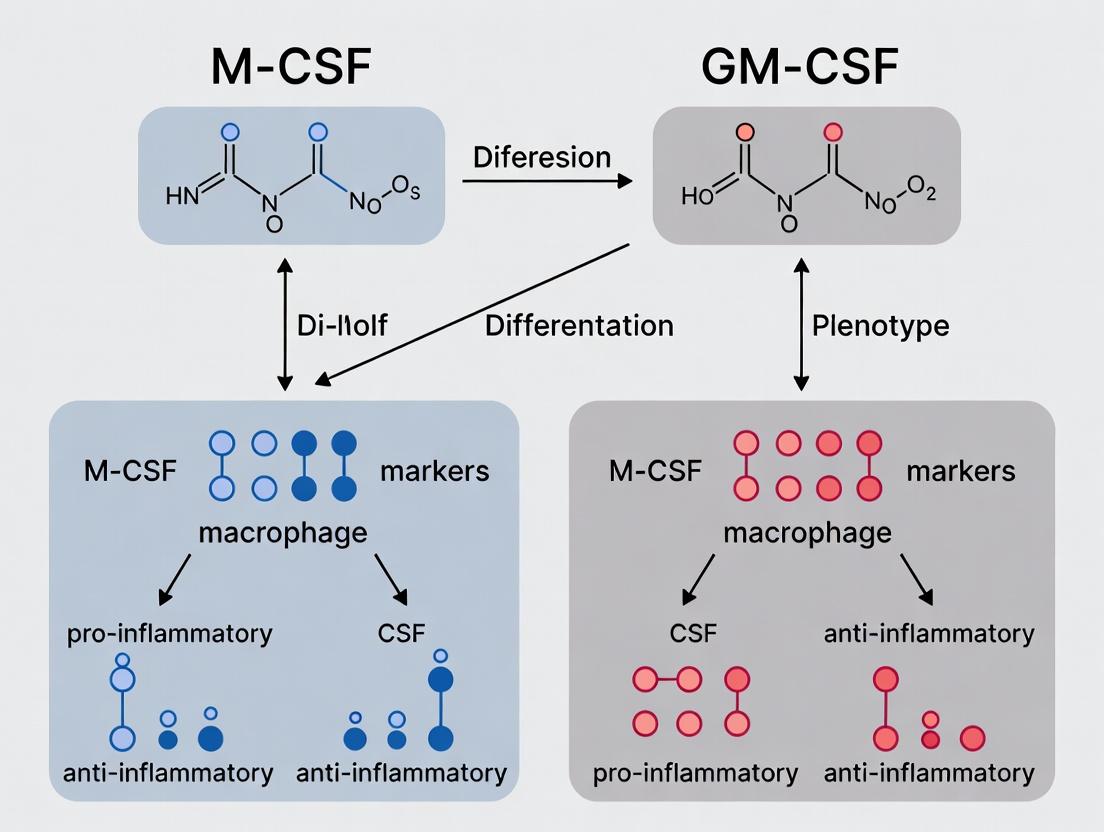
This comprehensive review synthesizes current knowledge on the distinct macrophage phenotypes generated by macrophage colony-stimulating factor (M-CSF) and granulocyte-macrophage colony-stimulating factor (GM-CSF).
M-CSF vs GM-CSF Macrophage Polarization: A Definitive Guide to Origins, Protocols, and Translational Implications
Abstract
This comprehensive review synthesizes current knowledge on the distinct macrophage phenotypes generated by macrophage colony-stimulating factor (M-CSF) and granulocyte-macrophage colony-stimulating factor (GM-CSF). Targeted at researchers, scientists, and drug development professionals, it provides a foundational understanding of the divergent transcriptional programs and functional profiles (M-CSF-Mφ vs GM-CSF-Mφ), details established and novel methodologies for their generation and characterization, offers troubleshooting solutions for common experimental challenges, and delivers a critical comparative analysis of their validation and relevance in disease models. The article bridges fundamental biology with practical application, highlighting implications for immunology research and therapeutic development.
M-CSF vs GM-CSF Macrophages: Decoding the Origins of M1/M2-like Phenotypes
Within the broader thesis investigating the divergent effects of M-CSF and GM-CSF on macrophage differentiation, understanding their distinct biological roles in myelopoiesis is fundamental. Myelopoiesis is the process by which hematopoietic stem cells (HSCs) in the bone marrow give rise to granulocytes, monocytes, macrophages, and other myeloid cells. Both M-CSF (Macrophage Colony-Stimulating Factor, CSF1) and GM-CSF (Granulocyte-Macrophage Colony-Stimulating Factor, CSF2) are critical cytokines governing this process, yet they exert their influence through different pathways and with distinct cellular outcomes.
M-CSF is primarily responsible for the survival, proliferation, and differentiation of mononuclear phagocytes, particularly monocytes and tissue-resident macrophages. It promotes a macrophage phenotype often associated with homeostasis, tissue repair, and immune regulation.
GM-CSF drives the differentiation of granulocytes (neutrophils, eosinophils) and monocytes, and is a key factor in generating inflammatory macrophages and dendritic cells. It is crucial for host defense but also implicated in pathological inflammation.
Quantitative Comparison of M-CSF vs. GM-CSF Signaling and Effects
Table 1: Key Biological and Signaling Characteristics
| Feature | M-CSF (CSF1) | GM-CSF (CSF2) |
|---|---|---|
| Primary Receptor | CSF1R (c-fms, CD115) | GM-CSFR (composed of α chain CD116 & common β chain) |
| JAK/STAT Pathway | Activates STAT3, STAT1 weakly | Strongly activates STAT5 |
| Key Downstream Pathways | PI3K/Akt, MAPK/ERK | JAK2/STAT5, PI3K/Akt, MAPK/ERK |
| Primary Myeloid Target | Monocyte-Macrophage lineage | Granulocytes, Monocytes, Dendritic Cells |
| Differentiation Outcome | Anti-inflammatory, Tissue-reparative (M2-like) macrophages | Pro-inflammatory, Immunogenic (M1-like) macrophages & DCs |
| Key Transcription Factors | PU.1, MITF, MAFB | PU.1, C/EBPβ, IRF4 |
| Role in Homeostasis | Essential (maintains tissue-resident macrophages) | Dispensable (steady-state hematopoiesis normal in KO mice) |
| Role in Inflammation | Early, regulatory | Potent driver of inflammatory responses |
Table 2: Representative Experimental Concentrations & Outcomes (in vitro)
| Application | M-CSF Typical Concentration | GM-CSF Typical Concentration | Duration | Resulting Cell Population |
|---|---|---|---|---|
| Human Monocyte to Macrophage | 20-100 ng/mL | 20-100 ng/mL | 5-7 days | M-CSF: M2-like, tolerogenic. GM-CSF: M1-like, inflammatory. |
| Mouse Bone Marrow Progenitor | 10-50 ng/mL L929-conditioned medium (M-CSF source) | 10-50 ng/mL | 7-10 days | M-CSF: Bone Marrow-Derived Macrophages (BMDMs). GM-CSF: BMDMs & some granulocytes/DCs. |
| Dendritic Cell Generation | Not typically used | 20-100 ng/mL (+ IL-4) | 5-7 days | GM-CSF: Conventional DCs or Monocyte-Derived DCs. |
Detailed Experimental Protocols
Protocol 3.1: Generation of Human Monocyte-Derived Macrophages (hMDMs) using M-CSF or GM-CSF
Purpose: To differentiate primary human monocytes into polarized macrophages for functional studies. Reagents: Ficoll-Paque PLUS, Human CD14+ MicroBeads, RPMI-1640 + 10% FBS (heat-inactivated), Penicillin/Streptomycin, recombinant human M-CSF, recombinant human GM-CSF, PBS (Ca2+/Mg2+-free).
Procedure:
- Isolate PBMCs from healthy donor buffy coats via density gradient centrifugation over Ficoll-Paque (400 x g, 30 min, room temp, brake off).
- Collect the PBMC layer and wash twice with PBS (300 x g, 10 min).
- Isolate CD14+ monocytes by positive selection using CD14 MicroBeads and LS columns per manufacturer's protocol.
- Seed monocytes in tissue culture plates at 0.5-1 x 10^6 cells/mL in complete RPMI medium.
- Differentiation: Add either M-CSF (50 ng/mL) or GM-CSF (50 ng/mL) to the respective cultures.
- Incubate at 37°C, 5% CO2 for 6 days. Add fresh medium with cytokines on day 3.
- On day 6, cells are fully differentiated macrophages. Wash with PBS to remove non-adherent cells. Adherent hMDMs can be lifted using gentle cell scraping or chilled PBS/EDTA for downstream assays.
- Polarization (Optional): Following differentiation, stimulate macrophages for 24-48h with LPS/IFN-γ (for M1) or IL-4/IL-13 (for M2) to assess polarization capacity.
Protocol 3.2: Murine Bone Marrow-Derived Macrophage (BMDM) Generation
Purpose: To generate large numbers of primary mouse macrophages for in vitro research. Reagents: Mouse (C57BL/6), 70% ethanol, DMEM/F12 or RPMI-1640, 10% FBS, Pen/Strep, L929-conditioned medium (source of M-CSF) or recombinant murine GM-CSF, PBS, 10mM EDTA/PBS.
Procedure:
- Euthanize mouse following institutional guidelines. Sterilize hind legs with 70% ethanol.
- Dissect out femurs and tibias. Clean off muscle tissue.
- Cut bone ends and flush marrow cavities with cold PBS using a 25G needle into a sterile dish.
- Dissociate cells by pipetting, pass through a 70μm cell strainer. Centrifuge (300 x g, 5 min).
- Lyse red blood cells using ACK buffer (1-2 min, RT). Wash twice with complete medium.
- Seed cells in bacteriological Petri dishes (to prevent stromal cell adhesion) at 1-2 x 10^6 cells/mL in complete medium supplemented with either:
- M-CSF BMDMs: 15-30% L929-conditioned medium OR 20 ng/mL recombinant murine M-CSF.
- GM-CSF BMDMs: 20 ng/mL recombinant murine GM-CSF.
- Incubate at 37°C, 5% CO2. On day 3, add an equal volume of fresh medium with appropriate cytokine.
- By day 6-7, a confluent monolayer of macrophages should be visible. Harvest cells by incubation with cold PBS/EDTA (10-15 min on ice) followed by gentle scraping.
- Plate for assays. For GM-CSF cultures, some loosely adherent granulocytes may be present; careful washing can enrich for macrophages.
Signaling Pathway Diagrams
The Scientist's Toolkit: Research Reagent Solutions
Table 3: Essential Reagents for Myelopoiesis and Macrophage Differentiation Research
| Reagent / Material | Function / Purpose | Example Application |
|---|---|---|
| Recombinant Human/Murine M-CSF | Drives monocyte survival and differentiation into anti-inflammatory macrophages. Essential for generating M-CSF-polarized models. | Primary hMDM and BMDM differentiation (Protocols 3.1 & 3.2). |
| Recombinant Human/Murine GM-CSF | Drives differentiation of inflammatory macrophages, granulocytes, and dendritic cells from progenitors. | Generating GM-Macs, DCs, and studying inflammatory responses. |
| L929 Cell Line Conditioned Medium | A natural, cost-effective source of murine M-CSF. Used for large-scale BMDM generation. | Standard protocol for mouse M-CSF BMDM differentiation. |
| CD14+ MicroBeads (Human) | Magnetic-activated cell sorting (MACS) for rapid, high-purity isolation of primary human monocytes from PBMCs. | Purifying starting population for hMDM differentiation (Protocol 3.1). |
| Ficoll-Paque PLUS / Lymphoprep | Density gradient medium for isolation of peripheral blood mononuclear cells (PBMCs) from whole blood. | First step in primary human immune cell isolation. |
| Bacteriological Petri Dishes | Non-tissue culture treated plates that prevent adhesion of stromal cells, allowing selective adhesion of mature macrophages. | Essential for murine BMDM generation to remove fibroblasts. |
| Phospho-Specific Antibodies (p-STAT3, p-STAT5, p-Akt, p-ERK) | Detect activation of key signaling pathways downstream of CSF1R/GM-CSFR via flow cytometry or western blot. | Validating cytokine receptor engagement and signaling studies. |
| Polarization Cocktails (LPS+IFN-γ, IL-4+IL-13) | Used to further polarize differentiated macrophages into classical (M1) or alternative (M2) activation states. | Functional validation of macrophage phenotype post-differentiation. |
This application note details protocols and analyses for investigating the divergent roles of the PI3K/Akt and JAK/STAT signaling pathways within the context of macrophage differentiation driven by M-CSF (CSF-1) versus GM-CSF. These pathways are central transcriptional blueprints that dictate functional polarization, survival, and metabolic reprogramming, with direct implications for therapeutic targeting in oncology and immunology.
Table 1: Core Characteristics of PI3K/Akt vs. JAK/STAT Pathways in Macrophage Differentiation
| Feature | PI3K/Akt Pathway | JAK/STAT Pathway |
|---|---|---|
| Primary Receptor | CSF-1R (M-CSF driven) | GM-CSFR β common chain (GM-CSF driven) |
| Key Initiating Kinase | PI3K (Class IA) | JAK1, JAK2 |
| Core Signal Transducer | Akt (PKB) | STAT1, STAT3, STAT5 |
| Primary M-CSF-Driven Role | Survival, proliferation, metabolic skewing (glycolysis), M2-like polarization. | Modulatory, often secondary. |
| Primary GM-CSF-Driven Role | Supports survival and metabolic needs. | Dominant driver of pro-inflammatory (M1-like) gene programming. |
| Key Transcriptional Targets | c-Myc, SREBP (metabolism), NF-κB (subsets). | IRF1, SOCS3, IRF8 (pro-inflammatory). |
| Typical Inhibition Outcome (MΦ Diff.) | Reduced cell yield, impaired metabolic adaptation. | Attenuated inflammatory phenotype, reduced antimicrobial response. |
| Therapeutic Inhibitors (Examples) | Pictilisib (PI3K), MK-2206 (Akt) | Ruxolitinib (JAK1/2), Tofacitinib (JAK) |
Table 2: Representative Quantitative Signaling Outputs in Differentiation*
| Measurement | M-CSF (Day 5) | GM-CSF (Day 5) | Technique |
|---|---|---|---|
| p-Akt (S473) Level | High (Sustained) | Moderate (Transient) | Western Blot / Flow Cytometry |
| p-STAT5 Level | Low/Moderate | Very High | Western Blot / Flow Cytometry |
| p-STAT3 Level | Moderate (Late phase) | High (Early phase) | Western Blot / Flow Cytometry |
| Glycolytic Rate | High | Moderate/High | Seahorse XF Glycolysis Assay |
| IL-12 Secretion | Low | High | ELISA |
| CD206 (MRC1) Expression | High | Low | Flow Cytometry |
*Data synthesized from recent literature; actual values are model/system dependent.
Detailed Experimental Protocols
Protocol 1: Assessing Pathway Activation During Human Monocyte-Derived Macrophage Differentiation
Objective: To quantify temporal activation (phosphorylation) of Akt and STAT proteins during M-CSF vs. GM-CSF differentiation.
Materials: See "The Scientist's Toolkit" below. Procedure:
- Isolate CD14+ monocytes from PBMCs using positive selection magnetic beads.
- Seed cells at 1x10⁶ cells/mL in 12-well plates in base medium (RPMI-1640, 10% FBS, 1% P/S).
- Differentiate with either:
- M-CSF condition: 50 ng/mL recombinant human M-CSF.
- GM-CSF condition: 50 ng/mL recombinant human GM-CSF.
- At time points (Day 0, 1, 3, 5), lyse cells directly in 150 µL RIPA buffer supplemented with phosphatase/protease inhibitors.
- Clarify lysates by centrifugation (14,000g, 15 min, 4°C).
- Perform BCA assay to normalize protein concentration.
- Load 20 µg protein per lane on 4-12% Bis-Tris gels, transfer to PVDF membranes.
- Probe with primary antibodies: p-Akt (S473), total Akt, p-STAT5 (Y694), p-STAT3 (Y705), total STAT5/3, and β-actin loading control.
- Quantify band density using imaging software. Express p-protein signal normalized to total protein and loading control.
Protocol 2: Functional Pathway Inhibition and Phenotypic Analysis
Objective: To determine the functional contribution of each pathway to final macrophage phenotype.
Procedure:
- Differentiate monocytes as in Protocol 1.
- Include inhibitor treatments from Day 0:
- PI3K/Akt inhibition: Add 1 µM Pictilisib (or 5 µM MK-2206) to respective differentiation wells.
- JAK/STAT inhibition: Add 100 nM Ruxolitinib to respective wells.
- Include DMSO vehicle controls.
- On Day 5, harvest cells for analysis.
- Surface Markers: Detach with gentle cell scraping. Stain for CD80 (M1-like), CD206 (M2-like), and HLA-DR. Analyze by flow cytometry.
- Cytokine Secretion: Stimulate cells with 100 ng/mL LPS for 24h. Collect supernatant and quantify TNF-α (M-CSF cultures) and IL-12/IL-23 (GM-CSF cultures) by ELISA.
- Metabolic Profiling: Analyze a separate plate on Day 5 using a Seahorse XF Analyzer with the Mito Stress Test and Glycolysis Stress Test kits per manufacturer instructions.
Diagrams
The Scientist's Toolkit: Research Reagent Solutions
| Reagent / Material | Supplier Examples | Function in Protocol |
|---|---|---|
| Recombinant Human M-CSF | PeproTech, BioLegend | Drives differentiation towards anti-inflammatory, tissue-repair macrophage phenotypes. |
| Recombinant Human GM-CSF | PeproTech, BioLegend | Drives differentiation towards pro-inflammatory, immunostimulatory macrophage phenotypes. |
| Pictilisib (GDC-0941) | Selleckchem, MedChemExpress | Selective PI3K p110α/δ inhibitor to probe PI3K/Akt pathway dependence. |
| Ruxolitinib (INCB018424) | Selleckchem, Sigma-Aldrich | Selective JAK1/2 inhibitor to block JAK/STAT signaling downstream of GM-CSFR. |
| Phospho-Akt (Ser473) Antibody | Cell Signaling Technology (CST #4060) | Detects activated Akt via Western Blot or Flow Cytometry. |
| Phospho-STAT5 (Tyr694) Antibody | Cell Signaling Technology (CST #9351) | Detects activated STAT5, crucial for GM-CSF signaling. |
| CD14 MicroBeads, human | Miltenyi Biotec | For positive selection of monocytes from PBMCs. |
| Seahorse XF Glycolysis Stress Test Kit | Agilent Technologies | Measures glycolytic function (ECAR) of live macrophages. |
| Human IL-12p70 ELISA Kit | R&D Systems, BioLegend | Quantifies key pro-inflammatory cytokine from GM-CSF-derived macrophages. |
| Cell Recovery Solution (Corning) | Corning | For non-enzymatic detachment of adherent macrophages to preserve surface markers. |
Application Notes
This document details the metabolic and functional profiling of human monocyte-derived macrophages polarized with Macrophage Colony-Stimulating Factor (M-CSF) or Granulocyte-Macrophage Colony-Stulating Factor (GM-CSF). Within the broader thesis on cytokine-driven macrophage differentiation, these notes establish that GM-CSF-derived macrophages (GM-Mφ) exhibit a glycolytic, pro-inflammatory metabolic phenotype, while M-CSF-derived macrophages (M-Mφ) rely on oxidative phosphorylation (OXPHOS) and display an anti-inflammatory, tissue-reparative profile.
Key Quantitative Findings: Table 1: Core Metabolic Parameters of M-CSF-Mφ vs GM-CSF-Mφ
| Parameter | M-CSF-Mφ | GM-CSF-Mφ | Measurement Method |
|---|---|---|---|
| Basal OCR (pmol/min/μg protein) | 52.1 ± 4.3 | 28.7 ± 3.1 | Seahorse XF Analyzer |
| Maximal OCR | 125.6 ± 10.2 | 65.4 ± 7.8 | Seahorse XF Analyzer |
| Glycolytic Rate (ECAR, mpH/min/μg protein) | 18.5 ± 2.1 | 45.3 ± 5.6 | Seahorse XF Analyzer |
| ATP Production Rate (% from OXPHOS) | 82% ± 5% | 38% ± 6% | Seahorse XF Mito Stress Test |
| Intracellular Succinate (nmol/mg protein) | 12.4 ± 1.8 | 42.7 ± 5.2 | LC-MS/MS |
| Citrate Synthase Activity (mU/mg protein) | 35.2 ± 3.5 | 18.9 ± 2.4 | Spectrophotometric Assay |
| Glut1 Surface Expression (MFI) | 1,250 ± 210 | 4,850 ± 520 | Flow Cytometry |
| Key Cytokine: IL-10 (pg/mL) | 950 ± 120 | 85 ± 25 | ELISA (24h LPS stimulation) |
| Key Cytokine: IL-12p70 (pg/mL) | 55 ± 15 | 1,250 ± 180 | ELISA (24h LPS stimulation) |
Table 2: Phenotypic Marker Expression (Mean Fluorescence Intensity, MFI)
| Surface Marker | M-CSF-Mφ | GM-CSF-Mφ | Associated Function |
|---|---|---|---|
| CD163 | 15,400 ± 1,850 | 1,200 ± 350 | Hemoglobin scavenger, anti-inflammatory |
| CD206 (MMR) | 22,500 ± 2,900 | 3,100 ± 550 | Endocytosis, tissue remodeling |
| HLA-DR | 8,500 ± 950 | 25,300 ± 3,200 | Antigen presentation |
| CD86 | 9,200 ± 1,100 | 31,500 ± 4,100 | Co-stimulation, pro-inflammatory |
Experimental Protocols
Protocol 1: Generation of M-CSF and GM-CSF Polarized Macrophages from Human Monocytes
Purpose: To differentiate CD14+ human monocytes into M-Mφ or GM-Mφ.
- Isolate CD14+ monocytes from PBMCs using positive selection magnetic beads.
- Seed monocytes at 1x10^6 cells/mL in RPMI-1640 supplemented with 10% heat-inactivated FBS, 1% Penicillin-Streptomycin, and 2mM L-glutamine.
- Polarization: Add either 50 ng/mL recombinant human M-CSF (for M-Mφ) or 20 ng/mL recombinant human GM-CSF (for GM-Mφ).
- Incubate cells for 6 days at 37°C, 5% CO2.
- On day 3, add fresh complete medium containing the respective cytokine.
- On day 6, detach cells using gentle cell scraping in cold PBS for downstream assays.
Protocol 2: Seahorse XF96 Metabolic Flux Analysis
Purpose: To measure mitochondrial respiration (OCR) and glycolytic flux (ECAR) in real-time.
- Day Prior: Seed polarized macrophages at 1.5x10^5 cells/well in a Seahorse XF96 cell culture microplate. Centrifuge to ensure attachment.
- Prepare assay medium: XF Base Medium supplemented with 10mM Glucose, 1mM Pyruvate, and 2mM L-Glutamine (pH 7.4). Pre-warm to 37°C.
- Mito Stress Test (for OCR): Hydrate sensor cartridge. Load ports: Port A: 1.5μM Oligomycin; Port B: 1μM FCCP; Port C: 0.5μM Rotenone/Antimycin A.
- Glycolysis Stress Test (for ECAR): Hydrate sensor cartridge. Load ports: Port A: 10mM Glucose; Port B: 1μM Oligomycin; Port C: 50mM 2-DG.
- Wash cell plate with assay medium and add 180μL/well. Incubate at 37°C, non-CO2 for 1 hour.
- Run assay on Seahorse XFe96 Analyzer using standard cycling protocol (3min mix, 3min measure). Normalize data to total protein content (BCA assay).
Protocol 3: Intracellular Metabolite Extraction for LC-MS/MS
Purpose: To quantify TCA cycle intermediates and other key metabolites.
- Rapidly wash macrophage monolayers (6-well plate) with 2 mL of ice-cold 0.9% saline.
- Quench metabolism immediately with 1 mL of 80% methanol (-80°C) containing internal standards.
- Scrape cells on dry ice and transfer suspension to a pre-chilled microcentrifuge tube.
- Vortex for 30s, then incubate at -80°C for 1 hour.
- Centrifuge at 16,000 x g for 20 minutes at 4°C.
- Transfer supernatant to a new tube and dry completely in a vacuum concentrator.
- Reconstitute dried metabolite pellets in 100μL of LC-MS compatible solvent (e.g., water:acetonitrile, 1:1).
- Analyze using a targeted LC-MS/MS platform with appropriate reverse-phase or HILIC chromatography and multiple reaction monitoring (MRM).
Diagrams
Title: Macrophage Differentiation and Metabolic Polarization Workflow
Title: Key Glycolytic and Inflammatory Nodes in GM-CSF-Mφ
Title: Key Oxidative and Anti-inflammatory Nodes in M-CSF-Mφ
The Scientist's Toolkit: Research Reagent Solutions
Table 3: Essential Reagents for Metabolic Macrophage Research
| Reagent / Material | Function / Purpose | Example Vendor / Catalog |
|---|---|---|
| Recombinant Human M-CSF | Polarizing cytokine for generating anti-inflammatory, oxidative macrophages. | PeproTech, 300-25 |
| Recombinant Human GM-CSF | Polarizing cytokine for generating pro-inflammatory, glycolytic macrophages. | PeproTech, 300-03 |
| CD14 MicroBeads, human | Isolation of monocytes from PBMCs for a pure starting population. | Miltenyi Biotec, 130-050-201 |
| XF Base Medium | Customizable, serum-free medium for Seahorse XF metabolic assays. | Agilent, 103334-100 |
| Seahorse XF Mito Stress Test Kit | Pre-optimized kit to measure key parameters of mitochondrial function. | Agilent, 103015-100 |
| Seahorse XF Glycolysis Stress Test Kit | Pre-optimized kit to measure key parameters of glycolytic function. | Agilent, 103020-100 |
| IL-10 Human ELISA Kit | Quantify anti-inflammatory cytokine output from M-CSF-Mφ. | Invitrogen, BMS215-2 |
| IL-12p70 Human ELISA Kit | Quantify pro-inflammatory cytokine output from GM-CSF-Mφ. | Invitrogen, BMS238-2 |
| Anti-human CD163 Antibody | Flow cytometry antibody for identifying M-CSF-Mφ phenotype. | BioLegend, 333602 |
| Anti-human HLA-DR Antibody | Flow cytometry antibody for identifying activated, GM-CSF-Mφ. | BioLegend, 307602 |
| Mass Spectrometry Grade Methanol | For quenching metabolism and extracting intracellular metabolites for LC-MS. | Fisher Scientific, A456-212 |
| Oligomycin | ATP synthase inhibitor for Seahorse assays and metabolic perturbation studies. | Cayman Chemical, 11341 |
This application note details the canonical functional profiles of macrophages (Mφ) differentiated by Granulocyte-Macrophage Colony-Stimulating Factor (GM-CSF) and Macrophage Colony-Stimulating Factor (M-CSF). This work is framed within a broader thesis investigating the distinct transcriptional, metabolic, and functional programs induced by these two growth factors, which generate macrophages with opposing roles in inflammation and tissue homeostasis. Understanding this dichotomy is crucial for research in immunology, chronic inflammatory diseases, cancer, and regenerative medicine.
Canonical Profiles & Comparative Analysis
Table 1: Core Functional & Phenotypic Profiles of Canonical Macrophages
| Feature | GM-CSF-derived Macrophages (GM-Mφ) | M-CSF-derived Macrophages (M-Mφ) |
|---|---|---|
| Primary Designation | Pro-inflammatory, Immunogenic | Homeostatic, Tissue-Repair |
| Key Polarization Analogue | Closer to M1-like | Closer to M2-like |
| Major Secretory Profile | High IL-12, IL-23, IL-1β, TNF-α, CXCL9/10 | High IL-10, TGF-β, CCL17, CCL22 |
| Metabolic Preference | Glycolysis, PPP (aerobic glycolysis) | Oxidative Phosphorylation, FAO |
| Surface Marker Signature | CD80hi, CD86hi, MHC-IIhi, CD64, low CD163 | CD163hi, CD206hi, CX3CR1hi, low CD80/86 |
| Phagocytic Capacity | Moderate | High |
| Migratory Behavior | Inflammatory site recruitment | Tissue resident & repair site localization |
| Role in T-cell Immunity | Strong Th1/Th17 priming | Supports Treg differentiation |
| Therapeutic Context | Target in autoimmunity; adjuvant for cancer vaccines | Target for fibrosis, wound healing, regenerative medicine |
Table 2: Quantitative Gene Expression Differences (Representative Genes, RT-qPCR fold change vs. naïve monocytes)
| Gene | Function | GM-Mφ Fold Change | M-Mφ Fold Change |
|---|---|---|---|
| IL12B (p40) | Pro-inflammatory cytokine | 85.2 ± 12.5 | 1.5 ± 0.8 |
| NOS2 (iNOS) | Antimicrobial NO production | 42.7 ± 9.3 | Not detected |
| CD80 | T-cell co-stimulation | 22.5 ± 4.1 | 3.2 ± 1.1 |
| ARG1 | Arginine metabolism, tissue repair | 2.1 ± 0.9 | 18.6 ± 3.7 |
| MRC1 (CD206) | Endocytic receptor | 5.5 ± 2.0 | 65.3 ± 10.2 |
| IL10 | Anti-inflammatory cytokine | 4.8 ± 1.5 | 32.7 ± 6.4 |
Experimental Protocols
Protocol 1: In Vitro Differentiation of Human Macrophages from Peripheral Blood Mononuclear Cells (PBMCs)
Aim: To generate canonical GM-CSF-Mφ and M-CSF-Mφ from human CD14+ monocytes.
Materials: See "Scientist's Toolkit" below. Procedure:
- Isolate PBMCs from leukapheresis or buffy coat using density gradient centrifugation (Ficoll-Paque PLUS).
- Isolate CD14+ monocytes using positive selection (human CD14 MicroBeads) per manufacturer's protocol.
- Seed monocytes at 1-1.5 x 10^6 cells/mL in complete RPMI-1640 (with 10% FBS, 1% Pen/Strep, 1% L-Glutamine) in tissue culture-treated plates.
- Differentiation: Add the appropriate cytokine immediately.
- For GM-Mφ: Add 50 ng/mL recombinant human GM-CSF.
- For M-Mφ: Add 50 ng/mL recombinant human M-CSF.
- Incubate at 37°C, 5% CO2 for 6 days. On day 3, add fresh medium containing the respective cytokine (same concentration).
- On day 6, confirm differentiation by morphology (GM-Mφ: elongated, dendritic-like; M-Mφ: large, rounded, vacuolated) and flow cytometry for surface markers (e.g., CD80, CD86, CD163, CD206).
- Cells are now ready for downstream functional assays or stimulation.
Protocol 2: Functional Assay - Phagocytosis (pHrodo BioParticles Assay)
Aim: Quantitatively compare the phagocytic capacity of GM-Mφ vs. M-Mφ.
Procedure:
- Differentiate macrophages as per Protocol 1 in a black-walled, clear-bottom 96-well plate.
- On day 6, prepare opsonized pHrodo Red E. coli or S. aureus BioParticles according to the product manual. Opsonization with human serum is recommended for FcγR-mediated phagocytosis.
- Gently wash macrophage monolayers with warm PBS.
- Add 100 µL of the opsonized BioParticle suspension to each well.
- Immediately place the plate in a pre-warmed (37°C) fluorescence plate reader.
- Measure fluorescence (Ex/Em ~560/585 nm) kinetically every 5-10 minutes for 2-4 hours. The pHrodo dye fluoresces intensely only in the acidic phagosome.
- Analysis: Calculate the slope of the fluorescence increase over the linear phase (typically first 60-90 min) as a measure of phagocytic rate. M-Mφ typically show a 1.5-2.5x higher rate than GM-Mφ.
Key Signaling Pathways
Diagram 1: Core Differentiation Signaling Pathways
Experimental Workflow Diagram
Diagram 2: Macrophage Differentiation & Characterization Workflow
The Scientist's Toolkit
Table 3: Essential Research Reagent Solutions
| Reagent / Material | Supplier Examples (Catalogue #) | Function in Protocol |
|---|---|---|
| Recombinant Human GM-CSF | PeproTech (300-03), R&D Systems (215-GM) | Key cytokine to drive pro-inflammatory macrophage differentiation. |
| Recombinant Human M-CSF | PeproTech (300-25), R&D Systems (216-MC) | Key cytokine to drive homeostatic macrophage differentiation. |
| Ficoll-Paque PLUS | Cytiva (17144002) | Density gradient medium for isolation of PBMCs from whole blood. |
| Human CD14 MicroBeads | Miltenyi Biotec (130-050-201) | Magnetic bead-based positive selection of monocytes from PBMCs. |
| Cell Culture Media (RPMI-1640) | Gibco (21875034) | Base medium for macrophage culture and differentiation. |
| pHrodo Red BioParticles | Thermo Fisher (P35361) | Fluorescent, pH-sensitive particles for quantitative phagocytosis assays. |
| Flow Cytometry Antibodies: Anti-human CD80, CD86, CD163, CD206, HLA-DR | BioLegend, BD Biosciences | Surface marker profiling to confirm canonical phenotype. |
| Seahorse XFp Analyzer Cartridge | Agilent Technologies | For real-time analysis of glycolytic rate (ECAR) and mitochondrial respiration (OCR). |
Application Note AN-0102: Profiling Intra-Population Heterogeneity in M-CSF- vs. GM-CSF-Derived Human Macrophages
1. Introduction Within the broader thesis investigating the fundamental differences imposed by M-CSF (CSF-1) versus GM-CSF priming, the classical M1/M2 dichotomy is insufficient. This protocol details a multi-parametric framework to resolve the spectrum of heterogeneity within macrophages derived from each growth factor, crucial for understanding context-specific functions in homeostasis, disease, and therapeutic response.
2. Key Comparative Data Summary
Table 1: Core Phenotypic & Functional Heterogeneity Markers
| Parameter | M-CSF (CSF-1) Derived Macrophages | GM-CSF Derived Macrophages | Measurement Technique |
|---|---|---|---|
| Transcriptional Clusters | 3-4 distinct subsets (e.g., SPP1+, C1Q+, ISG15+) |
3-4 distinct subsets (e.g., CCL2+, IL1B+, APOE+) |
scRNA-Seq (10x Genomics) |
| Metabolic Bias | ~70% Oxidative Phosphorylation (OXPHOS) high | ~65% Glycolysis (ECAR) high | Seahorse XF Mito Stress Test |
| Surface Protein Variability (CV>20%) | CD163, CD206, CCR2, CX3CR1 | CD86, CD14, HLADR, CD11c | High-Parameter Flow Cytometry (≥15 colors) |
| Polarization Plasticity | IL-4→M2a: High (CD206 ΔMFI +450%). IFNγ+LPS→M1: Moderate. | IFNγ+LPS→M1: High (TNFα +800%). IL-4→M2a: Limited. | Cytokine Re-stimulation & Surface Marker Flux |
| Secretome Diversity | High CCL18, VEGF, MMP9 variance (log2 scale 2-8). | High IL-1β, IL-23, CXCL10 variance (log2 scale 1-10). | Luminex 45-plex Assay |
Table 2: Recommended Panel for High-Dimensional Flow Cytometry (16-color/18-parameter)
| Fluorochrome | Target | Population Relevance | Function |
|---|---|---|---|
| BV421 | CD45 | All | Pan-leukocyte marker |
| BUV395 | CD11b | All | Macrophage/myeloid integrin |
| FITC | CD14 | M-MΦ (hi), GM-MΦ (var) | LPS co-receptor |
| PE | CD206 | M2-like, M-MΦ subset | Mannose receptor |
| PerCP-Cy5.5 | CD163 | M2-like, Hemophagocytic | Hemoglobin scavenger |
| PE-Cy7 | CD86 | M1-like, GM-MΦ (hi) | Co-stimulation |
| APC | HLADR | All (varies in density) | Antigen presentation |
| APC-R700 | CD64 (FcγRI) | All (M-MΦ > GM-MΦ) | High-affinity IgG receptor |
| BV605 | CD11c | GM-MΦ (hi), inflammatory | Integrin, adhesion |
| BV650 | CCR2 | Inflammatory/recruiting subset | Chemotaxis to CCL2 |
| BV711 | CX3CR1 | Tissue-resident subset | Fractalkine receptor |
| BV785 | CD38 | Inflammatory, GM-MΦ subset | Activation, NAD+ metabolism |
| AF700 | CD115 (CSF1R) | M-MΦ (hi), GM-MΦ (lo) | M-CSF Receptor |
| Live/Dead | Viability | - | Exclusion of dead cells |
3. Experimental Protocols
Protocol 3.1: Generation and Single-Cell RNA Sequencing Analysis of Primary Human Macrophage Subsets
A. Macrophage Differentiation
- Isolate CD14+ monocytes from human PBMCs using positive selection magnetic beads.
- Seed at 1x10^6 cells/mL in RPMI-1640 + 10% FBS + 1% Pen/Strep.
- M-CSF-Macrophages: Add 50 ng/mL recombinant human M-CSF. GM-CSF-Macrophages: Add 50 ng/mL recombinant human GM-CSF.
- Culture for 6 days, with medium + cytokine refresh on day 3.
- On day 6, harvest using enzyme-free cell dissociation buffer.
B. Single-Cell Library Preparation & Sequencing
- Resuspend cells in 0.04% BSA-PBS. Filter through a 35μm strainer. Count and assess viability (>90%).
- Load onto 10x Genomics Chromium Controller using Chromium Next GEM Single Cell 3' Kit v3.1 to target 10,000 cells/sample.
- Follow manufacturer's protocol for GEM generation, cDNA amplification, and library construction.
- Pool libraries and sequence on an Illumina NovaSeq 6000, aiming for ≥50,000 reads per cell.
C. Bioinformatic Analysis Pipeline
- Processing: Use Cell Ranger (10x Genomics) for demultiplexing, alignment, and feature counting.
- Quality Control: Filter cells with <200 or >5000 genes, or >10% mitochondrial reads.
- Integration & Clustering: Use Seurat (v4.0+) to normalize, identify highly variable features, integrate M-CSF and GM-CSF datasets using CCA, and perform PCA. Cluster cells using the Louvain algorithm on the first 30 PCs.
- Annotation: Identify cluster markers using
FindAllMarkers. Reference public datasets (e.g., MacSpectrum) to annotate subsets.
Protocol 3.2: High-Parameter Spectral Flow Cytometry for Surface Proteome Profiling
- Preparation: Harvest day-6 macrophages as in Protocol 3.1. Wash twice in FACS buffer (PBS + 2% FBS + 2mM EDTA).
- Viability Stain: Incubate with fixable viability dye (e.g., Zombie NIR) for 15 min at RT in the dark. Wash.
- FC Block: Incubate with human Fc block (1:50) for 10 min on ice.
- Surface Staining: Add pre-titrated antibody cocktail (Table 2) in 100μL FACS buffer. Incubate 30 min on ice in the dark. Wash twice.
- Fixation: Fix cells in 2% PFA for 20 min on ice. Wash. Resuspend in FACS buffer.
- Acquisition: Acquire immediately on a spectral flow cytometer (e.g., Cytek Aurora). Use single-color and unstained controls for unmixing.
- Analysis: Use SpectroFlo (Cytek) or OMIQ for unmixing. Analyze in FlowJo v10: perform t-SNE or UMAP on concatenated, viably-gated files to visualize heterogeneity.
4. Signaling Pathway & Workflow Visualizations
Diagram Title: M-CSF vs GM-CSF Receptor Signaling Pathways
Diagram Title: Workflow for Profiling Macrophage Heterogeneity
5. The Scientist's Toolkit: Research Reagent Solutions
| Product Category | Example Item | Function in This Research |
|---|---|---|
| Recombinant Human Cytokines | Premium Grade M-CSF & GM-CSF (e.g., Miltenyi) | Defined, low-endotoxin cytokines for consistent primary macrophage differentiation. |
| Cell Separation Kits | CD14 MicroBeads, human (e.g., Miltenyi) | Positive selection of monocytes from PBMCs with high purity (>95%). |
| Spectral Flow Cytometry Antibodies | Pre-conjugated mAbs from TotalSeq or Brilliant/BD Horizon | Antibodies optimized for minimal spectral overlap in high-parameter panels. |
| scRNA-Seq Kits | Chromium Single Cell 3' Kit (10x Genomics) | Comprehensive solution for capturing transcriptomes of thousands of single cells. |
| Bioinformatics Software | Seurat, Scanpy, OMIQ | Open-source/commercial platforms for clustering and analyzing high-dimensional data. |
| Metabolic Assay Kits | Seahorse XFp Cell Mito Stress Test Kit (Agilent) | Real-time measurement of OXPHOS vs. glycolytic activity in live cells. |
| Multiplex Cytokine Arrays | Luminex Human Cytokine 45-Plex Panel (Invitrogen) | Simultaneous quantification of a broad spectrum of secreted factors. |
Protocols for Polarization: Generating and Characterizing M-CSF and GM-CSF Macrophages In Vitro
This Application Note provides a comparative analysis of two primary in vitro macrophage differentiation models—Bone Marrow-Derived Macrophages (BMDMs) and human Monocyte-Derived Macrophages (MDMs)—within the broader thesis research on the distinct polarization and functional effects driven by Macrophage Colony-Stimulating Factor (M-CSF) versus Granulocyte-Macrophage Colony-Stimulating Factor (GM-CSF). The choice of source cell fundamentally influences the resulting macrophage phenotype, downstream signaling, and applicability to disease modeling, making selection a critical first step in experimental design.
Comparative Analysis: BMDMs vs. MDMs
The following table summarizes the key characteristics, advantages, and limitations of each model system.
Table 1: Core Comparison of BMDM and MDM Model Systems
| Parameter | Bone Marrow-Derived Macrophages (BMDMs) | Monocyte-Derived Macrophages (MDMs) |
|---|---|---|
| Species Source | Typically mouse (or other rodents) | Primarily human (from peripheral blood) |
| Starting Population | Hematopoietic stem & progenitor cells (HSPCs) in bone marrow. | Mature circulating CD14+ monocytes. |
| Differentiation Time | 7-10 days with M-CSF. | 5-7 days with M-CSF or GM-CSF. |
| Key Advantage | Recapitulates myelopoiesis; large yield from one donor; genetically modifiable host. | Direct human translational relevance; assesses donor-specific variation. |
| Key Limitation | Murine origin may not fully mirror human immunology. | Donor variability; limited expansion potential post-differentiation. |
| Primary Use in Thesis | Mechanistic studies of signaling in vivo relevance in murine models. | Translational studies for human disease & drug screening. |
Table 2: Phenotypic & Functional Outcomes Under M-CSF vs. GM-CSF Differentiation
| Differentiation Factor | BMDM Phenotype (Mouse) | MDM Phenotype (Human) | Key Functional Skew |
|---|---|---|---|
| M-CSF (CSF-1) | Homeostatic, anti-inflammatory (M2-like). Tends to express F4/80hi, CD115, CD206. | "M-CSF-MDM": Homeostatic, trophic, tissue-repair oriented. High CD14, CD163, CD206. | Phagocytosis, tissue remodeling, anti-inflammatory cytokine production (IL-10, TGF-β). |
| GM-CSF | Inflammatory, immunostimulatory (M1-like). Tends to express MHC IIhi, CD11c, CD86. | "GM-CSF-MDM": Inflammatory, antimicrobial. High HLA-DR, CD86, CD64. | Antigen presentation, pro-inflammatory cytokine production (IL-1β, IL-6, TNF-α), pathogen killing. |
| Yield (Relative Cell Number) | ~5-10 x 10^6 cells per mouse femur/tibia. | ~2-5 x 10^6 cells per 50ml of human blood. | - |
Experimental Protocols
Protocol 1: Generation of Mouse BMDMs with M-CSF or GM-CSF
Objective: To differentiate primary mouse macrophages from bone marrow precursors.
Materials: See Scientist's Toolkit below. Procedure:
- Euthanize mouse (C57BL/6, 6-12 weeks) using approved methods.
- Isolate Bones: Aseptically remove femurs and tibias. Clean off muscle tissue.
- Flush Bone Marrow: Using a 25G needle and 10ml of cold, sterile BMDM Growth Medium (complete RPMI-1640 + 10% FBS + 1% Pen/Strep), flush marrow into a sterile petri dish.
- Dissociate & Strain: Gently pass cell suspension through a 70µm cell strainer to obtain a single-cell suspension.
- Centrifuge & Count: Spin at 300 x g for 5 min. Resuspend in Red Blood Cell (RBC) Lysis Buffer for 5 min on ice to lyse erythrocytes. Wash with medium and count cells.
- Seed Cells: Plate cells in BMDM Growth Medium supplemented with the appropriate CSF.
- For M-CSF-BMDMs: Add 20 ng/mL recombinant mouse M-CSF.
- For GM-CSF-BMDMs: Add 20 ng/mL recombinant mouse GM-CSF.
- Seed at ~1 x 10^6 cells per 10cm non-tissue culture treated dish (prevents adherence of progenitors).
- Differentiate: Incubate at 37°C, 5% CO2 for 7 days. On Day 3, add an additional 10ml of fresh Growth Medium containing the same CSF.
- Harvest: On Day 7, wash dishes with cold PBS and use gentle cell scraping or incubation with cold PBS/2mM EDTA for 10-15 min to detach adherent macrophages.
- Replate for Assays: Count and replate harvested BMDMs onto tissue-culture treated plates for functional experiments.
Protocol 2: Generation of Human MDMs with M-CSF or GM-CSF
Objective: To differentiate primary human macrophages from peripheral blood monocytes.
Materials: See Scientist's Toolkit below. Procedure:
- Obtain PBMCs: Isolate Peripheral Blood Mononuclear Cells (PBMCs) from buffy coat or leukapheresis product using standard Ficoll-Paque density gradient centrifugation.
- Monocyte Isolation: Isolate CD14+ monocytes from PBMCs using positive magnetic selection (CD14 MicroBeads) per manufacturer's protocol.
- Count & Seed: Count purified monocytes. Seed at a density of 0.5-1 x 10^6 cells/ml in MDM Growth Medium (RPMI-1640 or X-VIVO 15 + 10% human AB serum or FBS + 1% Pen/Strep) in tissue culture-treated plates.
- Add Differentiation Factor:
- For M-CSF-MDMs: Add 50 ng/mL recombinant human M-CSF.
- For GM-CSF-MDMs: Add 20 ng/mL recombinant human GM-CSF.
- Differentiate: Incubate at 37°C, 5% CO2 for 6 days. On Day 3, gently remove half the medium and replace with fresh medium containing the respective CSF.
- Harvest for Assays: On Day 6, cells are fully differentiated and adherent. Wash with PBS and use enzymatic (Accutase) or gentle scraping for detachment if required, or assay directly in the differentiation plate.
Signaling Pathways in CSF-Driven Differentiation
Diagram 1: M-CSF vs GM-CSF Signaling Pathways
Diagram 2: BMDM and MDM Generation Workflow
The Scientist's Toolkit: Key Research Reagent Solutions
Table 3: Essential Materials for BMDM/MDM Differentiation & Analysis
| Reagent/Material | Function & Purpose | Example (Vendor Non-Specific) |
|---|---|---|
| Recombinant M-CSF (mouse/human) | Key cytokine driving differentiation towards homeostatic, tissue-repair macrophage phenotypes. | Carrier-free protein, >95% purity. |
| Recombinant GM-CSF (mouse/human) | Key cytokine driving differentiation towards inflammatory, immunostimulatory macrophage phenotypes. | Carrier-free protein, >95% purity. |
| Cell Strainer (70µm) | To obtain a single-cell suspension from bone marrow or dissociated tissue. | Sterile, nylon mesh. |
| Ficoll-Paque Premium | Density gradient medium for the isolation of viable PBMCs from human blood. | Sterile, for in vitro use. |
| CD14 MicroBeads (human) | Magnetic-activated cell sorting (MACS) for positive selection of monocytes from PBMCs. | UltraPure, human specific. |
| Non-Tissue Culture Treated Dishes | For BMDM differentiation; prevents premature adherence of progenitors, allowing selective adherence of mature macrophages. | Bacteriological grade petri dishes. |
| Human AB Serum or Charcoal-Stripped FBS | Provides defined growth factors and low IgG for human MDM differentiation, reducing donor serum variability. | Sterile, certified for cell culture. |
| Flow Cytometry Antibodies (mouse) | Phenotypic validation: CD11b, F4/80, CD115 (M-CSFR), MHC-II, CD206. | Fluorescently conjugated, clone-specific. |
| Flow Cytometry Antibodies (human) | Phenotypic validation: CD14, CD11b, CD163, HLA-DR, CD86, CD206. | Fluorescently conjugated, clone-specific. |
| ELISA/CBA Kits (IL-10, TNF-α, IL-6 etc.) | Quantification of cytokine secretion to confirm functional polarization post-differentiation or stimulation. | High-sensitivity, validated kits. |
Application Notes
Within the broader thesis investigating the distinct functional and phenotypic outcomes of macrophage differentiation driven by M-CSF versus GM-CSF, standardization of the initial differentiation protocol is paramount. This document provides a detailed, side-by-side comparison of the two primary in vitro protocols used to generate human monocyte-derived macrophages (MDMs). Consistency in media formulations, cytokine concentrations, and timing is critical for reproducible generation of M1-like (GM-CSF-derived) and M2-like (M-CSF-derived) macrophages, enabling clear interpretation of their roles in immunology, cancer, and therapeutic development.
Protocols: Human Monocyte-Derived Macrophage Differentiation
1. Monocyte Isolation
- Source: Peripheral blood mononuclear cells (PBMCs) from leukapheresis or buffy coats.
- Method: Isolate monocytes via positive selection (anti-CD14 magnetic beads) or negative selection kits. Alternatively, use plastic adherence (incubate PBMCs for 1-2 hours in serum-free media, then wash away non-adherent cells).
- Seeding Density: (0.5-1.0 \times 10^6) cells/mL in complete differentiation media.
2. Differentiation Media Formulations & Schedule
Table 1: Differentiation Media Components
| Component | M-CSF Protocol | GM-CSF Protocol | Function & Notes |
|---|---|---|---|
| Base Medium | RPMI-1640 or DMEM | RPMI-1640 or DMEM | Standard cell culture base. |
| Serum | 10% heat-inactivated FBS | 10% heat-inactivated FBS | Provides essential growth factors and adhesion proteins. |
| Antibiotics | 1% Penicillin-Streptomycin | 1% Penicillin-Streptomycin | Prevents bacterial contamination. |
| Primary Cytokine | Recombinant Human M-CSF | Recombinant Human GM-CSF | The driving factor for differentiation. |
| Cytokine Concentration | 50 ng/mL | 50 ng/mL | Standard efficacious concentration. |
| Additional Factors | None required initially. | None required initially. | Polarizing stimuli are added after Day 5-7. |
| Differentiation Duration | 6-7 days | 5-6 days | M-CSF differentiation typically proceeds slower. |
| Media Refresh Schedule | Add fresh cytokine every 2-3 days. | Add fresh cytokine every 2-3 days. | Full or half-media change. |
3. Detailed Protocol Steps
- Day 0: Seed isolated CD14+ monocytes in complete differentiation media (with respective cytokine) in tissue culture-treated plates or flasks.
- Day 2-3: Perform a half-media change, carefully adding an equal volume of fresh, pre-warmed media containing the full concentration of cytokine (M-CSF or GM-CSF). This replenishes nutrients and cytokines.
- Day 5-6 (GM-CSF) / Day 6-7 (M-CSF): Differentiation is complete. Cells appear fully adherent with distinct morphologies: M-CSF-Mφ are large, elongated, and spindle-shaped; GM-CSF-Mφ are more heterogeneous, with both round and spread forms.
- Harvesting: Use enzyme-free cell dissociation buffers or gentle scraping on ice for downstream applications. Trypsin can affect surface marker expression.
The Scientist's Toolkit: Key Research Reagent Solutions
Table 2: Essential Materials for MDM Differentiation
| Item | Function in Protocol | Example/Note |
|---|---|---|
| Recombinant Human M-CSF | Binds to CSF1R, driving differentiation towards anti-inflammatory, tissue-remodeling macrophages. | Carrier-free, >95% purity. Aliquot to avoid freeze-thaw cycles. |
| Recombinant Human GM-CSF | Binds to GM-CSFR α/β, driving differentiation towards pro-inflammatory, immunostimulatory macrophages. | Carrier-free, >95% purity. Critical for M1-polarization studies. |
| CD14 MicroBeads, human | For positive selection of monocytes from PBMCs with high purity (>95%). | Magnetic-activated cell sorting (MACS) system. |
| Monocyte Isolation Kit (Pan) | For negative selection of untouched monocytes. | Preserves receptor function; no antibody binding. |
| X-VIVO 15 or MACS Medium | Serum-free, defined media alternatives. | Reduces batch variability from FBS; supports differentiation. |
| Cell Recovery Solution | Enzyme-free buffer to detach adherent macrophages. | Preserves cell surface receptors for flow cytometry. |
| LPS (Lipopolysaccharide) | TLR4 agonist used for classical M1 polarization post-differentiation. | Used at 10-100 ng/mL for 24-48 hours on GM-CSF-Mφ. |
| Recombinant Human IL-4 | Cytokine used for alternative M2 polarization post-differentiation. | Used at 20 ng/mL with IL-13 for 48 hours on M-CSF-Mφ. |
Signaling Pathways in Macrophage Differentiation
Diagram Title: Core M-CSF vs GM-CSF Differentiation Signaling
Experimental Workflow for Comparative Studies
Diagram Title: Workflow for Generating & Comparing MDMs
Application Notes
Within the context of a broader thesis investigating the distinct phenotypic and functional outcomes of macrophage differentiation driven by M-CSF versus GM-CSF, the assessment of cell purity and differentiation state is paramount. Surface marker analysis via flow cytometry provides a quantitative, high-throughput method for this critical quality control step. The choice of colony-stimulating factor (CSF) fundamentally redirects progenitor cell fate, necessitating precise immunophenotyping panels to validate and interrogate these divergent pathways.
M-CSF-derived macrophages typically exhibit a more pronounced expression of markers associated with tissue-resident and anti-inflammatory profiles. In contrast, GM-CSF-derived cells (often termed monocyte-derived dendritic cells or inflammatory macrophages) display a distinct surface signature. Key markers for discrimination include:
- F4/80: A highly specific marker for mature murine macrophages; its expression is strong and consistent on M-CSF-derived macrophages but is significantly lower or absent on GM-CSF-derived cells.
- CD11b (Integrin αM): A pan-myeloid marker expressed on monocytes, macrophages, and granulocytes. It is upregulated during differentiation with both CSFs but may exhibit differential density.
- CD115 (M-CSFR): The receptor for M-CSF. Surface expression is dynamically regulated; it is often high on precursors and downregulated upon maturation with M-CSF, while GM-CSF differentiation can lead to distinct modulation.
Accurate gating strategies using multi-parameter panels are essential to distinguish target macrophage populations from precursor monocytes, residual progenitors, or granulocytes that may contaminate the culture. The tables below summarize quantitative expectations for these key markers.
Table 1: Expected Surface Marker Expression in M-CSF vs. GM-CSF Differentiation
| Surface Marker | M-CSF-Derived Macrophages | GM-CSF-Derived Cells | Key Discrimination Purpose |
|---|---|---|---|
| F4/80 (Mouse) | High (≥90% positive) | Low/Moderate (10-50% positive) | Primary discriminator for mature macrophage identity in mouse systems. |
| CD11b | High | High | Pan-myeloid gate; confirms hematopoietic lineage. |
| CD115 (M-CSFR) | Low/Moderate (downregulated) | Variable (can be low) | Identifies precursor state; loss correlates with M-CSF-driven maturation. |
| MHC Class II | Low/Moderate | Very High | Distinguishes GM-CSF's role in promoting antigen presentation capacity. |
| CD206 (MMR) | Moderate/High | Low | Associated with alternative activation; often higher in M-CSF baseline. |
Table 2: Typical Purity Assessment Metrics
| Metric | Target Threshold | Calculation | Notes |
|---|---|---|---|
| Viable Cell Purity | >95% | (Viable, Singlet Cells / Total Events) x 100 | Excludes debris, dead cells (DAPI+), and doublets. |
| Lineage Purity (CD11b+) | >85% | (CD11b+ of Viable Singlets) x 100 | Confirms myeloid lineage commitment. |
| Differentiation Purity (F4/80+) | >80% for M-CSF | (F4/80+ of CD11b+ Viable Singlets) x 100 | Critical for assessing M-CSF protocol efficacy. Lower expected for GM-CSF. |
| Precursor Contamination (CD115+Hi) | <5% in mature cultures | (CD115+Hi of CD11b+ Viable Singlets) x 100 | High CD115 indicates undifferentiated monocytes. |
Experimental Protocols
Protocol 1: Flow Cytometry for Macrophage Purity & Differentiation Assessment
Objective: To stain and analyze bone marrow-derived macrophages (BMDMs) differentiated with either M-CSF or GM-CSF for key surface markers.
Materials: See "Research Reagent Solutions" table.
Method:
- Cell Harvest & Preparation:
- Gently scrape differentiated BMDMs (typically day 6-7) from culture dishes using cold PBS + 2mM EDTA.
- Centrifuge at 300 x g for 5 min at 4°C. Resuspend in FACS Buffer (PBS + 2% FBS + 1mM EDTA). Count cells.
- Aliquot 0.5-1 x 10^6 cells per staining tube. Centrifuge and aspirate supernatant.
Fc Receptor Block:
- Resuspend cell pellet in 100 µL of FACS Buffer containing purified anti-mouse CD16/32 antibody (1:100 dilution). Incubate on ice for 15 minutes.
Surface Marker Staining:
- Direct Staining: Add pre-titrated volumes of fluorescent antibody cocktail (e.g., anti-F4/80-APC, anti-CD11b-FITC, anti-CD115-PE) directly to the Fc-blocked cells. No wash is required in between.
- Live/Dead Discrimination: Include a viability dye (e.g., DAPI, 1 µg/mL or equivalent) in the final staining mix.
- Vortex gently and incubate in the dark on ice for 30 minutes.
Wash and Acquisition:
- Add 2 mL of cold FACS Buffer to each tube. Centrifuge at 300 x g for 5 min at 4°C. Aspirate supernatant.
- Repeat wash step once.
- Resuspend the final pellet in 300-500 µL of FACS Buffer. Keep samples at 4°C in the dark until acquisition on a flow cytometer.
- Acquire data immediately (recommended). Use uncompensated single-stained controls or ultra-compensation beads for spectral overlap correction.
Gating Strategy & Analysis:
- Gate 1 (Singlets): Plot FSC-H vs FSC-A to exclude cell doublets and aggregates.
- Gate 2 (Viable Cells): From singlets, plot viability dye vs. SSC-A. Gate to exclude dead (viability dye-positive) cells.
- Gate 3 (Myeloid Lineage): From viable singlets, plot CD11b vs. SSC-A. Gate CD11b+ population.
- Gate 4 (Differentiation Assessment): From the CD11b+ gate, plot F4/80 vs. CD115 (or MHC II). Analyze the distribution of populations.
- Purity Calculation: Report the percentage of cells within the target gates (e.g., % of Viable Singlets that are CD11b+; % of CD11b+ that are F4/80+).
Protocol 2: Kinetic Analysis of Differentiation via Surface Marker Expression
Objective: To track the temporal dynamics of marker expression (F4/80, CD115) during differentiation.
Method:
- Differentiate bone marrow cells with M-CSF (10-20 ng/mL) or GM-CSF (10 ng/mL) as per standard protocols.
- At days 0, 1, 3, 5, and 7 post-stimulation, harvest a sample of cells from culture.
- Perform surface staining as described in Protocol 1, using a consistent panel including CD11b, F4/80, CD115, and a viability dye.
- Acquire and analyze data at each time point. Plot the Mean Fluorescence Intensity (MFI) of F4/80 and CD115 over time on the CD11b+ viable singlet population.
- Expected Result: In M-CSF cultures, CD115 MFI will peak early and decline as F4/80 MFI steadily increases. In GM-CSF cultures, F4/80 increase will be modest, and CD115 dynamics will differ.
Pathway and Workflow Diagrams
Diagram Title: CSF Signaling Drives Divergent Differentiation Fates
Diagram Title: Flow Cytometry Gating Strategy for Purity
The Scientist's Toolkit: Research Reagent Solutions
| Item | Function & Role in Assessment | Example/Specifications |
|---|---|---|
| Recombinant M-CSF | Drives differentiation towards anti-inflammatory, tissue-resident macrophage phenotype. Essential for generating the target population for M-CSF purity checks. | Mouse M-CSF, carrier-free, >95% purity. Typical use: 10-20 ng/mL for 6-7 days. |
| Recombinant GM-CSF | Drives differentiation towards inflammatory macrophages/DC-like cells. Serves as the contrasting differentiation agent in comparative studies. | Mouse GM-CSF, carrier-free, >95% purity. Typical use: 10 ng/mL for 6-7 days. |
| Anti-Mouse F4/80 Antibody | Primary marker for mature murine macrophages. Critical for confirming successful M-CSF-driven differentiation and assessing purity. | Clone BM8, recommended for flow cytometry. Conjugates: APC, PE, eFluor450. |
| Anti-Mouse CD11b Antibody | Pan-myeloid lineage marker. Used as a primary gate to identify the total myeloid-derived population before assessing subset purity. | Clone M1/70, widely validated. Conjugates: FITC, PerCP-Cy5.5, BV605. |
| Anti-Mouse CD115 (M-CSFR) Antibody | Marks M-CSF-responsive precursors and monocytes. Kinetic analysis of its downregulation is a metric of maturation with M-CSF. | Clone AFS98, excellent for surface staining. Conjugates: PE, APC. |
| Anti-Mouse CD16/32 (Fc Block) | Blocks non-specific antibody binding via Fcγ receptors, which are highly expressed on macrophages, reducing background and improving data accuracy. | Clone 93, purified. Use at 1:50-1:100 dilution prior to surface staining. |
| Viability Dye | Distinguishes live from dead cells. Essential for excluding apoptotic/dead cells from analysis, which can nonspecifically bind antibodies. | DAPI, Propidium Iodide (PI), or fixable viability dyes (e.g., Zombie NIR). |
| Flow Cytometry Buffer | Provides an isotonic, protein-supplemented medium for antibody staining and cell washing. Preserves cell viability and reduces clumping. | PBS, pH 7.4 + 2% Fetal Bovine Serum (FBS) + 1mM EDTA. Filter sterilize (0.2 µm). |
| Compensation Controls | Required for correcting spectral overlap in multicolor flow cytometry. Enables accurate quantification of co-expression. | UltraComp eBeads or single-stained cell samples for each fluorochrome used. |
Application Notes
Within the context of M-CSF vs. GM-CSF macrophage differentiation research, functional assays are critical for defining the distinct polarized phenotypes (often termed M1-like for GM-CSF and M2-like for M-CSF). These assays move beyond surface markers to quantify definitive effector functions. Cytokine secretion profiling establishes immunomodulatory profiles, phagocytosis measures innate immune capacity, and metabolic flux assays reveal the underlying bioenergetic pathways that drive and sustain these functions.
1. Cytokine Secretion: ELISA & Luminex
- Application: GM-CSF-derived macrophages typically secrete pro-inflammatory cytokines (e.g., IL-6, TNF-α, IL-12) upon LPS stimulation. M-CSF-derived macrophages secrete higher levels of anti-inflammatory/remodeling factors (e.g., IL-10, CCL18) and show a dampened response to LPS. Multiplexing (Luminex) is preferred for comprehensive, sample-sparing profiling.
- Quantitative Data Summary:
Table 1: Representative Cytokine Secretion Profile of Polarized Macrophages (24h post-LPS stimulation)
| Cytokine | M-CSF (M2-like) (pg/mL) | GM-CSF (M1-like) (pg/mL) | Key Implication |
|---|---|---|---|
| TNF-α | 150 - 500 | 2,000 - 8,000 | GM-CSF drives strong pro-inflammatory response. |
| IL-6 | 200 - 1,000 | 5,000 - 15,000 | GM-CSF macrophages are potent inducters of acute phase response. |
| IL-12p70 | ND - 50 | 200 - 800 | GM-CSF promotes Th1-polarizing capacity. |
| IL-10 | 800 - 3,000 | 100 - 800 | M-CSF macrophages exhibit a stronger immunoregulatory signature. |
| CCL18 | 5,000 - 20,000 | ND - 500 | M-CSF macrophages show tissue remodeling & Treg recruitment. |
ND: Not Detected or very low. Data is a consolidated range from representative literature.
Protocol: Multiplex Cytokine Assay (Luminex) for Conditioned Media
- Cell Differentiation & Stimulation: Differentiate human monocytes with M-CSF (50 ng/mL) or GM-CSF (20 ng/mL) for 6-7 days. Stimulate with LPS (100 ng/mL) or vehicle for 24h. Collect conditioned media; centrifuge to remove debris.
- Assay Preparation: Thaw and prepare magnetic bead-based multiplex kit according to manufacturer's instructions. Prepare standards and controls in base medium.
- Plate Setup: Add 25 µL of standards, controls, and samples to a 96-well plate in duplicate. Add 25 µL of mixed magnetic beads. Seal and incubate for 1h on a plate shaker.
- Washing: Wash plate 3x using a magnetic plate washer with wash buffer.
- Detection Antibody Incubation: Add 25 µL of detection antibody cocktail. Seal, incubate for 30 min on shaker.
- Streptavidin-PE Incubation: Wash 3x. Add 25 µL of Streptavidin-PE. Seal, incubate for 10 min on shaker.
- Final Wash & Reading: Wash 3x. Resuspend beads in 100 µL reading buffer. Analyze on a Luminex analyzer using 5-parameter logistic curve fitting.
2. Phagocytosis Assay
- Application: Both subsets perform phagocytosis, but targets and mechanisms differ. M-CSF macrophages often show higher baseline phagocytic activity for apoptotic cells (efferocytosis), while GM-CSF macrophages may excel in phagocytosing opsonized pathogens via Fcγ receptors.
- Quantitative Data Summary:
Table 2: Phagocytic Capacity of M-CSF vs. GM-CSF Macrophages
| Phagocytic Target | M-CSF (M2-like) (% Uptake or MFI) | GM-CSF (M1-like) (% Uptake or MFI) | Assay Type |
|---|---|---|---|
| pHrodo E. coli Bioparticles | 40-60% positive cells | 55-75% positive cells | Flow Cytometry |
| pHrodo S. aureus Bioparticles | 35-55% positive cells | 50-70% positive cells | Flow Cytometry |
| pHrodo-labeled Apoptotic Cells | 60-85% positive cells | 20-40% positive cells | Flow Cytometry |
| Fluorescent Latex Beads (1µm) | High MFI | Moderate MFI | Microscopy / Flow |
MFI: Mean Fluorescence Intensity. Data indicates representative relative differences.
Protocol: Flow Cytometry-based Phagocytosis of pHrodo Bioparticles
- Cell Preparation: Seed differentiated macrophages in a 96-well U-bottom plate.
- Particle Opsonization (Optional): Reconstitute pHrodo Red E. coli or S. aureus bioparticles. Opsonize with human IgG or complement serum per protocol.
- Assay Setup: Add particles to cells at an optimized MOI (e.g., 10:1). Include controls: cells only (negative), cells + particles at 4°C (adhesion control).
- Incubation: Incubate plate at 37°C, 5% CO2 for 1-2h. For the 4°C control, place on ice or in a cold room.
- Stop & Wash: Place plate on ice. Wash cells twice with cold PBS + 0.5% BSA.
- Surface Marker Staining (Optional): Resuspend cells in antibody cocktail for surface markers (e.g., CD11b, CD206) in cold buffer. Incubate 20 min on ice. Wash.
- Acquisition: Resuspend in cold buffer containing a viability dye. Analyze immediately on a flow cytometer. pHrodo fluorescence increases in acidic phagolysosomes.
3. Metabolic Flux Analysis
- Application: GM-CSF macrophages rely primarily on glycolysis, even in normoxia (Warburg effect), supporting rapid ATP production and inflammatory mediator synthesis. M-CSF macrophages depend more on oxidative phosphorylation (OXPHOS) and fatty acid oxidation, supporting long-term tissue residency and repair.
- Quantitative Data Summary:
Table 3: Key Metabolic Parameters from Seahorse XF Analysis
| Metabolic Parameter | M-CSF (M2-like) | GM-CSF (M1-like) | Interpretation |
|---|---|---|---|
| Basal Glycolysis (ECAR, mpH/min) | 20-35 | 60-100 | GM-CSF macrophages are highly glycolytic. |
| Glycolytic Capacity | Low | Very High | GM-CSF macrophages have large glycolytic reserve. |
| Basal Oxygen Consumption (OCR, pmol/min) | 80-150 | 40-80 | M-CSF macrophages have higher mitochondrial respiration. |
| Maximal Respiration | High | Low | M-CSF macrophages have greater spare respiratory capacity. |
| ATP-linked Respiration | High | Low | M-CSF energy is OXPHOS-driven. |
Protocol: Seahorse XF Cell Mito Stress Test
- Cell Seeding: Differentiate macrophages directly in Seahorse XF96 cell culture microplates. Seed at 40,000-80,000 cells/well. Include background correction wells.
- Assay Day Preparation: Wash cells twice and incubate for 1h at 37°C (non-CO2) in 180 µL/well of Seahorse XF Base Medium supplemented with 10 mM glucose, 1 mM pyruvate, and 2 mM glutamine (pH 7.4).
- Port Loading: Load compounds into injection ports of the sensor cartridge:
- Port A: Oligomycin (1.5 µM final) – inhibits ATP synthase.
- Port B: FCCP (1.0 µM final, titrate for cell type) – uncoupler for maximal respiration.
- Port C: Rotenone & Antimycin A (0.5 µM final each) – inhibit Complex I & III.
- Run Assay: Calibrate cartridge and run the Mito Stress Test program on the Seahorse Analyzer.
- Data Analysis: Normalize data to cell count (e.g., via post-assay DNA quantification). Calculate key parameters using Wave software.
Signaling & Functional Relationships in Macrophage Differentiation
Workflow for Comparative Macrophage Functional Profiling
The Scientist's Toolkit: Essential Reagents & Materials
Table 4: Key Research Reagent Solutions for Macrophage Functional Assays
| Item | Function & Application | Example/Catalog Consideration |
|---|---|---|
| Recombinant M-CSF | Drives differentiation towards an M2-like, tissue-resident phenotype. | Human or mouse-specific, carrier-free for in vitro use. |
| Recombinant GM-CSF | Drives differentiation towards an M1-like, inflammatory phenotype. | Human or mouse-specific, activity-tested. |
| LPS (Lipopolysaccharide) | TLR4 agonist used to stimulate and challenge macrophage cytokine response. | Ultrapure from E. coli, standardize source and batch. |
| pHrodo BioParticles | pH-sensitive fluorescent particles for quantitative phagocytosis assays. | Conjugates available for E. coli, S. aureus, zymosan; opzonization kits. |
| Seahorse XF Base Medium | Assay-specific, bicarbonate-free medium for metabolic flux analysis. | Must be supplemented with nutrients (glucose, glutamine, pyruvate). |
| XF Cell Mito Stress Test Kit | Contains optimized concentrations of inhibitors (oligomycin, FCCP, rotenone/antimycin A). | Essential for standardized measurement of OCR and ECAR parameters. |
| Multiplex Cytokine Magnetic Bead Panel | Allows simultaneous quantification of 20+ analytes from small sample volumes. | Pre-configured panels for human/mouse innate immunity or custom panels. |
| Anti-human CD14 MicroBeads | For the positive selection of monocytes from PBMCs, ensuring purity for differentiation. | Magnetic separation using LS columns. |
| Cell Recovery Solution | Detaches adherent macrophages without surface antigen damage for flow cytometry. | Preferable over enzymatic methods for functional assays. |
| Extracellular Flux Assay Kits | Kits for specific metabolic pathways (e.g., Glycolysis Rate, Fatty Acid Oxidation). | For advanced metabolic profiling beyond the Mito Stress Test. |
This Application Notes and Protocols document supports a thesis investigating the distinct immunological and functional outcomes of macrophage differentiation driven by Macrophage Colony-Stimulating Factor (M-CSF) versus Granulocyte-Macrophage Colony-Stimulating Factor (GM-CSF). Understanding these differences is critical for modeling disease states, screening therapeutics, and developing cell-based therapies. The integration of advanced co-culture systems, biomimetic 3D models, and precise CRISPR-Cas9 genome editing provides a powerful, multi-modal toolkit to dissect the specific roles of these macrophage subsets in health and disease with unprecedented fidelity.
Table 1: Core Characteristics of M-CSF vs. GM-CSF Derived Macrophages
| Characteristic | M-CSF (M2-like/Tissue Resident) | GM-CSF (M1-like/Inflammatory) | Key Assays |
|---|---|---|---|
| Primary Surface Markers | CD163, CD206, CX3CR1 | CD86, MHC-II, CD80 | Flow Cytometry |
| Cytokine Secretion Profile | High: IL-10, TGF-β | High: IL-12, IL-23, TNF-α | Multiplex ELISA/MSD |
| Metabolic Phenotype | Oxidative Phosphorylation | Glycolysis (Warburg-like) | Seahorse Analyzer |
| Phagocytic Capacity | High (Apoptotic cells) | Moderate (Pathogens) | pHrodo/ Zymosan assay |
| Therapeutic Context | Tissue repair, Cancer progression | Anti-pathogen, Anti-tumor immunity | In vivo models |
Table 2: Applications of Advanced Models in Macrophage Research
| Model System | Key Application for M-/GM-Mφ | Throughput | Physiological Relevance | Major Limitation |
|---|---|---|---|---|
| Transwell Co-culture | Paracrine signaling with fibroblasts/T cells | Medium-High | Good for soluble factors | No direct cell contact |
| 3D Spheroid (Tumor) | Tumor-associated macrophage (TAM) infiltration | Medium | High (Tumor microenvironment) | Imaging complexity |
| Organ-on-a-Chip | Shear stress, tissue barrier modeling | Low-Medium | Very High | Specialized equipment |
| CRISPR-Cas9 KO Pool | High-throughput gene function screening | Very High | Context-dependent | Off-target effects |
Detailed Protocols
Protocol 3.1: Establishing a Monocyte-Endothelial Cell Co-culture to Study Differentiation Effects
Objective: To model the early transmigration and tissue-specific differentiation of monocytes into M-CSF or GM-CSF polarized macrophages under endothelial influence.
Materials (Research Reagent Solutions):
- Primary Human CD14+ Monocytes: Isolated from PBMCs using magnetic beads.
- HUVECs (Human Umbilical Vein Endothelial Cells): Model for vascular endothelium.
- Transwell Inserts (3.0 µm pore): Allows monocyte migration without direct contact.
- Endothelial Growth Medium-2 (EGM-2): For HUVEC culture.
- RPMI-1640 + 10% FBS: Base medium for monocytes/macrophages.
- Recombinant Human M-CSF or GM-CSF (50 ng/mL): Polarizing cytokines.
- CellTracker Dyes (e.g., CMFDA, CMTPX): For differential fluorescent labeling.
Procedure:
- Day 0: Seed HUVECs in the lower chamber of a 24-well plate in EGM-2. Culture until a confluent, quiescent monolayer forms (typically 2-3 days).
- Day 3: Label isolated CD14+ monocytes with a CellTracker dye (e.g., 5 µM CMFDA) for 20 min. Wash twice.
- Add the labeled monocytes to the upper chamber of the Transwell insert.
- Replace the lower chamber medium with RPMI-1640 + 10% FBS containing either 50 ng/mL M-CSF or 50 ng/mL GM-CSF.
- Allow monocytes to migrate through the HUVEC monolayer towards the cytokine gradient for 24-48 hrs.
- Analysis: Carefully remove the insert. Harvest migrated cells from the lower chamber for:
- Flow cytometry (analysis of differentiation markers CD163 vs. CD86).
- RNA extraction (qPCR for ARG1, IL1B, etc.).
- Functional assays (phagocytosis).
Troubleshooting: Ensure HUVEC monolayer integrity via TEER measurement or microscopy. Optimize cytokine concentration for your specific donor cells.
Protocol 3.2: Generating 3D Tumor Spheroids with Infiltrating Polarized Macrophages
Objective: To create a biomimetic model for studying the interaction of tumor cells with M-CSF- or GM-CSF-derived macrophages in a 3D architecture.
Materials (Research Reagent Solutions):
- Ultra-Low Attachment (ULA) 96-well Plates: Promotes spontaneous spheroid formation.
- Cancer Cell Line (e.g., A549, MDA-MB-231): Selected based on thesis focus.
- Matrigel or Collagen I Matrix: Provides extracellular matrix support.
- Differentiated Macrophages: Pre-differentiate CD14+ monocytes with M-CSF or GM-CSF for 5-7 days.
- Live/Dead Cell Stain (e.g., Calcein AM / Propidium Iodide): For viability/cytotoxicity.
Procedure:
- Spheroid Formation:
- Harvest cancer cells and resuspend at 5,000 cells/well in complete medium.
- Plate 100 µL cell suspension into each well of a ULA round-bottom plate.
- Centrifuge the plate at 300 x g for 3 min to aggregate cells.
- Culture for 72 hrs to form a compact, single spheroid per well.
- Macrophage Infiltration:
- Carefully pre-label pre-differentiated M-Mφ or GM-Mφ with a fluorescent dye (e.g., CellTrace Violet).
- Using a wide-bore tip, gently add 500-1000 labeled macrophages in 50 µL medium to each well containing a pre-formed spheroid.
- Optional: Embed the co-culture in a 30 µL droplet of Matrigel for added structure.
- Culture for an additional 48-72 hrs.
- Endpoint Analysis:
- Imaging: Use confocal microscopy to visualize macrophage infiltration depth (Z-stacks). Quantify using image analysis software (e.g., Fiji/ImageJ).
- Cytokine Analysis: Collect conditioned medium for multiplex analysis of IL-10, TNF-α, etc.
- Dissociation: Use gentle enzymatic digestion (e.g., Liberase) to recover cells for flow cytometry to assess phenotype changes.
Protocol 3.3: CRISPR-Cas9-Mediated Knockout in Human Monocytes to Probe Differentiation Pathways
Objective: To knockout key transcription factors (e.g., PPARγ for M-CSF or IRF5 for GM-CSF) in primary monocytes prior to differentiation, assessing the functional consequence.
Materials (Research Reagent Solutions):
- CRISPR-Cas9 Ribonucleoprotein (RNP) Complex: Commercially synthesized sgRNA (targeting gene of interest) and Alt-R S.p. HiFi Cas9 Nuclease.
- Primary Human CD14+ Monocytes: Freshly isolated, healthy donor.
- Electroporation System (e.g., Lonza 4D-Nucleofector): For high-efficiency delivery.
- Monocyte Nucleofector Kit: Optimized reagent kit.
- Validation Primers: For T7 Endonuclease I (T7EI) or Next-Generation Sequencing (NGS) assay.
- Antibiotics-free Macrophage Differentiation Media: To avoid confounding effects post-editing.
Procedure:
- sgRNA Design & RNP Complex Formation:
- Design two sgRNAs targeting early exons of your target gene (PPARγ, IRF5).
- Reconstitute sgRNA and Cas9 nuclease according to manufacturer instructions.
- Mix 10 µg HiFi Cas9 protein with 6 µg sgRNA. Incubate at 25°C for 10 min to form RNP complex.
- Monocyte Nucleofection:
- Isolate CD14+ monocytes using positive selection. Keep cells in cold, serum-free media.
- For each reaction, mix 1x10^6 cells with the pre-formed RNP complex in 20 µL of Nucleofector Solution.
- Transfer to a cuvette and electroporate using the recommended program (e.g., EH-100 for monocytes).
- Immediately add pre-warmed, antibiotic-free RPMI medium and transfer to a culture plate.
- Recovery and Differentiation:
- Allow cells to recover for 24 hrs in antibiotic-free medium.
- Split cells and initiate differentiation with M-CSF or GM-CSF (50 ng/mL) for 5-7 days.
- Efficiency and Functional Validation:
- Genotyping: Harvest a portion of cells 48-72 hrs post-nucleofection. Extract genomic DNA. Perform T7EI assay or PCR followed by Sanger sequencing/NGS to calculate indel percentage.
- Phenotyping: After differentiation, analyze by flow cytometry for expected marker shifts (e.g., loss of PPARγ should reduce CD206 expression in M-CSF conditions).
- Functional Assay: Perform a relevant assay (e.g., efferocytosis for M-Mφ, LPS-stimulated IL-12 secretion for GM-Mφ).
Safety & Ethics: Follow all institutional guidelines for genetic manipulation of primary human cells.
Visualization Diagrams
Title: Co-culture Differentiation Workflow
Title: M-CSF vs GM-CSF Signaling Pathways
Title: CRISPR-Cas9 Editing in Monocytes
The Scientist's Toolkit: Research Reagent Solutions
Table 3: Essential Reagents for Advanced Macrophage Differentiation Research
| Item | Function/Application | Example Vendor/Cat. No (Representative) |
|---|---|---|
| Recombinant Human M-CSF | Drives differentiation towards anti-inflammatory, tissue-resident (M2-like) phenotype. | PeproTech, 300-25 |
| Recombinant Human GM-CSF | Drives differentiation towards pro-inflammatory, immunogenic (M1-like) phenotype. | PeproTech, 300-03 |
| Ultra-Low Attachment Plates | Enables formation of 3D spheroids for tumor microenvironment co-culture models. | Corning, #7007 |
| Matrigel, Growth Factor Reduced | Provides a biologically active basement membrane matrix for 3D culture. | Corning, #356231 |
| Alt-R S.p. HiFi Cas9 Nuclease | High-fidelity Cas9 for precise genome editing with reduced off-target effects. | IDT, 1081060 |
| CRISPR sgRNA (Synthego) | Chemically modified, high-efficiency sgRNA for robust knockout performance. | Synthego, Custom |
| Monocyte Nucleofector Kit | Optimized reagents for high-efficiency transfection of primary human monocytes. | Lonza, VPA-1007 |
| Multiplex Cytokine Assay | Simultaneously quantifies multiple cytokines from conditioned media (e.g., IL-10, TNF-α). | Meso Scale Discovery, U-PLEX kits |
| CellTrace Proliferation/Viability Dyes | For fluorescently labeling different cell populations in co-culture for tracking. | Thermo Fisher, C34557 etc. |
| pHrodo Bioparticles | Sensitive, pH-sensitive probes for quantifying phagocytic activity. | Thermo Fisher, P35361 |
Troubleshooting Macrophage Differentiation: Contamination, Phenotype Drift, and Reproducibility
Within a thesis investigating the differential effects of M-CSF vs. GM-CSF on macrophage polarization and function, experimental reproducibility hinges on robust primary human monocyte-derived macrophage (MDM) cultures. This protocol details strategies to overcome three major, interlinked pitfalls: low cell yield after differentiation, poor adherence during culture, and contamination with fibroblast-like cells. These issues can critically confound data interpretation, especially when comparing subtle cytokine-driven phenotypic outcomes.
Pitfall 1: Low Yield of Differentiated Macrophages
| Factor | Typical Impact on Yield (%) | Recommended Optimization | Key Reference (Current Search) |
|---|---|---|---|
| Monocyte Isolation Method | PBMC vs. CD14+ Selection: PBMC: 5-15% CD14+ cells; Positive selection: >90% purity, >80% recovery. | Use magnetic-activated cell sorting (MACS) for high-purity, high-recovery isolation. | (Milde et al., J Vis Exp, 2022) |
| Initial Seeding Density | Sub-optimal: <50% confluence post-differentiation. Optimal: 0.5-1.0 x 10^6 cells/cm². | Seed at 0.8 x 10^6 cells/cm² in complete medium + 10% human serum. | (Bovenstraat et al., Immunol Lett, 2023) |
| CSF Concentration | M-CSF: <10 ng/ml yields poor survival; GM-CSF: <5 ng/ml yields immature cells. | Use 20-50 ng/ml M-CSF (M-MΦ) or 10-20 ng/ml GM-CSF (GM-MΦ). | (Lachmandas et al., J Innate Immun, 2024 Review) |
| Serum Source & Quality | FBS variability can reduce yield by 20-40%. | Use pooled human AB serum or characterized, lot-tested FBS. | (Commercial vendor white papers, 2024) |
| Donor Variability | Age, health status can cause yield fluctuations up to ±30%. | Normalize yields by seeding counted monocytes, not PBMCs. | (Ong et al., Front Immunol, 2023) |
Detailed Protocol: High-Yield Monocyte Isolation and Differentiation
Title: MACS-based Isolation and CSF Differentiation for Maximal Macrophage Yield.
Reagents:
- LeukoPak or buffy coat from healthy donor.
- PBS + 2mM EDTA.
- Ficoll-Paque PLUS.
- CD14 MicroBeads, human (Miltenyi Biotec).
- LS Columns and MACS Separator.
- Complete RPMI-1640: RPMI, 10% human AB serum (or FBS), 1% penicillin/streptomycin, 1% L-glutamine.
- Recombinant Human M-CSF and GM-CSF (carrier-free).
Procedure:
- PBMC Isolation: Dilute blood product 1:1 with PBS/EDTA. Layer over Ficoll. Centrifuge at 400 x g, 30 min, 20°C, no brake. Collect PBMC layer.
- Monocyte Enrichment: Wash PBMCs 3x with PBS/EDTA. Resuspend in 80 µl buffer per 10^7 cells. Add 20 µl CD14 MicroBeads per 10^7 cells. Incubate 15 min, 4°C. Wash, resuspend in 1 ml buffer. Pass through pre-wet LS column. Wash column 3x. Remove column from magnet, elute CD14+ cells.
- Counting & Seeding: Count cells using trypan blue. Critical Step: Adjust concentration to seed 0.8 x 10^6 cells/cm² in complete medium.
- Differentiation: Add appropriate CSF: 50 ng/ml M-CSF for M-MΦ, 20 ng/ml GM-CSF for GM-MΦ. Incubate at 37°C, 5% CO2.
- Feeding: At day 3, add an equal volume of fresh complete medium containing a 2x concentration of the respective CSF (i.e., 100 ng/ml M-CSF or 40 ng/ml GM-CSF).
- Harvesting: At day 6-7, yield assessment. For adherent cells, use gentle cell scraping in cold PBS. Do not use trypsin, which degrades macrophage surface markers.
Pitfall 2: Poor Adherence During Culture
Experimental Protocol: Enhancing Macrophage Adherence
Title: Surface Pretreatment and Culture Handling for Optimal Adherence.
Research Reagent Solutions:
| Reagent/Material | Function & Rationale |
|---|---|
| Human Fibronectin (1-5 µg/cm²) | Coats surface with natural ligand for monocyte integrins (VLA-4, VLA-5), enhancing initial attachment. |
| Poly-D-Lysine (0.1 mg/ml) | Positively charged coating enhances electrostatic interaction with cell membrane. |
| Tissue-Culture Treated Polystyrene | Standard; provides mild hydrophilicity for cell attachment. |
| Primaria or Nunc UpCell Surfaces | Proprietary hydrophilic, charged surfaces designed for difficult-to-attach cells. |
| Gentle Swirling During Feeding | Prevents localized nutrient depletion without shearing off semi-adherent cells. |
| PBS without Ca2+/Mg2+ for Washes | Minimizes integrin activation during wash steps, preventing forced detachment. |
Procedure for Coating:
- Prepare a sterile solution of human fibronectin at 5 µg/ml in PBS.
- Add enough solution to cover the culture surface (e.g., 0.5 ml for a 24-well plate).
- Incubate for 1 hour at 37°C or overnight at 4°C.
- Aspirate the coating solution just before seeding cells. Do not wash. Seed monocytes directly onto the coated surface.
Adherence Monitoring Workflow:
Diagram Title: Workflow for Monitoring Macrophage Adherence During Differentiation
Pitfall 3: Fibroblast Contamination
| Contamination Source | Likelihood in MDM Culture | Mitigation Strategy | Confirmation Assay |
|---|---|---|---|
| Non-Monocyte PBMCs (Lymphocytes) | High initially, but most do not adhere long-term. | Rigorous CD14+ selection; wash non-adherent cells at 24h. | Flow cytometry for CD3/CD19. |
| Plastic-Adherent Progenitors | Low in healthy donor blood, but variable. | Use of defined serum lots; limit culture time to <10 days. | Morphology (spindle-shaped). |
| Fibroblast Overgrowth | Low if monocytes pure, but can dominate if present. | Critical: Do not use PBMC adhesion for isolation. | Flow cytometry for CD14, CD68 vs. CD90, TE-7. |
Detailed Protocol: Detection and Elimination of Fibroblasts
Title: Flow Cytometric Gating Strategy to Identify Contaminating Fibroblasts.
Principle: Macrophages (CD14+, CD68+, CD163+) are distinctly negative for mesenchymal markers (CD90/Thy-1, TE-7). Flow cytometry provides quantitative contamination assessment.
Staining Protocol:
- Harvest Cells: At differentiation day 7, harvest adherent cells using gentle scraping in cold PBS. Filter through a 70 µm strainer.
- Staining: Aliquot 2-5 x 10^5 cells per tube. Use Fc receptor blocking reagent (10 min). Stain with antibody cocktails:
- Tube 1 (Macrophage): anti-CD14-APC, anti-CD163-PE.
- Tube 2 (Fibroblast): anti-CD90-FITC, anti-TE-7-Alexa Fluor 647 (or anti-PDGFRβ).
- Include viability dye (e.g., Zombie NIR) and appropriate isotype controls.
- Acquisition & Analysis: Acquire on a flow cytometer. Gate on single, live cells. Plot CD14 vs. CD90. True macrophages are CD14+CD90-.
Visualization of Contamination and Purity Check:
Diagram Title: Flow Cytometry Strategy to Detect Fibroblast Contamination
Integrated Workflow: A Pitfall-Avoidance Protocol for M-CSF vs. GM-CSF Research
Diagram Title: Integrated Pitfall-Avoidance Workflow for Macrophage Differentiation
Consistent generation of high-purity, adherent M-CSF- and GM-CSF-derived macrophages is fundamental to elucidating their distinct roles in immunity and disease. By systematically addressing yield, adherence, and contamination through the protocols outlined, researchers can ensure that observed phenotypic and functional differences are attributable to cytokine programming, not technical artifact. This rigor is essential for building a robust thesis on macrophage biology.
Managing Phenotype Instability and Unintended Activation (LPS Endotoxin)
Thesis Context: This application note is framed within a broader investigation into the distinct immunomodulatory and functional outcomes of monocyte-derived macrophage differentiation driven by Macrophage Colony-Stimulating Factor (M-CSF) versus Granulocyte-Macrophage Colony-Stimulating Factor (GM-CSF). A critical challenge in this comparative research is the maintenance of phenotype stability and the prevention of unintended, confounding activation, most commonly triggered by Lipopolysaccharide (LPS) endotoxin contamination.
In M-CSF vs. GM-CSF macrophage studies, subtle differences in cytokine production, surface marker expression, and metabolic state define phenotypic identity. LPS contamination, even at picogram/mL levels, can profoundly skew these readouts by inducing a potent pro-inflammatory (M1-like) activation, irrespective of the differentiation factor. This unintended activation obscures genuine differences between M-CSF (often associated with anti-inflammatory, reparative functions) and GM-CSF (associated with pro-inflammatory, antimicrobial functions) derived macrophages, leading to unreliable data and erroneous conclusions.
Quantitative Impact of LPS Contamination on Macrophage Phenotype
The table below summarizes key phenotypic markers and how their expression is altered by low-level LPS exposure during or after differentiation, compromising the integrity of M-CSF/GM-CSF comparative studies.
Table 1: Effect of Low-Level LPS Contamination on Macrophage Phenotypic Markers
| Phenotypic Feature | M-CSF Macrophage (Baseline) | GM-CSF Macrophage (Baseline) | Effect of LPS Contamination (≥10 pg/mL) |
|---|---|---|---|
| Surface Marker CD206 | High (M2-like) | Low/Moderate | Strongly Downregulated in both |
| Surface Marker CD80 | Low | Moderate | Strongly Upregulated in both |
| Cytokine Secretion (IL-10) | Moderate | Low | Suppressed; IL-10/TNF-α ratio inverted |
| Cytokine Secretion (TNF-α) | Low | Moderate | Strongly Upregulated in both (100-1000x) |
| Phagocytic Capacity | High | Moderate | Can be transiently enhanced or suppressed |
| Metabolic State | Oxidative Phosphorylation | Glycolysis | Shift towards Glycolysis in both |
Protocols for Mitigation and Detection
Protocol 1: Endotoxin-Free Cell Culture Workflow for Macrophage Differentiation
Objective: To differentiate human monocytes into macrophages under stringent endotoxin-free conditions. Materials: See "Research Reagent Solutions" below. Procedure:
- Preparation: Perform all work in a dedicated, cleaned laminar flow hood. Use only endotoxin-free plastics (e.g., certified tissue culture plates, tubes).
- Monocyte Isolation: Isolate PBMCs from human blood via density gradient centrifugation (e.g., Ficoll-Paque). Isolate monocytes using a negative selection magnetic bead kit (endotoxin-free).
- Media and Supplement Preparation: Use certified endotoxin-free base medium (e.g., X-VIVO 15, RPMI-1640). Reconstitute and aliquot M-CSF and GM-CSF with endotoxin-free PBS/BSA. Pass all media and cytokines through a 0.1 µm ultrafilter immediately before use.
- Differentiation: Seed monocytes at 0.5-1x10^6 cells/mL in endotoxin-free medium supplemented with either 50 ng/mL M-CSF or 20 ng/mL GM-CSF.
- Incubation: Culture for 6-7 days at 37°C, 5% CO2. Add fresh cytokine-supplemented medium on day 3 or 4.
- Harvesting: On day 6/7, gently scrape adherent macrophages using cold, endotoxin-free PBS and cell lifters. Replate for assays as needed.
Protocol 2:LimulusAmebocyte Lysate (LAL) Assay for Routine Screening
Objective: Quantify endotoxin levels in cell culture reagents. Procedure:
- Sample Collection: Aseptically collect 50-100 µL of culture supernatant or reconstituted cytokine solution.
- Assay Setup: Use a commercially available kinetic chromogenic LAL assay kit. Prepare endotoxin standards (0.1 - 1.0 EU/mL).
- Reaction: Mix 50 µL of sample/standard with 50 µL LAL reagent in a pyrogen-free microplate. Incubate at 37°C.
- Detection: Add 100 µL chromogenic substrate, stop the reaction, and read absorbance at 405-410 nm.
- Analysis: Calculate endotoxin concentration from the standard curve. Acceptance Criterion: Critical reagents (cytokines, serum) should contain <0.01 EU/mL. Final culture medium should be <0.1 EU/mL.
Protocol 3: TLR4 Signaling Inhibition Control Experiment
Objective: To confirm suspected LPS contamination by pharmacological inhibition of its primary receptor, TLR4. Procedure:
- Differentiate macrophages as in Protocol 1.
- Pre-treatment: 1 hour prior to a planned stimulus or assay, add a specific TLR4 inhibitor (e.g., TAK-242, 1 µM) or an isotype control to cell cultures.
- Stimulation: Proceed with experimental stimulation.
- Readout: Measure TNF-α secretion by ELISA after 6-24 hours.
- Interpretation: A significant reduction in TNF-α secretion in the TAK-242 treated group, compared to control, indicates that the observed activation was TLR4-dependent and likely due to LPS contamination.
Research Reagent Solutions Toolkit
Table 2: Essential Reagents for Endotoxin-Controlled Macrophage Research
| Reagent | Function | Critical Specification |
|---|---|---|
| Endotoxin-Free Media (X-VIVO 15) | Serum-free basal medium for differentiation | <0.001 EU/mL; eliminates serum variability |
| Recombinant Human M-CSF | Drives anti-inflammatory macrophage differentiation | Carrier-free, <0.1 ng/µg endotoxin level |
| Recombinant Human GM-CSF | Drives pro-inflammatory macrophage differentiation | Carrier-free, <0.1 ng/µg endotoxin level |
| LAL Assay Kit (Kinetic Chromogenic) | Gold-standard for endotoxin quantification | Sensitivity range 0.01 - 1.0 EU/mL |
| Ultrafiltration Device (0.1 µm) | Physical removal of endotoxin aggregates from solutions | Low protein-binding PES membrane |
| TAK-242 (Resatorvid) | Small-molecule inhibitor of TLR4 signaling | Control for confirming LPS-specific effects |
| Polymyxin B | LPS-neutralizing antibiotic | Can be used to sequester LPS in media (5-10 µg/mL) |
| Endotoxin-Free FBS | Serum supplement for non-serum-free protocols | Heat-inactivated, <1 EU/mL |
Signaling Pathways and Workflow Diagrams
Title: LPS Disruption of Macrophage Phenotype Study
Title: Endotoxin Control Experimental Workflow
Optimizing Serum Batches and Growth Factor Activity
Application Notes & Protocols Thesis Context: M-CSF vs GM-CSF Macrophage Differentiation
Inconsistent serum batches and variable growth factor activity are critical confounding variables in macrophage differentiation studies. This protocol outlines systematic approaches to qualify serum and standardize growth factor use for reproducible generation of M-CSF-derived (M1-like/pro-inflammatory) and GM-CSF-derived (M2-like/anti-inflammatory) macrophages, enabling precise comparative research.
I. Serum Batch Qualification Protocol
Objective: To pre-screen and qualify lots of Fetal Bovine Serum (FBS) for consistent support of human monocyte-derived macrophage differentiation.
Materials:
- Candidate FBS lots (≥ 3)
- Reference ("Gold Standard") FBS lot
- Human CD14+ monocytes (isolated from PBMCs)
- X-Vivo 15 or RPMI-1640 serum-free base medium
- Recombinant human M-CSF (carrier-free)
- Recombinant human GM-CSF (carrier-free)
- Flow cytometry antibodies: CD11b, CD14, CD16, CD68, CD163, HLA-DR
Procedure:
- Preparation: Create complete differentiation media for each candidate and reference serum lot. Formulate as: 10% (v/v) FBS + 1% Penicillin/Streptomycin + 50 ng/mL M-CSF (or 20 ng/mL GM-CSF) in base medium.
- Monocyte Culture: Seed isolated CD14+ monocytes at 5x10^5 cells/mL in 12-well plates. Add 2 mL of the respective differentiation media.
- Differentiation: Incubate at 37°C, 5% CO₂ for 6 days (M-CSF) or 5 days (GM-CSF). Add a 50% volume of fresh corresponding medium on day 3.
- Harvest & Analysis: On day 6/5, harvest cells using gentle scraping. Assess:
- Yield: Viable cell count via trypan blue exclusion.
- Purity/Maturation: Stain for surface markers and analyze by flow cytometry.
- Morphology: Document via phase-contrast microscopy.
Data Analysis & Qualification Criteria: A candidate serum lot passes if macrophage yields and marker expression profiles are within ±15% of the reference lot for both M-CSF and GM-CSF differentiations.
Table 1: Example Serum Lot Qualification Results
| FBS Lot | Differentiation | Viable Yield (x10^5/mL) | % CD11b+CD68+ | % HLA-DR High (MFI) | Morphology Score (1-5) |
|---|---|---|---|---|---|
| Reference | M-CSF | 8.2 ± 0.5 | 95 ± 3 | 8500 ± 500 | 5 |
| Candidate A | M-CSF | 7.9 ± 0.6 | 92 ± 4 | 8200 ± 600 | 4 |
| Candidate B | M-CSF | 6.0 ± 0.7* | 88 ± 5* | 7200 ± 700* | 3 |
| Reference | GM-CSF | 7.5 ± 0.4 | 90 ± 2 | 10500 ± 600 | 5 |
| Candidate A | GM-CSF | 7.8 ± 0.5 | 91 ± 3 | 10000 ± 550 | 5 |
| Candidate B | GM-CSF | 5.5 ± 0.6* | 82 ± 4* | 8800 ± 650* | 2 |
Fails qualification criteria. MFI: Mean Fluorescence Intensity.
II. Growth Factor Activity Calibration Protocol
Objective: To determine the specific biological activity of a new vial/lot of M-CSF or GM-CSF and calibrate the working concentration for optimal differentiation.
Materials:
- Test vial of M-CSF/GM-CSF
- Reference standard of known activity (e.g., from reputable supplier)
- Serum-qualified FBS
- TF-1 cell line (proliferation bioassay) or M-NFS-60 cell line (for M-CSF)
- CellTiter-Glo Luminescent Cell Viability Assay kit
Procedure (Proliferation Bioassay):
- Cell Preparation: Harvest and wash TF-1 cells (responsive to both GM-CSF and M-CSF) 3x in serum-free medium to remove residual cytokines. Resuspend at 2x10^5 cells/mL in assay medium (base medium + 5% qualified FBS).
- Dilution Series: Prepare 2-fold serial dilutions of the test and reference growth factors in assay medium, covering 0.1–100 ng/mL.
- Assay Setup: Seed cells in a 96-well plate at 1x10^4 cells/well in 50 µL. Add 50 µL of each cytokine dilution (triplicates). Include a "no cytokine" control.
- Incubation: Culture for 48 hours at 37°C, 5% CO₂.
- Viability Readout: Add 100 µL CellTiter-Glo reagent, lyse, and measure luminescence.
Data Analysis: Plot luminescence (relative light units, RLU) vs. log cytokine concentration. Calculate the half-maximal effective concentration (EC₅₀) for reference and test samples. The specific activity (Units/µg) is calculated as: (EC₅₀ Reference / EC₅₀ Test) x Stated Activity of Reference Standard. Calibrate the working concentration for differentiation protocols based on the effective dose producing 80-90% of maximal proliferation (EC₈₀-₉₀).
Table 2: Growth Factor Activity Calibration Data
| Cytokine Lot | Bioassay EC₅₀ (pg/mL) | Calculated Specific Activity (U/µg) | Recommended Working Conc. for Differentiation |
|---|---|---|---|
| M-CSF Reference (1x10⁷ U/µg) | 120 ± 15 | 1.0 x 10⁷ | 50 ng/mL |
| M-CSF New Lot A | 115 ± 12 | 1.04 x 10⁷ | 48 ng/mL |
| GM-CSF Reference (2x10⁷ U/µg) | 45 ± 8 | 2.0 x 10⁷ | 20 ng/mL |
| GM-CSF New Lot B | 65 ± 10* | 1.38 x 10⁷* | 29 ng/mL* |
Requires concentration adjustment for equivalent activity.
III. Integrated Workflow for Differentiated Macrophage Production
Title: Macrophage Differentiation Standardization Workflow
IV. Signaling Pathway Context for Differentiation
Title: Core M-CSF vs GM-CSF Signaling Pathways
The Scientist's Toolkit: Research Reagent Solutions
| Item | Function & Rationale |
|---|---|
| Charcoal/Dextran-Stripped FBS | Removes endogenous steroids and cytokines; reduces hormone-sensitive variable. |
| Recombinant, Carrier-Free Cytokines | Prevents interference from irrelevant proteins (e.g., BSA) in activity assays. |
| Validated Low-Endotoxin FBS | Minimizes unintended TLR activation, crucial for baseline macrophage state. |
| Defined Serum Alternatives (e.g., HL-1) | Useful for initial screening to isolate serum-specific effects; not always suitable for primary differentiation. |
| Aliquoted, Single-Use Serum Batches | Prevents freeze-thaw degradation; ensures consistency across long-term studies. |
| Cytokine Activity Reference Standards | Essential for calibrating in-house bioassays and comparing commercial sources. |
| Standardized Monocyte Isolation Kit | Ensures consistent starting population; magnetic bead-based (CD14+) recommended. |
| Functional Polarization Assay Kits | (e.g., NO production, Phagocytosis) Post-differentiation quality control to confirm functional phenotypes. |
Standardization Strategies for Cross-Study Reproducibility
Within the critical research axis comparing M-CSF (M-CSF) and GM-CSF (GM-CSF) derived macrophage phenotypes, significant variability in differentiation protocols, characterization markers, and functional assays hinders robust cross-study comparisons and reproducibility. This application note establishes standardized workflows and validation criteria to ensure consistent generation, characterization, and functional profiling of human monocyte-derived macrophages (MDMs) across laboratories, directly supporting reproducible research into their differential roles in immunity, inflammation, and disease.
Macrophages differentiated in vitro using M-CSF (CSF1) or GM-CSF (CSF2) yield cells with distinct transcriptional, phenotypic, and functional profiles, often broadly categorized as M2-like and M1-like, respectively. However, a literature survey reveals extensive protocol heterogeneity in critical parameters such as cytokine concentration, culture duration, serum source, and monocyte isolation methods, leading to conflicting data. Standardization is paramount for translating basic findings into reliable drug discovery pipelines, particularly in immuno-oncology and autoimmune disease.
Core Standardized Protocols
Standardized Monocyte Isolation & Differentiation
Objective: To obtain highly pure, viable populations of human CD14+ monocytes and differentiate them reproducibly into M-CSF or GM-CSF macrophages.
Protocol:
- Monocyte Isolation (Negative Selection):
- Source: Leukapheresis cones or PBMCs from healthy donors (Donor variability must be recorded).
- Method: Use a standardized negative selection kit (e.g., Miltenyi Biotec's Pan Monocyte Isolation Kit). Avoid plastic adherence due to variable yield and activation.
- QC Criteria: >95% CD14+ purity by flow cytometry, >98% viability (Trypan Blue or AO/PI).
- Differentiation:
- Baseline Medium: RPMI-1640 + 10% Heat-Inactivated Fetal Bovine Serum (HI-FBS; same lot for comparative studies) + 1% Penicillin/Streptomycin + 2 mM L-Glutamine.
- Cytokine Supplementation:
- M-Macrophages (M-MØ): 50 ng/mL recombinant human M-CSF.
- GM-Macrophages (GM-MØ): 50 ng/mL recombinant human GM-CSF.
- Culture: Seed 1 x 10^6 cells/mL in tissue-culture treated plates. Incubate at 37°C, 5% CO2 for 6 days. Add fresh medium + cytokines on Day 3.
- Harvest: On Day 6, wash with PBS and detach using gentle cell scraping or Accutase for 15-20 min at 37°C.
Standardized Phenotypic Characterization by Flow Cytometry
Objective: To define a core surface marker panel for confirming successful differentiation and distinguishing phenotypes.
Protocol:
- Antibody Staining: Harvest Day 6 macrophages, block Fc receptors, and stain with a pre-titrated antibody cocktail in PBS + 2% FBS for 30 min at 4°C.
- Core Marker Panel: Include the following fluorochrome-conjugated antibodies (clones suggested for consistency):
- Lineage/Identity: CD14, CD11b, HLA-DR.
- M-MØ-associated: CD163, CD206 (MMR), MerTK.
- GM-MØ-associated: CD86, CD64 (FcγRI), SLAMF1.
- Acquisition & Analysis: Use a calibrated flow cytometer. Collect a minimum of 10,000 single-cell events. Analyze using predefined gating strategies (see Figure 1). Report Median Fluorescence Intensity (MFI) and % positive cells.
Table 1: Expected Surface Marker Expression Profiles (MFI Range)
| Surface Marker | M-CSF Macrophages (M-MØ) | GM-CSF Macrophages (GM-MØ) | Key Function |
|---|---|---|---|
| CD11b | High (10^4 - 10^5) | High (10^4 - 10^5) | Integrin, adhesion |
| CD14 | Moderate-High | Moderate-High | LPS co-receptor |
| HLA-DR | Moderate (10^3 - 10^4) | High (10^4 - 10^5) | Antigen presentation |
| CD163 | High (10^4 - 10^5) | Low/Negative (<10^3) | Scavenger receptor |
| CD206 | High (10^4 - 10^5) | Low/Moderate (<10^4) | Mannose receptor |
| CD86 | Low/Moderate (<10^4) | High (10^4 - 10^5) | Co-stimulation (T cell) |
| CD64 | Moderate | Very High (>10^5) | High-affinity FcγRI |
Standardized Functional Assays
Objective: To quantify prototypical and differential functional outputs.
Protocol 1: Phagocytosis Assay (Standardized)
- Reagent: pHrodo Red E. coli BioParticles.
- Method: Resuspend Day 6 macrophages in assay medium. Incubate with opsonized or non-opsonized pHrodo particles (10 µg/mL) for 90 min at 37°C. Include a 4°C control. Stop, wash, and analyze by flow cytometry or fluorescence plate reader.
- Output: Report phagocytic score (% positive cells * MFI) or mean fluorescence.
Protocol 2: Cytokine Secretion Profile upon LPS/IFN-γ Stimulation
- Stimulation: Treat macrophages with 100 ng/mL LPS + 20 ng/mL IFN-γ for 24h.
- Measurement: Use a multiplex ELISA (e.g., Luminex) or standard ELISA to quantify supernatant levels of TNF-α, IL-6, IL-10, IL-12p70, and CCL18.
- Expected Output: GM-MØs produce higher TNF-α and IL-12; M-MØs produce higher CCL18 and, variably, IL-10.
Table 2: Expected Cytokine Secretion Ranges (pg/mL) after 24h LPS/IFN-γ Stimulation
| Cytokine | M-CSF Macrophages (M-MØ) | GM-CSF Macrophages (GM-MØ) |
|---|---|---|
| TNF-α | 500 - 2,000 | 5,000 - 20,000 |
| IL-6 | 1,000 - 5,000 | 10,000 - 50,000 |
| IL-12p70 | < 50 | 200 - 1,000 |
| IL-10 | 200 - 1,500 | 50 - 500 |
| CCL18 | High (>10,000) | Low (<1,000) |
Signaling Pathway & Workflow Visualization
The Scientist's Toolkit: Research Reagent Solutions
Table 3: Essential Materials for Standardized Macrophage Differentiation Research
| Item | Example Product/Catalog # | Function & Standardization Purpose |
|---|---|---|
| Monocyte Isolation Kit | Pan Monocyte Isolation Kit, human (Miltenyi, 130-096-537) | Negative selection ensures high purity and minimizes pre-activation vs. adherence methods. |
| Recombinant Human M-CSF | PeproTech (300-25) or BioLegend (574802) | Use carrier-free, endotoxin-free (<0.1 EU/µg) cytokine at 50 ng/mL for standardized differentiation. |
| Recombinant Human GM-CSF | PeproTech (300-03) or BioLegend (572902) | Use carrier-free, endotoxin-free (<0.1 EU/µg) cytokine at 50 ng/mL for standardized differentiation. |
| Characterization Antibody Cocktail | Custom panel including CD14, CD11b, CD163, CD206, CD86, HLA-DR | Pre-configured, pre-titrated panels ensure consistent staining and gating across experiments. |
| Phagocytosis Assay Reagent | pHrodo Red E. coli BioParticles (Thermo Fisher, P36600) | Fluorescent signal increases only upon phagocytosis (acidic phagosome), providing a quantitative, standardized readout. |
| Multiplex Cytokine Array | Human ProcartaPlex Panel (Thermo Fisher) or LegendPlex (BioLegend) | Allows simultaneous, quantitative measurement of multiple secreted factors from low-volume supernatants. |
| Cell Dissociation Reagent | Accutase (Innovative Cell Tech, AT104) | Gentle enzyme mixture for detaching adherent macrophages with higher viability and surface antigen preservation than scraping. |
Troubleshooting Flow Cytometry and Functional Readouts
Within the context of a thesis investigating the distinct immunomodulatory effects of M-CSF vs. GM-CSF derived macrophages, robust flow cytometry and functional assays are critical. This document provides application notes and protocols for troubleshooting common issues, ensuring accurate phenotypic characterization and functional readouts essential for downstream analysis in drug development research.
Common Pitfalls & Solutions in Macrophage Differentiation Analysis
Table 1: Common Flow Cytometry Issues and Resolutions
| Issue | Possible Cause | Solution |
|---|---|---|
| High Background/Non-Specific Staining | Fc receptor-mediated antibody binding, cell autofluorescence, dead cells. | Use Fc block (e.g., anti-CD16/32). Include viability dye (e.g., Fixable Viability Dye). Titrate antibodies. |
| Poor Population Resolution | Over-conjugated antibodies, voltage too high/low, spectral overlap. | Titrate antibodies. Adjust PMT voltages using unstained and single-stained controls. Apply compensation. |
| Low Signal Intensity | Insufficient antibody, low antigen expression, fixation/permeabilization issues. | Titrate and increase antibody concentration. Check fixation protocol (e.g., BD Cytofix). Use intracellular staining positive control. |
| High Coefficient of Variation (CV) | Clogged fluidics, inconsistent sample prep, poor instrument maintenance. | Filter cells (70µm nylon mesh). Clean instrument lines. Standardize resuspension buffer and timing. |
| Loss of M1/M2 Marker Expression | Over-fixation, inappropriate differentiation time, cytokine batch variability. | Optimize fixation time (≤30min, 4°C). Validate differentiation time (typically 5-7 days). Aliquot and titer cytokines. |
Table 2: Key Functional Assay Troubleshooting
| Assay | Challenge | Corrective Action |
|---|---|---|
| Phagocytosis (pHrodo beads) | High background, low signal. | Optimize bead:cell ratio (e.g., 10:1). Incubate at 37°C, not 4°C (control). Use inhibitors (e.g., Cytochalasin D) for specificity. |
| Cytokine Secretion (ELISA/MSD) | Values below detection, high well-to-well variance. | Concentrate supernatant (Amicon filters). Check cytokine kinetics (e.g., IL-6 peaks early vs. IL-10 later). Use high-sensitivity plates. |
| Metabolic Flux (Seahorse) | Low basal respiration, poor cell adherence. | Optimize cell seeding density (M-CSF macrophages adhere better). Use poly-D-lysine or CELL-TAK coating. Include substrate controls. |
| Gene Expression (qPCR) | Inconsistent differentiation effects (e.g., ARG1). | Ensure >90% purity (check via CD11b/F4/80). Use appropriate reference genes (e.g., HPRT, GAPDH). DNase treat RNA. |
Detailed Protocols
Protocol 1: High-Parameter Phenotyping of Human M-CSF vs. GM-CSF Macrophages
Objective: To discriminate M-CSF (M2-like) and GM-CSF (M1-like) derived macrophages using surface and intracellular markers. Materials: See "Research Reagent Solutions" table. Steps:
- Differentiate monocytes in 6-well plates (1x10^6 cells/mL) with 50 ng/mL M-CSF or GM-CSF for 6 days in RPMI-1640 + 10% FBS.
- Harvest cells using gentle cell scraping (GM-CSF macrophages are less adherent). Wash with PBS.
- Block with Human TruStain FcX (1:50) in FACS buffer (PBS + 2% FBS) for 15 min on ice.
- Surface Stain with antibody cocktail (e.g., CD11b, CD14, CD163, CD86, HLA-DR) for 30 min in the dark on ice. Wash twice.
- Fix & Permeabilize using BD Cytofix/Cytoperm for 20 min on ice. Wash with 1x Perm/Wash buffer.
- Intracellular Stain for markers like TNF-α (M1) or CD206 (M2) in Perm/Wash buffer for 30 min on ice. Wash twice.
- Resuspend in FACS buffer, filter through a 70µm mesh, and acquire on a flow cytometer within 24 hours. Use compensation beads for panel setup.
Protocol 2: Phagocytosis Assay Using pHrodo Bioparticles
Objective: Quantify phagocytic capacity, often diminished in M2-polarized macrophages. Steps:
- Differentiate macrophages in black-walled, clear-bottom 96-well plates.
- Prepare pHrodo Red E. coli Bioparticles per manufacturer's instructions. Resuspend in warm assay buffer.
- Aspirate cell media and add 100 µL of bioparticle suspension per well.
- Immediately measure fluorescence (Ex/Em ~560/585 nm) in a plate reader at 37°C with 5% CO2, taking reads every 5 min for 2 hours.
- Include Controls: Wells with cells + bioparticles at 4°C (inhibited phagocytosis); wells with bioparticles alone.
- Analyze the maximum slope (Vmax) of fluorescence increase over time as the phagocytic rate.
The Scientist's Toolkit: Research Reagent Solutions
| Item | Function & Application |
|---|---|
| Recombinant Human M-CSF & GM-CSF | Drives monocyte differentiation into distinct macrophage lineages. Critical for generating the cellular model. |
| Fc Receptor Blocking Solution | Reduces non-specific antibody binding, essential for clean surface marker staining in flow cytometry. |
| Fixable Viability Dye (e.g., Zombie NIR) | Distinguishes live/dead cells during flow analysis, improving accuracy of population gating. |
| BD Cytofix/Cytoperm Kit | Enables fixation and permeabilization for simultaneous analysis of surface and intracellular markers. |
| pHrodo Red E. coli Bioparticles | Phagocytosis probe whose fluorescence increases dramatically in acidic phagolysosomes, enabling kinetic measurement. |
| CELL-TAK | Adhesive coating improves adherence of non-adherent cell types (e.g., GM-CSF macrophages) for functional assays. |
| Ultra-LEAF Purified Antibodies | Low-endotoxin, azide-free antibodies recommended for functional assays involving primary immune cells. |
Visualization Diagrams
M-CSF vs GM-CSF Differentiation Pathways
Flow Cytometry Workflow for Macrophage Phenotyping
Key Signaling Pathways in Macrophage Activation
Benchmarking M-CSF and GM-CSF Macrophages: Validation, Disease Relevance, and Model Selection
This application note details protocols for the parallel transcriptomic and proteomic analysis of human monocyte-derived macrophages (MDMs) polarized with M-CSF or GM-CSF. Framed within a thesis investigating the differential effects of these growth factors, it provides a workflow for generating multi-omics signatures, comparing data, and reconciling mRNA-protein discrepancies.
Macrophage differentiation is critically regulated by Macrophage Colony-Stimulating Factor (M-CSF) and Granulocyte-Macrophage Colony-Stimulating Factor (GM-CSF), leading to distinct phenotypes with implications in homeostasis, inflammation, and disease. A core thesis posits that M-CSF primes macrophages for tissue repair and anti-inflammatory roles, while GM-CSF drives pro-inflammatory, immunostimulatory states. This document provides the methodological framework to test this thesis by integratively analyzing the transcriptional (RNA-seq) and proteomic (LC-MS/MS) landscapes of the resulting macrophages, offering a systems-level view of differentiation.
Experimental Workflow & Protocols
Primary Human Monocyte Isolation and Macrophage Differentiation
Objective: Generate pure populations of M-CSF (M-MØ) and GM-CSF (GM-MØ) differentiated macrophages from healthy donor PBMCs.
Protocol:
- PBMC Isolation: Draw peripheral blood into heparin tubes. Dilute blood 1:1 with PBS. Layer over Ficoll-Paque PLUS density gradient medium and centrifuge at 400 × g for 30 min at 20°C with brakes off. Collect the PBMC layer.
- Monocyte Enrichment: Use a negative selection human monocyte isolation kit. Incubate PBMCs with biotin-antibody cocktail (10 min, 4°C), then with anti-biotin microbeads (15 min, 4°C). Pass through an LS column in a magnetic field. Collect flow-through containing untouched monocytes. Count and assess viability via trypan blue (>95% required).
- Differentiation Culture: Seed monocytes at 1x10^6 cells/mL in RPMI-1640 + 10% FBS + 1% Pen/Strep.
- M-MØ: Add 50 ng/mL recombinant human M-CSF.
- GM-MØ: Add 50 ng/mL recombinant human GM-CSF. Culture for 6-7 days in a humidified 37°C, 5% CO2 incubator, with a medium change and cytokine replenishment on day 3.
- Phenotypic Validation (Day 7): Harvest cells. Perform flow cytometry to confirm surface marker profiles: M-MØ (high CD14, CD163, CD206); GM-MØ (high CD1a, CD86, MHC Class II).
RNA Sequencing (Transcriptomic Analysis)
Objective: Profile the complete transcriptome of M-MØ and GM-MØ.
Protocol:
- RNA Extraction: Lyse 1x10^6 cells in TRIzol. Isolate total RNA using a silica-membrane column kit with on-column DNase I digestion. Assess RNA integrity (RIN > 8.5) via Bioanalyzer.
- Library Preparation: Use a stranded mRNA-seq library prep kit. Poly-A select mRNA, fragment, synthesize cDNA, add adapters, and PCR amplify (12-15 cycles). Validate library size (~300 bp insert) and quantify via qPCR.
- Sequencing: Pool libraries and sequence on a NovaSeq 6000 (PE 150 bp) to a minimum depth of 30 million reads per sample.
- Bioinformatic Analysis:
- Quality Control: FastQC for read quality.
- Alignment: Map reads to the human reference genome (GRCh38) using STAR.
- Quantification: Generate gene-level read counts using featureCounts.
- Differential Expression: Use DESeq2 in R. Genes with |log2FoldChange| > 1 and adjusted p-value < 0.05 are significant.
LC-MS/MS-based Proteomic Analysis
Objective: Profile the global proteome of M-MØ and GM-MØ.
Protocol:
- Protein Extraction & Digestion: Lyse 2x10^6 cells in 8M Urea lysis buffer. Reduce (5 mM DTT, 30 min, RT), alkylate (15 mM iodoacetamide, 30 min, dark, RT), and quench. Dilute urea to <2M. Digest with Lys-C (3h) then trypsin (overnight) at 37°C.
- Peptide Cleanup: Desalt peptides using C18 solid-phase extraction tips. Dry in a vacuum concentrator.
- LC-MS/MS Acquisition: Reconstitute peptides in 0.1% formic acid. Load onto a nanoflow UPLC system coupled to a high-resolution tandem mass spectrometer (e.g., Orbitrap Exploris 480). Use a 120-min gradient (5-35% acetonitrile).
- MS1: Resolution 120,000, scan range 375-1500 m/z.
- MS2: Data-Dependent Acquisition (DDA) or Data-Independent Acquisition (DIA). For DDA: top 20 precursors, HCD fragmentation, resolution 15,000.
- Proteomic Data Analysis:
- DDA: Search .raw files against the UniProt human database using Sequest HT in Proteome Discoverer or MaxQuant. Use a 1% FDR cutoff.
- DIA: Use a spectral library (from DDA runs or synthetic) for analysis in Spectronaut or DIA-NN.
- Differential Analysis: Use Limma-Voom in R. Proteins with |log2FC| > 0.58 (1.5-fold) and adj. p-value < 0.05 are significant.
Comparative Data Analysis and Key Signatures
| Analysis Type | Total Features Quantified | Up in M-MØ | Up in GM-MØ | Key Pathway Enrichment (M-MØ) | Key Pathway Enrichment (GM-MØ) |
|---|---|---|---|---|---|
| RNA-seq (Transcriptome) | ~18,000 genes | 1,250 genes | 980 genes | PPARγ signaling, Fatty acid metabolism, TGF-β signaling | Inflammatory response, IFN-γ signaling, IL-6/JAK/STAT3 |
| LC-MS/MS (Proteome) | ~6,500 proteins | 310 proteins | 420 proteins | Lysosome, Oxidative phosphorylation, ECM-receptor interaction | Proteasome, Spliceosome, Antigen processing & presentation |
Table 2: Correlation Analysis of mRNA-Protein Changes for Select Marker Genes
| Gene Symbol | Protein Function | RNA-seq Log2FC (M/GM) | Proteomics Log2FC (M/GM) | Concordance |
|---|---|---|---|---|
| MRC1 (CD206) | Mannose receptor, phagocytosis | +3.2 | +2.8 | High |
| CD163 | Hemoglobin scavenger receptor | +4.1 | +1.9 | Moderate |
| IL1B | Pro-inflammatory cytokine | -5.2 | -3.1 | Moderate |
| SOD2 | Mitochondrial superoxide dismutase | +1.5 | +0.2 (ns) | Low |
| STAT1 | Signal transducer/activator | -2.8 | -1.5 | Moderate |
The Scientist's Toolkit: Research Reagent Solutions
| Item | Function/Application | Example Product/Catalog |
|---|---|---|
| Ficoll-Paque PLUS | Density gradient medium for PBMC isolation. | Cytiva, 17144002 |
| Human Monocyte Isolation Kit (Neg. Selection) | High-purity isolation of untouched monocytes. | Miltenyi Biotec, 130-096-537 |
| Recombinant Human M-CSF | Differentiation factor for M-MØ polarization. | PeproTech, 300-25 |
| Recombinant Human GM-CSF | Differentiation factor for GM-MØ polarization. | PeproTech, 300-03 |
| TRIzol Reagent | Monophasic solution for total RNA isolation. | Thermo Fisher, 15596026 |
| Stranded mRNA Library Prep Kit | Preparation of sequencing-ready RNA-seq libraries. | Illumina, 20040532 |
| Urea, LC-MS Grade | Denaturing agent for efficient protein extraction. | Thermo Fisher, 29700 |
| Sequencing Grade Trypsin | Protease for specific digestion of proteins to peptides. | Promega, V5280 |
| C18 Desalting Tips | Desalting and cleanup of peptide samples prior to MS. | Thermo Fisher, 87782 |
| Human UniProt FASTA Database | Curated protein sequence database for MS search. | UniProt, Proteome ID UP000005640 |
Visualization of Workflows and Pathways
Title: Integrated Transcriptomic and Proteomic Workflow for Macrophage Analysis
Title: Core Signaling Pathways in M-CSF vs. GM-CSF Macrophage Differentiation
Title: Causes of Discordance and Validation Strategy for Multi-Omics Data
Application Notes
Within the broader thesis investigating the distinct effects of M-CSF (Mφ) vs. GM-CSF (GMφ) macrophage differentiation, validating in vitro-derived models against in vivo counterparts is critical. This validation ensures experimental findings have physiological relevance, especially for drug development targeting tissue-specific immune responses. Alveolar Macrophages (AMs) and Peritoneal Macrophages (PMs) represent two well-characterized, anatomically distinct resident macrophage populations.
Key Rationale for Comparison:
- Developmental & Functional Divergence: AMs are tissue-resident macrophages of the lung alveoli, primarily derived from fetal liver progenitors and maintained by GM-CSF and TGF-β signaling. PMs populate the peritoneal cavity, largely seeded from embryonic precursors and sustained by M-CSF. They serve as prime in vivo validation benchmarks for GMφ and Mφ, respectively.
- Phenotypic & Metabolic Profiles: AMs exhibit a characteristic Siglec-F⁺, CD11cʰⁱ, CD11bˡᵒ phenotype with high phagocytic capacity and an oxidative metabolic profile. PMs are typically Siglec-F⁻, CD11cˡᵒ⁻ᵐᵉᵈ, CD11bʰⁱ and display stronger inflammatory potential and glycolytic metabolism under stimulation.
- Thesis Context Validation: Comparing transcriptomic, proteomic, and functional data from M-CSF- and GM-CSF-derived bone marrow macrophages (BMDMs) to freshly isolated AMs and PMs allows researchers to ascertain which in vitro differentiation protocol yields cells most closely resembling a given in vivo tissue niche.
Table 1: Core Phenotypic Markers of In Vivo Macrophages vs. In Vitro Derived Counterparts
| Marker | Alveolar Macrophages (AMs) In Vivo | GM-CSF BMDMs (In Vitro) | Peritoneal Macrophages (PMs) In Vivo | M-CSF BMDMs (In Vitro) |
|---|---|---|---|---|
| CD11b | Low (10-20%⁺) | High (>95%⁺) | High (>90%⁺) | High (>95%⁺) |
| CD11c | Very High (>90%⁺) | High (>80%⁺) | Low/Moderate (15-40%⁺) | Low (<20%⁺) |
| F4/80 | High (>85%⁺) | High (>90%⁺) | Very High (>95%⁺) | Very High (>95%⁺) |
| Siglec-F | High (>80%⁺) | Low/Negative (<5%⁺) | Negative (<2%⁺) | Negative (<2%⁺) |
| MHC II | Constitutively High | Inducible (High with IFN-γ) | Low (Inducible) | Low (Inducible) |
| Ly6C | Negative | Negative/Low | Negative on residents; High on exudates | Negative |
Table 2: Functional & Metabolic Comparison
| Parameter | Alveolar Macrophages (AMs) | GM-CSF BMDMs | Peritoneal Macrophages (PMs) | M-CSF BMDMs |
|---|---|---|---|---|
| Primary Energy Pathway | Oxidative Phosphorylation | Glycolysis-OxPhos Mix | Glycolytic (upon stimulation) | Glycolytic |
| Phagocytosis (pHrodo beads) | Very High (>90%⁺ cells) | High (70-85%⁺ cells) | Moderate (50-70%⁺ cells) | High (75-90%⁺ cells) |
| LPS-Induced TNF-α Secretion | Low (Tolerant) | High | High | Moderate-High |
| Arginase-1 Activity (Basal) | Low | Low | Low | Higher than GMφ |
Detailed Experimental Protocols
Protocol 1: Isolation of Murine Alveolar Macrophages (AMs)
Objective: To obtain a pure population of resident AMs for downstream comparison with in vitro-derived GMφ. Principle: Bronchoalveolar lavage (BAL) gently washes macrophages from the lung airspaces.
Materials:
- Anesthetized/euthanized mouse (C57BL/6, 8-12 weeks).
- Sterile 1x PBS (Ca²⁺/Mg²⁺-free), ice-cold.
- Surgical tools (forceps, scissors).
- 18-22G blunt-ended catheter.
- Syringe (1 mL).
- Centrifuge tubes.
Procedure:
- Euthanize mouse via approved method (e.g., CO₂ overdose followed by cervical dislocation).
- Pin mouse supine. Sterilize the ventral neck/chest area with 70% ethanol.
- Make a small transverse incision at the base of the neck. Expose the trachea by blunt dissection.
- Carefully insert the blunt-ended catheter 2-3mm into the trachea and secure with suture or thread.
- Slowly instill 1 mL of ice-cold PBS into the lungs via the catheter. Gently massage the chest for 10 seconds.
- Slowly aspirate the fluid (≈0.8-0.9 mL recovery). This is the BAL fluid. Place on ice.
- Repeat lavage 9 more times (10x total) with 1 mL PBS each.
- Pool all lavages, centrifuge at 400 x g for 5 min at 4°C.
- Resuspend cell pellet in complete RPMI medium. Count cells. Typical yield: 2-5 x 10⁵ AMs per mouse.
- Proceed to flow cytometry or functional assays. Purity is typically >90% AMs (CD11c⁺Siglec-F⁺).
Protocol 2: Isolation of Resident Murine Peritoneal Macrophages (PMs)
Objective: To harvest resident peritoneal cavity macrophages for comparison with in vitro-derived Mφ. Principle: Peritoneal lavage collects free-floating cells from the peritoneal cavity without elicitation.
Materials:
- Euthanized mouse.
- Sterile 1x PBS (Ca²⁺/Mg²⁺-free), ice-cold.
- Surgical tools.
- 21G needle.
- Syringe (5-10 mL).
Procedure:
- Euthanize mouse and fix it supine. Sterilize the abdomen with 70% ethanol.
- Gently lift the abdominal skin with forceps, make a small incision, and peel the skin upward to expose the intact peritoneal wall.
- Using a 21G needle attached to a 10 mL syringe filled with 5-10 mL of ice-cold PBS, inject the fluid slowly into the lower right quadrant of the peritoneal cavity. The abdomen will distend.
- Gently massage the abdomen for 30 seconds.
- Carefully insert the needle (bevel up) into the distended cavity and aspirate the lavage fluid. Avoid puncturing organs. Recovery is typically 70-80%.
- Transfer lavage to a centrifuge tube on ice.
- Centrifuge at 400 x g for 5 min at 4°C.
- Resuspend pellet in complete medium. Count cells. Typical yield: 1-3 x 10⁶ cells per mouse, with 30-50% being F4/80ʰⁱ CD11bʰⁱ resident macrophages.
- For higher purity, plate cells for 2 hours and wash off non-adherent cells.
Protocol 3: Validation via Multi-Parameter Flow Cytometry
Objective: To phenotypically compare isolated in vivo macrophages to in vitro-differentiated BMDMs.
Staining Panel:
- Live/Dead: Zombie NIR or similar viability dye.
- Fc Block: Anti-CD16/32 (clone 93), 10 min on ice.
- Surface Markers: Antibody cocktail (all titrated) in FACS buffer (PBS + 2% FBS) for 30 min on ice, protected from light.
- FITC anti-mouse F4/80 (clone BM8)
- PE/Cyanine7 anti-mouse CD11b (clone M1/70)
- APC anti-mouse CD11c (clone N418)
- PE anti-mouse Siglec-F (clone E50-2440)
- Brilliant Violet 711 anti-mouse MHC II (I-A/I-E) (clone M5/114.15.2)
Procedure:
- Prepare single-cell suspensions of AMs, PMs, GM-CSF BMDMs (day 7-9), and M-CSF BMDMs (day 7).
- Count and aliquot 0.5-1 x 10⁶ cells per staining tube. Include single-stain and FMO controls.
- Wash cells with cold FACS buffer. Centrifuge 400 x g, 5 min.
- Resuspend in viability dye diluted in PBS. Incubate 15 min on ice.
- Wash with FACS buffer.
- Resuspend in Fc Block (1:100) for 10 min on ice.
- Add surface antibody cocktail directly (no wash). Incubate 30 min on ice.
- Wash twice with FACS buffer.
- Resuspend in fixation buffer (e.g., 4% PFA) or directly in FACS buffer for immediate acquisition on a flow cytometer.
- Analyze data using FlowJo software. Gate: Single cells → Live cells → Macrophage population (F4/80⁺) → compare marker expression.
Visualizations
Diagram 1: Thesis Validation Workflow
Diagram 2: Key Signaling Pathways In Vivo
The Scientist's Toolkit: Research Reagent Solutions
| Item | Function in Validation Studies |
|---|---|
| Recombinant Murine M-CSF | Differentiates bone marrow progenitors into M-CSF BMDMs, the primary in vitro analog for validation against peritoneal macrophages. |
| Recombinant Murine GM-CSF | Differentiates bone marrow progenitors into GM-CSF BMDMs, the primary in vitro model for comparison with alveolar macrophages. |
| Collagenase D / DNase I | Used for enzymatic digestion of tissues (e.g., lung parenchyma after BAL) if interstitial macrophage comparison is needed. |
| Percoll or Lympholyte-M | Density gradient media for further purification of macrophage populations from crude lavage or digest samples. |
| Fluorochrome-conjugated Antibodies (F4/80, CD11b, CD11c, Siglec-F, MHC II) | Essential for immunophenotyping by flow cytometry to create comparative surface marker profiles. |
| pHrodo BioParticles (E. coli or S. aureus) | Phagocytosis assay probes whose fluorescence increases in acidic phagolysosomes, allowing quantitative functional comparison. |
| Seahorse XFp/XFe96 Analyzer & Kits | For real-time assessment of mitochondrial oxidative phosphorylation and glycolysis (ECAR/OCR), comparing metabolic phenotypes. |
| RNA Stabilization Reagent (e.g., RNAlater) | Preserves RNA integrity from delicate primary macrophages for downstream transcriptomic analysis (RNA-seq, qPCR arrays). |
| ELISA/Multiplex Cytokine Assay Kits | Quantifies secretion of TNF-α, IL-6, IL-10, etc., in response to LPS/other stimuli, comparing functional polarization. |
| Cell Strainers (70µm, 100µm) | For generating single-cell suspensions from bone marrow or digested tissues prior to culture or analysis. |
Application Notes
This document details the comparative biology and experimental protocols for studying macrophage subsets polarized by Granulocyte-Macrophage Colony-Stimulating Factor (GM-CSF) and Macrophage Colony-Stimulating Factor (M-CSF). These subsets represent critical, context-dependent effectors in autoimmune disease (e.g., Rheumatoid Arthritis, RA) and cancer, respectively. Understanding their distinct differentiation pathways, functional phenotypes, and roles in disease microenvironments is central to developing targeted immunotherapies.
GM-CSF-Derived Macrophages (GM-CSF-Mφ) in RA: In the inflamed RA synovium, GM-CSF, produced by T cells, fibroblasts, and synovial cells, drives the differentiation of monocytes into pro-inflammatory macrophages. These cells exhibit a phenotype often aligned with human inflammatory (M1-like) macrophages, characterized by high antigen presentation capacity and production of inflammatory cytokines (e.g., TNF-α, IL-1β, IL-6, IL-23). They are key drivers of synovitis, cartilage destruction, and bone erosion. Therapeutic blockade of GM-CSF signaling is an active area of clinical research in RA.
M-CSF-Derived Macrophages (M-CSF-Mφ) in Tumors: In most solid tumor microenvironments (TMEs), M-CSF is abundantly produced by tumor and stromal cells. It drives the differentiation of monocytes into tumor-associated macrophages (TAMs), which typically exhibit an M2-like, pro-tumoral phenotype. These TAMs support tumor progression by promoting immunosuppression (e.g., via IL-10, TGF-β), angiogenesis, tissue remodeling, and metastasis. Targeting the M-CSF/CSF-1R axis is a strategic approach in oncology to deplete or reprogram TAMs.
Comparative Summary Table: Table 1: Core Characteristics of GM-CSF-Mφ and M-CSF-Mφ in Disease Contexts
| Feature | GM-CSF-Mφ (RA Context) | M-CSF-Mφ (Tumor Context) |
|---|---|---|
| Polarizing Cytokine | GM-CSF (CSF-2) | M-CSF (CSF-1) |
| Primary Receptor | GM-CSFR (CD116) | CSF-1R (CD115) |
| Typical Phenotype | Inflammatory (M1-like) | Pro-tumoral, Immunosuppressive (M2-like) |
| Key Surface Markers (Human) | CD80, CD86, HLA-DR high, CD64 | CD163, CD206, CD204, MerTK |
| Signature Cytokines | TNF-α, IL-1β, IL-6, IL-12, IL-23 | IL-10, TGF-β, CCL17, CCL22 |
| Metabolic Profile | Glycolysis, SDH/HIF-1α dependent | Oxidative Phosphorylation, Fatty Acid Oxidation |
| Major Pathogenic Role | Inflammation, Tissue damage, Osteoclastogenesis | Immunosuppression, Angiogenesis, Metastasis |
| Therapeutic Target | GM-CSF ligand (Namilumab), GM-CSFRα (Mavrilimumab) | CSF-1/IL-34, CSF-1R (Emactuzumab, Pexidartinib) |
Experimental Protocols
Protocol 2.1: In Vitro Differentiation of Human Macrophages from Monocytes
Objective: To generate GM-CSF-Mφ and M-CSF-Mφ from human peripheral blood monocytes for functional assays.
Materials (Research Reagent Solutions):
- Ficoll-Paque PLUS: Density gradient medium for peripheral blood mononuclear cell (PBMC) isolation.
- CD14+ MicroBeads (Human): Magnetic beads for positive selection of monocytes from PBMCs.
- RPMI 1640 Medium: Base culture medium.
- Heat-Inactivated Fetal Bovine Serum (HI-FBS): Provides essential growth factors and nutrients.
- Penicillin-Streptomycin: Antibiotic to prevent bacterial contamination.
| Item | Function | Example Vendor/Cat. No. |
|---|---|---|
| Recombinant Human GM-CSF | Polarizing cytokine for inflammatory macrophage differentiation. | PeproTech, 300-03 |
| Recombinant Human M-CSF | Polarizing cytokine for anti-inflammatory/TAM-like differentiation. | PeproTech, 300-25 |
| Cell Dissociation Enzyme (TrypLE) | Non-trypsin enzyme for gentle detachment of adherent macrophages. | Gibco, 12604021 |
| MACS Separation Columns & Magnet | Magnetic separation system for isolating CD14+ monocytes. | Miltenyi Biotec, 130-042-401 |
| Flow Cytometry Antibodies (CD80, CD163, etc.) | Phenotypic validation of differentiated macrophage subsets. | BioLegend, various |
Procedure:
- Isolate PBMCs from healthy donor buffy coats using Ficoll-Paque density gradient centrifugation.
- Isolate CD14+ monocytes using CD14 MicroBeads and MACS separation columns according to the manufacturer's instructions.
- Seed monocytes at 0.5-1x10⁶ cells/mL in RPMI 1640 + 10% HI-FBS + 1% Pen/Strep.
- Differentiation: Add either 50 ng/mL GM-CSF or 50 ng/mL M-CSF to the cultures.
- Incubate cells at 37°C, 5% CO₂ for 6-7 days. Replenish medium and cytokines on day 3-4.
- On day 6-7, harvest macrophages using cold PBS scraping or gentle enzymatic dissociation with TrypLE.
- Validation: Perform flow cytometry analysis to confirm phenotype: GM-CSF-Mφ (CD80+ CD163-), M-CSF-Mφ (CD163+ CD206+).
Protocol 2.2: Functional Assay for Phagocytosis (pHrodo Assay)
Objective: Quantitatively compare the phagocytic capacity of GM-CSF-Mφ vs M-CSF-Mφ.
Procedure:
- Differentiate macrophages as per Protocol 2.1 in a black-walled, clear-bottom 96-well plate.
- Prepare pHrodo Red E. coli BioParticles or Zymosan conjugates according to the manufacturer's protocol.
- Wash macrophage monolayers gently with warm assay buffer (PBS + 1% HI-FBS).
- Add the opsonized (recommended) pHrodo particle suspension to the wells.
- Immediately measure fluorescence (Ex/Em ~560/585 nm) every 30 minutes for 2-4 hours using a plate reader, maintaining 37°C. pHrodo fluorescence increases dramatically in the acidic phagolysosome.
- Analyze the slope of fluorescence increase over time as a measure of phagocytic rate.
Visualizations
Title: GM-CSF and M-CSF Drive Distinct Macrophage Fates
Title: GM-CSF and M-CSF Activate Different Signaling Cascades
Title: Key Steps in Macrophage Differentiation and Assay Workflow
Limitations and Strengths of In Vitro Models for Translational Research
This document frames the evaluation of in vitro models within a broader thesis investigating the differential effects of Macrophage Colony-Stimulating Factor (M-CSF) versus Granulocyte-Macrophage Colony-Stimulating Factor (GM-CSF) on human macrophage differentiation, polarization, and function. The choice and fidelity of the in vitro model are paramount, as these cytokines generate macrophages (M-MΦ and GM-MΦ, respectively) with distinct phenotypic, metabolic, and functional profiles, influencing their translational predictive value in disease modeling and drug screening.
Comparative Analysis: Strengths and Limitations
Table 1: Strengths and Limitations of In Vitro Macrophage Models in Translational Research
| Aspect | Strengths | Limitations |
|---|---|---|
| Experimental Control | Precise control over differentiation factors (e.g., 100 ng/mL M-CSF for 7 days vs. 50 ng/mL GM-CSF for 5-7 days), cytokine milieu, oxygen tension, and substrate. Enables direct M-CSF vs. GM-CSF comparison. | Lack of systemic endocrine, neural, and immune cross-talk. Absence of physiological pressure gradients (e.g., in tumors or atherosclerotic plaques). |
| Throughput & Cost | High-throughput screening compatible. Cost-effective for preliminary drug efficacy/toxicity testing (e.g., compound library screening on polarized macrophages). | Simplified systems may fail to predict in vivo organ-level toxicity or pharmacokinetic issues. |
| Genetic & Cellular Manipulation | Easy genetic modification (CRISPR, siRNA) of precursor cells (e.g., monocytes, iPSCs). Facilitates mechanistic studies on signaling pathways. | Clonal artifacts and overexpression systems may not reflect physiological protein levels or feedback mechanisms. |
| Complexity & Relevance | Co-culture systems (e.g., with tumor spheroids, endothelial cells) can better mimic tissue niches. iPSC-derived models offer patient-specific genetics. | Most cultures lack the full 3D architecture, extracellular matrix diversity, and multicellular complexity of native tissue. |
| Translational Predictive Value | Excellent for studying fundamental biology, signaling pathways (e.g., IRF5 vs. IRF4 in polarization), and initial target validation. | Poor correlation in some areas; e.g., ~89% of oncology drugs entering clinical trials fail, partly due to inadequate preclinical models. Limited capacity to model chronic, systemic diseases. |
| Data Quantification | Enables precise, quantitative assays (flow cytometry, scRNA-seq, metabolomics) on a pure cell population. | Quantitative data (e.g., cytokine pg/mL) may not scale linearly to in vivo tissue concentrations. |
Table 2: Quantitative Comparison of Key Features in M-CSF vs. GM-CSF Derived Macrophages
| Feature | M-CSF-derived (M-MΦ) | GM-CSF-derived (GM-MΦ) | Notes / Assay |
|---|---|---|---|
| Primary Cytokine | M-CSF (20-100 ng/mL) | GM-CSF (20-50 ng/mL) | Standard concentration range for human monocyte differentiation. |
| Differentiation Time | 5-7 days | 5-7 days | Time to achieve adherent, mature morphology. |
| Characteristic Markers (Surface) | High CD14, CD163, CD206, MERTK | High CD1a, CD86, MHC Class II, FCGR1 (CD64) | Flow cytometry analysis at day 7. |
| Cytokine Secretion Profile | IL-10high, IL-12low, CCL18high | IL-12/23high, IL-10low, CXCL10high | ELISA/MSD multiplex assay after LPS/IFN-γ or IL-4/IL-13 stimulation. |
| Metabolic Phenotype | Oxidative Phosphorylation, FAO | Glycolysis, PPP | Seahorse Analyzer measurements (OCR/ECAR). |
| Key Transcription Factor | c-MYC, MAFB, IRF4 | PU.1, SPI1, IRF5 | ChIP-seq, western blot analysis. |
| Phagocytic Capacity | High (pHrodo E. coli bioparticles) | Moderate to High | Quantified by flow cytometry or fluorescence plate reader. |
| Prototypic Polarization | M2-like (IL-4) enhances CD206. | M1-like (LPS+IFN-γ) enhances TNF-α. | Response to canonical polarizing signals. |
Detailed Protocols
Protocol 1: Differentiation of Human Macrophages from Peripheral Blood Monocytes
Objective:To generate M-MΦ and GM-MΦ from human peripheral blood mononuclear cells (PBMCs).
Materials:
- Leukapheresis pack or buffy coat from healthy donor.
- Ficoll-Paque PLUS.
- DPBS (without Ca2+/Mg2+).
- Complete RPMI-1640: RPMI-1640, 10% heat-inactivated FBS, 1% Penicillin-Streptomycin, 1% L-Glutamine.
- Recombinant Human M-CSF (carrier-free).
- Recombinant Human GM-CSF (carrier-free).
- Cell culture plates (non-tissue culture treated for GM-MΦ recommended).
- Macrophage Serum-Free Medium (optional, for defined conditions).
Procedure:
- PBMC Isolation: Dilute blood 1:1 with DPBS. Layer over Ficoll-Paque. Centrifuge at 400 × g for 30 min at 20°C (brake off). Collect mononuclear cell layer. Wash cells twice with DPBS (300 × g, 10 min).
- Monocyte Enrichment (Optional): Resuspend PBMCs in complete RPMI. Seed into tissue culture-treated flasks (5-10 × 10^6 cells/mL). Incubate at 37°C, 5% CO2 for 1-2 hours to allow monocyte adhesion. Gently remove non-adherent cells (lymphocytes). Wash adherent monocytes twice with warm DPBS.
- Differentiation:
- M-MΦ: Detach adherent monocytes (e.g., with cold DPBS + 2mM EDTA). Seed at 0.5-1 × 10^6 cells/mL in complete RPMI supplemented with 100 ng/mL M-CSF. Refresh medium + cytokines every 2-3 days. Differentiate for 7 days.
- GM-MΦ: Seed monocytes (or untouched PBMCs) at 0.5-1 × 10^6 cells/mL in complete RPMI supplemented with 50 ng/mL GM-CSF. Use non-tissue culture treated plates to minimize adherence-induced differentiation. Refresh medium + cytokines every 2-3 days. Differentiate for 5-7 days.
- Harvesting: For GM-MΦ, collect loosely adherent cells by gentle pipetting or scraping. For M-MΦ, use enzyme-free cell dissociation buffer or gentle scraping.
Protocol 2: Functional Characterization via Polarization and Cytokine Secretion Assay
Objective:To polarize M-MΦ and GM-MΦ and quantify their secretory profiles.
Materials:
- Day 7 differentiated macrophages.
- Polarizing stimuli: LPS (100 ng/mL) + IFN-γ (20 ng/mL) for M1; IL-4 (20 ng/mL) + IL-13 (20 ng/mL) for M2.
- Serum-free, low-protein base medium (e.g., X-VIVO 15).
- Human cytokine multiplex assay (e.g., ProcartaPlex) or ELISA kits for TNF-α, IL-6, IL-10, IL-12p40, CCL18.
Procedure:
- Rest & Stimulation: Wash differentiated macrophages twice with warm DPBS. Rest cells in serum-free base medium for 2-4 hours. Add fresh base medium containing the appropriate polarizing stimuli or vehicle control. Incubate for 24-48 hours (37°C, 5% CO2).
- Supernatant Collection: Carefully collect cell culture supernatants. Centrifuge at 500 × g for 5 min to remove any cells/debris. Aliquot and store at -80°C.
- Cytokine Quantification: Perform multiplex bead-based immunoassay or ELISA according to manufacturer's instructions. Use a 5-parameter logistic curve for standard curve fitting and calculate sample concentrations.
Protocol 3: Metabolic Profiling using the Seahorse XF Analyzer
Objective:To assess the oxidative and glycolytic phenotypes of M-MΦ vs. GM-MΦ.
Materials:
- Seahorse XFe96 Analyzer and XF96 Cell Culture Microplates.
- Seahorse XF Base Medium (pH 7.4).
- Seahorse XF Cell Mito Stress Test Kit: Oligomycin (1.5 µM), FCCP (1.0 µM), Rotenone/Antimycin A (0.5 µM).
- Seahorse XF Glycolysis Stress Test Kit: Glucose (10 mM), Oligomycin (1.0 µM), 2-DG (50 mM).
- Cell counting tool.
Procedure:
- Cell Seeding: Differentiate macrophages directly in the XF96 microplate at an optimized density (~50,000-80,000 cells/well for primary macrophages) in complete medium with cytokines. Include background correction wells.
- Day of Assay: 24h before assay, replace medium with Seahorse XF Base Medium + 2mM Glutamine + 1mM Pyruvate (for Mito Stress Test) or + 2mM Glutamine (for Glycolysis Test). Incubate overnight in a non-CO2 incubator at 37°C.
- Compound Loading: Load injector ports with compounds at 10X final concentration in XF Base Medium.
- Assay Run: Calibrate the XFe96 Analyzer. Follow the standard Mito Stress Test (Measure Basal OCR → Inject Oligomycin → Inject FCCP → Inject Rotenone/Antimycin A) or Glycolysis Stress Test (Measure Basal ECAR → Inject Glucose → Inject Oligomycin → Inject 2-DG) protocol.
- Data Analysis: Normalize data to cell number (post-assay via DNA or protein quantification). Calculate key parameters: Basal/Maximal OCR, ATP-linked respiration, Proton Leak, Glycolysis, Glycolytic Capacity, Glycolytic Reserve.
Visualizations
Title: M-CSF vs GM-CSF Macrophage Differentiation & Polarization Workflow
Title: Key Signaling Pathways in M-CSF vs GM-CSF Differentiation
The Scientist's Toolkit
Table 3: Essential Research Reagent Solutions for Macrophage Differentiation Studies
| Reagent / Material | Function / Role | Example & Notes |
|---|---|---|
| Recombinant Human M-CSF | Drives monocyte differentiation into homeostatic, M2-like macrophages. Essential for generating M-MΦ. | Carrier-free, >95% purity (e.g., PeproTech, BioLegend). Use at 20-100 ng/mL. |
| Recombinant Human GM-CSF | Drives monocyte differentiation into inflammatory, M1-like macrophages. Essential for generating GM-MΦ. | Carrier-free, >95% purity. Use at 20-50 ng/mL. |
| Ficoll-Paque PLUS | Density gradient medium for isolation of mononuclear cells (PBMCs) from whole blood. | Maintain at room temperature, protect from light. |
| Macrophage-SFM | Defined, serum-free medium for macrophage culture. Reduces batch variability from FBS. | Gibco formulation supports M-CSF and GM-CSF differentiation. |
| LPS (E. coli) | Toll-like receptor 4 (TLR4) agonist. Used to stimulate pro-inflammatory (M1) polarization. | Use ultrapure grade for consistent stimulation (e.g., InvivoGen). |
| Human Cytokine Multiplex Assay | Simultaneously quantifies multiple cytokines/chemokines from small supernatant volumes. | ProcartaPlex (Thermo), LEGENDplex (BioLegend), or MSD U-PLEX platforms. |
| Seahorse XF Analyzer Kits | Measure cellular metabolic function in real-time (OCR for oxidative phosphorylation, ECAR for glycolysis). | XF Cell Mito Stress Test Kit and XF Glycolysis Stress Test Kit are standard. |
| Flow Cytometry Antibody Panel | Surface/ intracellular staining to define macrophage phenotype (e.g., CD14, CD16, CD163, CD206, HLA-DR). | Include viability dye (e.g., Zombie NIR) and intracellular staining buffers for cytokines/TFs. |
| Non-Tissue Culture Treated Plates | Prevents strong adherence, favoring the generation of GM-MΦ which are more loosely adherent. | Critical for easy harvesting of GM-MΦ. |
Choosing the appropriate model for data integration is critical in comparative immunology, particularly when investigating the distinct effects of M-CSF (CSF1) versus GM-CSF (CSF2)-driven macrophage differentiation. This decision dictates the validity and translatability of findings. The choice hinges on the research question's spatial, temporal, and mechanistic scope.
Key Considerations for Model Selection
| Research Question Focus | Recommended Primary Model | Key Advantages for Integration | Quantitative Output Examples |
|---|---|---|---|
| Core Signaling Pathways (e.g., PI3K/Akt vs. STAT5 activation) | In Vitro Human/Mouse Monocyte Differentiation | High control, precise cytokine control, easy multiplex sampling. | p-STAT5/STAT5 ratio (3.2x higher in GM-CSF d0-2), PU.1 mRNA fold-change. |
| Transcriptomic & Epigenetic Landscapes | In Vitro Bone Marrow-Derived Macrophages (BMDMs) | Sufficient cell numbers for omics; gold standard for in vitro polarisation studies. | RNA-seq reveals M2-like (M-CSF) vs. Dendritic Cell-like (GM-CSF) signatures. |
| Tissue-Specific Differentiation & Function | Transgenic Csf1r Reporter Mice | Tracks origin, fate, and location in vivo; models tissue macrophage biology. | Flow cytometry: % of yolk sac vs. monocyte-derived macrophages in tissue. |
| Therapeutic Intervention & Disease Phenotype | Disease-Specific Models (e.g., CIA for RA, MCA-induced fibrosis) | Tests functional outcomes of modulating differentiation in vivo. | Clinical score, collagen deposition, tumor growth inhibition. |
| Human Translational Biomarkers | Patient-Derived Monocytes / 3D Co-culture Systems | Captures human genetic diversity and tissue microenvironment cross-talk. | Cytokine array of supernatant (e.g., IL-1β, CCL18). |
Experimental Protocols
Protocol 1: In Vitro Human Monocyte Differentiation for Phospho-Signaling Analysis Objective: Generate M-CSF (M1-like) and GM-CSF (DC-like) macrophages to compare early signaling events.
- Isolate CD14+ monocytes from PBMCs using magnetic bead separation.
- Seed cells at 1x10^6 cells/mL in serum-free media. After 2h, replace with complete media containing either:
- M-CSF (50 ng/mL)
- GM-CSF (50 ng/mL)
- Differentiate for 6 days, with cytokine replenishment on day 3.
- On day 6, starve cells in cytokine-free media for 4h. Re-stimulate with respective cytokine (50 ng/mL) for 15 min.
- Lyse cells immediately for Western blot. Probe for p-STAT5, total STAT5, p-Akt (Ser473), total Akt.
Protocol 2: Transcriptomic Profiling of Mouse BMDMs Objective: Define core gene expression programs induced by each CSF.
- Flush bone marrow from femurs/tibias of C57BL/6 mice.
- Differentiate in complete DMEM + 10% FBS with either:
- M-CSF (20 ng/mL) for 7 days
- GM-CSF (20 ng/mL) for 7 days
- On day 7, harvest cells. Extract total RNA with TRIzol, ensuring RIN > 8.5.
- Prepare libraries for stranded mRNA-seq (Illumina). Sequence to a depth of 30M paired-end reads/sample.
- Bioinformatic Integration: Align reads (STAR), quantify gene expression (featureCounts), perform differential expression analysis (DESeq2). Key check: Confirm Irf4 (GM-CSF-high) and Maf (M-CSF-high) as lineage markers.
Pathway Diagrams
The Scientist's Toolkit
| Research Reagent / Material | Function in M-CSF vs. GM-CSF Research |
|---|---|
| Recombinant Human/Mouse M-CSF (CSF1) | Drives differentiation towards homeostatic, tissue-resident-like macrophage phenotypes. Essential for control in vitro differentiation protocols. |
| Recombinant Human/Mouse GM-CSF (CSF2) | Drives differentiation towards inflammatory, monocyte-derived macrophage/DC-like phenotypes. Key for modeling inflammatory disease conditions. |
| Anti-phospho-STAT5 (Tyr694) Antibody | Critical flow cytometry/Western blot reagent to quantify activation of the canonical GM-CSF signaling pathway. |
| Anti-phospho-Akt (Ser473) Antibody | Key reagent to monitor PI3K/Akt pathway activation, more prominent in sustained M-CSF signaling. |
| CSF1R Inhibitor (e.g., PLX3397) | Pharmacologic tool to deplete M-CSF-dependent macrophages in vivo, testing their functional role in disease models. |
| Csf1r-EGFP Reporter Mice | Transgenic model to track, isolate, and fate-map macrophage precursors and mature cells in vivo across tissues. |
| CD14+ Monocyte Isolation Kit | Enables pure starting population for human in vitro differentiation studies, reducing variability. |
| Mouse Bone Marrow Stromal Cell Line (e.g., MS-5) | For co-culture studies modeling the hematopoietic niche's influence on macrophage differentiation. |
Conclusion
The dichotomy between M-CSF and GM-CSF-derived macrophages represents a fundamental and useful model for understanding macrophage biology, extending beyond the simplistic M1/M2 paradigm. M-CSF fosters macrophages with homeostatic, tissue-remodeling, and immunoregulatory functions, while GM-CSF drives a more inflammatory, antimicrobial, and antigen-presenting phenotype. Successful application requires rigorous methodological execution, awareness of technical pitfalls, and careful contextual selection based on the in vivo disease or physiological process being modeled. Future directions will involve integrating these classic models with single-cell multi-omics to dissect intra-population diversity, and exploiting this knowledge to develop targeted immunotherapies—such as modulating specific CSF pathways in cancer, fibrosis, or autoimmune disorders. A precise understanding of these differentiation pathways is thus not only crucial for basic science but also forms a cornerstone for the next generation of macrophage-targeted therapeutics.