Navigating the Clinical Translation Maze: Overcoming Challenges in Multi-Target DAMP Therapeutics
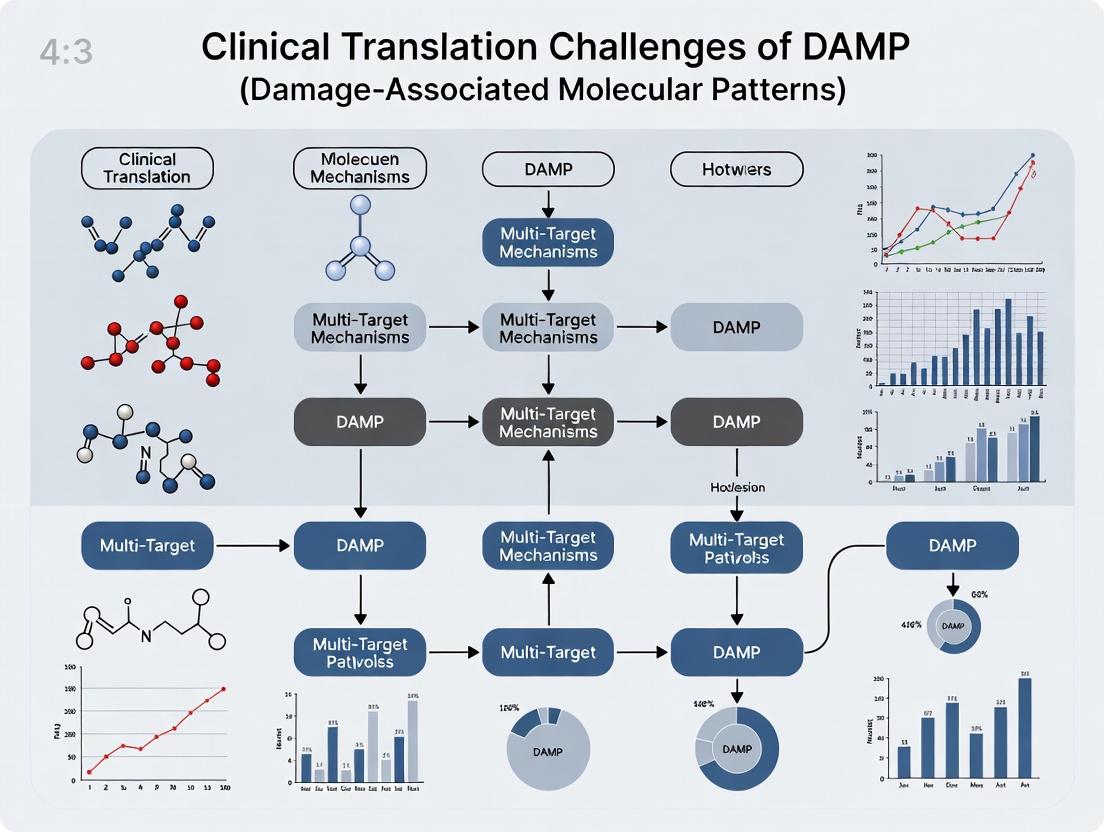
Damage-Associated Molecular Patterns (DAMPs) represent a promising frontier for treating complex, multifactorial diseases through their inherent multi-target mechanisms.
Navigating the Clinical Translation Maze: Overcoming Challenges in Multi-Target DAMP Therapeutics
Abstract
Damage-Associated Molecular Patterns (DAMPs) represent a promising frontier for treating complex, multifactorial diseases through their inherent multi-target mechanisms. However, translating this promise into clinical reality is fraught with significant hurdles. This article provides a comprehensive analysis for researchers, scientists, and drug development professionals. We first deconstruct the foundational biology of DAMP signaling networks and their therapeutic rationale. We then explore cutting-edge methodological approaches, from polypharmacology design to advanced delivery systems, for developing viable DAMP-modulating agents. A critical troubleshooting section addresses key roadblocks like target validation, biomarker identification, and safety profiling. Finally, we examine validation strategies, comparing DAMP-based approaches to conventional single-target drugs and other emerging modalities. The conclusion synthesizes a path forward for harnessing DAMP complexity to build the next generation of intelligent therapeutics.
DAMPs Decoded: Unraveling the Complex Biology and Therapeutic Rationale of Multi-Target Signaling
Technical Support Center
Troubleshooting Guides & FAQs
Q1: My ELISA for HMGB1 in serum samples consistently shows low or undetectable levels, despite evidence of inflammation in my disease model. What could be the issue? A: This is a common issue often related to HMGB1's redox state and sample preparation.
- Potential Cause 1: Improper Sample Handling. HMGB1 signaling is redox-sensitive. The fully reduced form (fr-HMGB1) binds to CXCR4, while the disulfide form (ds-HMGB1) activates TLR4. If samples are not processed and frozen rapidly, oxidative changes can occur, affecting antibody recognition.
- Solution: Use a reducing agent (e.g., DTT) in your lysis buffer for total HMGB1 detection. For specific redox form detection, utilize specialized ELISA kits (e.g., from Shino-Test Corporation) and follow strict, rapid processing protocols. Consider using protease and nicotinamide inhibitors to prevent degradation and ADP-ribosylation.
- Potential Cause 2: Antibody Specificity. Standard HMGB1 ELISAs may not detect all isoforms or complexes.
- Solution: Validate your assay with spiked recombinant HMGB1 controls. Consider western blot as a complementary method to confirm size and presence.
Q2: When I inhibit the NLRP3 inflammasome with MCC950 in a DAMP-driven in vitro model, I still observe significant IL-1β release. What are other potential sources? A: MCC950 is a specific NLRP3 inhibitor, but IL-1β can be processed and released via other inflammasomes or pathways.
- Potential Cause: Alternative Inflammasome Activation. Other DAMPs (e.g., ATP, mtDNA) can activate AIM2, NLRC4, or Pyrin inflammasomes.
- Solution:
- Perform a dose-response curve for MCC950 (typical range 10 nM - 10 µM) to confirm effective NLRP3 inhibition.
- Use a pan-caspase-1 inhibitor (e.g., VX-765) to see if IL-1β release is fully abrogated. If not, other proteases (e.g., neutrophil elastase, proteinase 3) may be involved.
- Utilize siRNA knockdown of Aim2 or Nlrc4 to identify the contributing inflammasome. A workflow is below.
Q3: I am observing high background noise in my flow cytometry analysis of DAMP receptors (e.g., TLR4, RAGE) on primary macrophages. How can I improve the signal-to-noise ratio? A: High background is often due to Fc receptor-mediated non-specific antibody binding.
- Solution: Always pre-incubate cells with an Fc receptor blocking solution (e.g., anti-CD16/32 antibody or purified IgG) for 15-20 minutes on ice prior to staining with your target antibody. Include fluorescence-minus-one (FMO) controls for every marker to correctly set positive gates. Titrate all antibodies to determine optimal staining concentrations.
Q4: In my in vivo sterile injury model, how can I definitively prove that a specific DAMP (e.g., S100A8/A9) is the key driver of pathology, not just a correlative marker? A: This requires a multi-pronged experimental approach central to validating a DAMP as a therapeutic target.
- Solution Protocol:
- Neutralization/Blockade: Administer a neutralizing monoclonal antibody against your target DAMP (e.g., anti-S100A8/A9) at the onset of injury. Compare outcomes (histology, cytokines, functional readouts) to isotype control-treated animals.
- Genetic Ablation: Use S100a9 KO mice (which lack the S100A8/A9 heterodimer) and subject them to your injury model. Compare responses to wild-type littermates.
- Recombinant DAMP Reconstitution: In a KO mouse, administer recombinant S100A8/A9 protein to see if it reconstitutes the pathological phenotype.
- Receptor Inhibition: Use a pharmacological inhibitor of the primary receptor (e.g., TAK-242 for TLR4, FPS-ZM1 for RAGE) to see if it phenocopies DAMP neutralization.
Table 1: Key DAMPs, Their Receptors, and Associated Clinical Trials
| DAMP (Key Player) | Primary Receptors | Exemplary Disease Link | Clinical Trial Phase (Example Drug/Target) |
|---|---|---|---|
| HMGB1 | TLR2, TLR4, RAGE, CXCR4 | Sepsis, Rheumatoid Arthritis, Cancer | Phase II (Anti-HMGB1 mAb, rycoplanin) |
| S100A8/A9 | TLR4, RAGE, CD36 | Atherosclerosis, Myocardial Infarction, RA | Phase II (ABR-238901 (S100A9 inhibitor)) |
| ATP (via P2X7R) | P2X7 Receptor | NLRP3-driven diseases (gout, IBD) | Phase III (Gefapixant/P2X3), Phase II (Selatogrel/P2Y12) |
| Cell-Free DNA (mtDNA, gDNA) | cGAS-STING, TLR9 | SLE, Age-related diseases, Cancer | Phase I (cGAS inhibitors, STING antagonists) |
| Heat Shock Proteins (e.g., HSP70) | TLR2, TLR4, CD91, LOX-1 | Cancer, Neurodegeneration | Preclinical/Phase I (HSP70-targeting vaccines) |
Table 2: Common DAMP Receptor Inhibitors & Their Specificity
| Inhibitor | Primary Target | Common Use Concentration (in vitro) | Key Off-Target Effects to Consider |
|---|---|---|---|
| TAK-242 (Resatorvid) | TLR4 | 1-10 µM | May inhibit other TLRs at high concentrations. |
| FPS-ZM1 | RAGE | 1-5 µM | Also interacts with Aβ aggregates. |
| MCC950 | NLRP3 Inflammasome | 10 nM - 1 µM | Highly specific for NLRP3; does not affect AIM2/NLRC4. |
| AZD9056 | P2X7 Receptor | 0.1 - 10 µM | Specific to human P2X7; check species reactivity. |
| C-176 / H-151 | STING (Covalent) | 0.5 - 5 µM | Cell-permeable, covalently binds to Cys91. |
Experimental Protocols
Protocol 1: Differentiating Inflammasome Sources of IL-1β Title: siRNA Knockdown Workflow for Inflammasome Identification. Method:
- Cell Preparation: Seed immortalized bone marrow-derived macrophages (iBMDMs) in 12-well plates at 70% confluence in antibiotic-free medium.
- Transfection: The next day, transfect cells with 50 nM ON-TARGETplus siRNA targeting Nlrp3, Aim2, or non-targeting control using a lipofectamine RNAiMAX protocol.
- Incubation: Incubate for 48-72 hours to allow for maximal protein knockdown.
- Priming & Activation: Prime cells with 100 ng/mL LPS for 3 hours. Stimulate with a DAMP: 5 mM ATP (for NLRP3), 2 µg/mL transfected poly(dA:dT) (for AIM2), or 10 µM nigericin (positive control).
- Analysis: Collect supernatant after 1 hour (ATP) or 6 hours (poly(dA:dT)). Measure IL-1β by ELISA. Perform cell lysis for western blot to confirm inflammasome component knockdown (e.g., NLRP3, ASC, AIM2).
Protocol 2: Assessing DAMP Release (HMGB1) from Damaged Cells Title: In Vitro Necrosis Induction and DAMP Measurement. Method:
- Induction of Regulated Necrosis: Culture adherent cells (e.g., L929 fibroblasts). Treat with a necroptosis inducer (e.g., 20 ng/mL TNF-α + 50 µM z-VAD-fmk + 2.5 µM Smac mimetic) for 12-18 hours.
- Sample Collection: Collect cell culture supernatant. Centrifuge at 500 x g for 5 min to remove debris. Aliquot and store at -80°C.
- HMGB1 Quantification: Use a commercial HMGB1 ELISA kit. Critical: Dilute samples 1:10 to 1:100 in provided diluent to avoid matrix effects. Run a standard curve from 0.1 ng/mL to 10 ng/mL.
- Normalization: Measure LDH release in parallel using a cytotoxicity kit to normalize HMGB1 levels to the degree of cell death.
Pathway & Workflow Visualizations
Diagram Title: Core DAMP-Receptor-Signaling Pathways in Disease
Diagram Title: Workflow to Validate a DAMP as a Pathological Driver
The Scientist's Toolkit: Research Reagent Solutions
| Item | Function & Application | Example/Note |
|---|---|---|
| Recombinant Human HMGB1 (various redox forms) | Used as a positive control in ELISAs, for in vitro stimulation studies, and for reconstitution experiments in KO models. | Available from R&D Systems, Sigma. Specify "disulfide" or "fully reduced" forms for receptor-specific studies. |
| TAK-242 (Resatorvid) | Selective small-molecule inhibitor of TLR4 signaling. Used to delineate TLR4-dependent DAMP effects. | Dissolve in DMSO. Typical working concentration 1-10 µM in vitro. |
| MCC950 (CP-456,773) | Potent and specific inhibitor of the NLRP3 inflammasome. Critical for testing NLRP3 involvement. | Highly selective; does not inhibit AIM2 or NLRC4. Use at 10 nM - 1 µM. |
| Anti-HMGB1 Neutralizing Antibody | For in vivo and in vitro neutralization of extracellular HMGB1 to establish causal role. | Clone 2G7 is commonly used for neutralization. Isotype control (e.g., IgG2b) is mandatory. |
| Cell Death Induction Kit (e.g., Necroptosis) | To induce regulated cell death in a standardized way for studying DAMP release mechanisms. | Often contains TNF-α/SMAC mimetic/z-VAD. Available from Cayman Chemical, etc. |
| cGAS-STING Pathway Inhibitors (e.g., C-176, H-151) | Covalent inhibitors of STING palmitoylation. Used to block cytosolic DNA sensing pathways. | Cell-permeable. Use controls to rule out off-target effects. |
| P2X7 Receptor Antagonist (e.g., A-438079, AZD9056) | To inhibit ATP-mediated NLRP3 activation and IL-1β release. | Verify species specificity (e.g., AZD9056 is for human P2X7). |
| RAGE Inhibitor (FPS-ZM1) | High-affinity RAGE antagonist. Useful for studying HMGB1 and S100A8/A9 signaling via RAGE. | Also shows efficacy in blocking Aβ binding in neurological models. |
| S100A8/A9 Heterodimer ELISA Kit | Specifically measures the active S100A8/A9 calprotectin complex in biological fluids. | More relevant than measuring subunits individually for many inflammatory diseases. |
Technical Support Center: Multi-Target Assay Development & DAMP Research
Troubleshooting Guides & FAQs
FAQ Category 1: Assay Design & Validation for Polypharmacology Screens
Q1: Our high-content screen for a multi-target DAMP inhibitor is showing high false-positive rates in the NF-κB reporter assay. What are the primary checks?
- A: High false positives often stem from off-target cytotoxicity or assay interference. Follow this protocol:
- Parallel Cytotoxicity Assay: Run a real-time cell viability assay (e.g., using Incucyte Cytotox Green Dye) in parallel with your reporter assay. Normalize luminescence/fluorescence to cell count.
- Hit Confirmation: Re-test primary hits in a secondary, orthogonal assay (e.g., ELISA for phospho-p65 or IkBα degradation).
- Compound Interference Check: Perform the reporter assay in the presence of a known, specific pathway inhibitor (e.g., BAY 11-7082 for NF-κB) to confirm signal specificity. Use the table below to validate your assay system.
- A: High false positives often stem from off-target cytotoxicity or assay interference. Follow this protocol:
Q2: How do we effectively profile off-target interactions for a designed polypharmacological agent without exhaustive individual assays?
- A: Utilize a tiered profiling approach.
- Primary Screen: Use a broad panel kinase assay (e.g., Eurofins KinaseProfiler or DiscoverX KINOMEscan) at a single concentration (10 µM).
- Secondary Validation: For hits with >65% inhibition, perform dose-response curves to generate Ki or IC50 values.
- Cellular Target Engagement: For key off-targets, employ cellular thermal shift assays (CETSA) or nanoBRET to confirm binding in live cells.
- A: Utilize a tiered profiling approach.
FAQ Category 2: DAMP-Specific Challenges in Translational Models
Q3: Our lead compound inhibiting multiple DAMPs (e.g., HMGB1 and S100A9) shows efficacy in murine sterile injury models but fails in human whole-blood ex-vivo assays. What could be the issue?
- A: This is a common DAMP translation gap. Key troubleshooting steps:
- Species-Specific Receptor Affinity: Validate binding affinity (SPR or ITC) of your compound to both human and mouse targets. DAMPs like HMGB1 have differential affinity for TLR4/MD2 across species.
- Plasma Protein Binding: Check compound binding to human vs. mouse serum albumin. High human plasma protein binding can drastically reduce free drug concentration. Use rapid equilibrium dialysis to quantify.
- Human Protease Degradation: Test compound stability in fresh human plasma. Incubate compound (1 µM) in plasma at 37°C, sample at 0, 15, 60, 240 min, and analyze via LC-MS.
- A: This is a common DAMP translation gap. Key troubleshooting steps:
Q4: What is the best practice for quantifying synergistic effects of a multi-target agent on DAMP release and downstream signaling?
- A: Use a combination index (CI) method across multiple readouts.
- Experimental Protocol: Treat primary human macrophages (e.g., derived from PBMCs) with your compound and a relevant stimulus (e.g., LPS + ATP). Collect supernatant (for DAMPs by ELISA) and lysate (for signaling) at multiple time points.
- Data Analysis: For each endpoint (e.g., HMGB1 release, IL-1β secretion, p38 MAPK phosphorylation), calculate the CI using the Chou-Talalay method (CompuSyn software). A CI < 0.9 indicates synergy. See table below for an example dataset.
- A: Use a combination index (CI) method across multiple readouts.
Table 1: Validation Data for a Representative Multi-Target DAMP Inhibitor (Compound X) in Primary Human Macrophages
| Assay Type | Target / Readout | IC50 / EC50 (nM) | Max Inhibition/Activation (%) | Assay Used |
|---|---|---|---|---|
| Binding (SPR) | Human TLR4/MD2 | 15.2 ± 2.1 | N/A | Surface Plasmon Resonance |
| Binding (SPR) | Human RAGE | 210 ± 45 | N/A | Surface Plasmon Resonance |
| Cellular Activity | LPS-induced IL-6 | 48.7 ± 5.6 | 92% | ELISA (Macrophage Supernatant) |
| Cellular Activity | HMGB1 Release | 105.3 ± 12.8 | 87% | ELISA (Supernatant) |
| Selectivity | Kinase Panel (Out of 468) | >10,000 (for 460) | <30% | KINOMEscan @ 1 µM |
| Cytotoxicity | Human PBMC Viability | >30,000 | N/A (CC50) | MTT Assay (72h) |
Table 2: Example Synergy Analysis (CI) for Compound X + Standard-of-Care in Sepsis Model
| Drug Combination | Ratio | Endpoint Measured | Fa (Fraction Affected) | Combination Index (CI) | Interpretation |
|---|---|---|---|---|---|
| Compound X + Dexamethasone | 1:1 (µM) | Serum IL-1β Reduction | 0.75 | 0.45 | Strong Synergy |
| Compound X + Dexamethasone | 1:1 (µM) | Survival Improvement | 0.60 | 0.68 | Synergy |
| Compound X + Anti-TNFα | 10:1 (nM:µg) | HMGB1 Release Inhibition | 0.50 | 0.89 | Near Additive |
Detailed Experimental Protocols
Protocol 1: Integrated Cellular Thermal Shift Assay (CETSA) for Target Engagement of Multiple DAMP Receptors
- Objective: Confirm cellular target engagement of a polypharmacology agent on TLR4 and RAGE in a relevant cell line (e.g., THP-1 macrophages).
- Materials: THP-1 cells, compound of interest, PMA, PBS, Halt Protease Inhibitor Cocktail, thermal cycler with gradient block, SDS-PAGE/Western blot apparatus, antibodies for TLR4 and RAGE.
- Method:
- Differentiate THP-1 cells with 100 nM PMA for 48h. Treat cells with compound (1 µM, 1h) or DMSO control.
- Harvest cells, wash with PBS, and resuspend in PBS with protease inhibitors.
- Aliquot cell suspension (~50 µL) into PCR tubes. Heat aliquots at a temperature gradient (e.g., 37°C to 67°C in 3°C increments) for 3 min in a thermal cycler.
- Immediately freeze all samples in liquid nitrogen for 1 min. Thaw on ice and lyse by freeze-thaw cycles (3x).
- Centrifuge at 20,000 x g for 20 min at 4°C. Collect soluble fraction.
- Analyze target protein remaining in soluble fraction by Western blot. Quantify band intensity. A leftward shift in the melting curve (Tm) for TLR4/RAGE in compound-treated cells indicates stabilization and direct engagement.
Protocol 2: Multi-Parametric Flow Cytometry for DAMP & Signaling Analysis in Single Cells
- Objective: Measure the effect of a multi-target compound on DAMP surface expression (e.g., calreticulin) and intracellular phospho-signaling nodes simultaneously.
- Materials: Primary dendritic cells, test compound, stimulus (e.g., oxaliplatin), fixation/permeabilization buffer kit, antibodies: surface (anti-Calreticulin-PE), intracellular (anti-phospho-STAT1-Alexa647, anti-phospho-NFκB p65-BV421), viability dye, flow cytometer.
- Method:
- Pre-treat cells with compound (30 min), then stimulate with oxaliplatin (6h).
- Harvest cells, stain with viability dye and surface anti-Calreticulin in PBS/2% FBS.
- Fix cells with 4% PFA (10 min, RT), then permeabilize with ice-cold 90% methanol (30 min on ice).
- Wash twice, stain with intracellular phospho-antibodies in permeabilization buffer (1h, RT, dark).
- Acquire data on a flow cytometer capable of 4+ colors. Use FSC-A/SSC-A and viability dye to gate live, single cells.
- Analyze using FlowJo. Use median fluorescence intensity (MFI) for phospho-proteins and percentage positive for surface calreticulin. This single-cell resolution reveals heterogeneous cell responses to polypharmacology.
Pathway & Workflow Visualizations
The Scientist's Toolkit: Research Reagent Solutions
Table: Essential Materials for Multi-Target DAMP Research
| Reagent / Material | Supplier Examples | Function in Polypharmacology/DAMP Research |
|---|---|---|
| Recombinant Human DAMP Proteins (HMGB1, S100A8/A9, ATP) | R&D Systems, Sigma-Aldrich, BioLegend | Essential for binding assays (SPR, ITC), receptor activation studies, and as assay standards for ELISA. |
| Engineered Reporter Cell Lines (TLR4-NF-κB, NLRP3-ASC-Casp1, RAGE-Luciferase) | InvivoGen, BPS Bioscience | Enable high-throughput screening for compounds modulating specific DAMP receptor pathways. |
| Phospho-Specific Antibody Panels (for p-p65, p-IRF3, p-STAT1, p-p38) | Cell Signaling Technology, Abcam | Critical for validating multi-target effects on downstream signaling nodes via Western blot or flow cytometry. |
| Selectivity Screening Panels (Kinase, GPCR, Epigenetic) | Eurofins, DiscoverX, Reaction Biology | Define the off-target profile of a polypharmacology agent to identify potential toxicity or additional efficacy mechanisms. |
| CETSA / Cellular Target Engagement Kits | Thermo Fisher, Pelago Biosciences | Confirm direct binding and stabilization of purported protein targets in a live cellular context. |
| Human Disease-Relevant Primary Cells (e.g., PBMCs, Macrophages, Fibroblasts) | STEMCELL Technologies, PromoCell | Provide physiologically relevant models for testing compound efficacy on human DAMP biology and cytokine release. |
| Multi-Analyte Profiling Kits (Luminex/ELISA for Cytokines & DAMPs) | Meso Scale Discovery (MSD), Bio-Rad, LEGENDplex | Quantify multiple DAMP and cytokine outputs from a single sample to assess broad anti-inflammatory effects. |
| In Vivo Sterile Injury Models (e.g., LPS-Induced Sepsis, Hepatic I/R, CIA) | Charles River, The Jackson Laboratory | Required for final preclinical validation of efficacy in complex, multi-DAMP driven disease models. |
Technical Support Center: DAMP Pathway Research & Therapeutics
FAQs & Troubleshooting Guides
Q1: My in vitro macrophage assay shows inconsistent IL-1β secretion in response to recombinant HMGB1. What could be wrong? A: Inconsistent IL-1β release is common. Follow this checklist:
- HMGB1 Redox State: Recombinant HMGB1's activity is strictly redox-dependent. Fully reduced (all-thiol) HMGB1 binds CXCR4 for chemotaxis; disulfide HMGB1 (Cys23-Cys45) binds TLR4/MD2 to induce cytokine release. Use a mass spec-compatible alkylation assay (e.g., with iodoacetamide) to verify the redox state of your stock. Always prepare fresh dilutions from a confirmed stock.
- Contaminant LPS: Even picogram levels of LPS can synergize or confound. Treat HMGB1 with Polymyxin B-agarose or use a specific TLR4 inhibitor (TAK-242) as a control.
- Priming Signal: IL-1β secretion typically requires two signals: Signal 1 (Priming, e.g., LPS via TLR4 for pro-IL-1β synthesis) and Signal 2 (Activation, e.g., HMGB1 or ATP via NLRP3 inflammasome). Ensure your cells have received an appropriate priming signal.
Q2: When testing a putative DAMP inhibitor in vivo in a sterile liver injury model, how do I distinguish its effect on the DAMPs themselves versus the downstream signaling pathways? A: This requires a tiered experimental strategy.
- Phase 1: DAMP Measurement: Use specific ELISAs for key DAMPs (e.g., HMGB1, S100A8/A9, DNA) in plasma and tissue homogenates post-mortem. A reduction indicates the inhibitor may block DAMP release.
- Phase 2: Pathway Readouts: From the same tissue, measure:
- Transcription: NF-κB target genes (Il6, Tnf) via qPCR.
- Inflammasome Activation: Caspase-1 cleavage (western blot) and mature IL-1β (ELISA).
- Compare the inhibitor's effect on DAMP levels versus downstream readouts. A disconnect (e.g., high DAMPs but low IL-6) suggests a downstream target.
Q3: What are the critical controls for a DAMPs-release assay from primary necrotic cells (e.g., freeze-thaw)? A:
- Viability Control: Confirm >95% necrosis (e.g., via propidium iodide uptake) before supernatant collection.
- Apoptosis Control: Include a sample of cells treated with a known apoptosis inducer (e.g., staurosporine). Apoptotic cells should not release significant HMGB1.
- Inhibition of Passive Release: Pre-treat cells with Glycyrrhizin (binds HMGB1) or NSA (Nicotinic acid adenine dinucleotide phosphate inhibitor for Ca2+ flux) to partially inhibit release.
- Specificity Control: Spike recombinant DAMP into control media to rule out assay interference.
Experimental Protocols
Protocol 1: Assessing HMGB1 Redox State via Non-Reducucing Alkylation & Western Blot
- Purpose: To determine the cysteine redox state of HMGB1 in experimental samples.
- Materials: Cell culture supernatant or purified protein, 100mM Iodoacetamide (IAM) in PBS (fresh), Non-reducing Laemmli buffer, Anti-HMGB1 antibody.
- Method:
- Immediately mix sample 1:1 with 100mM IAM. Incubate 20 min, dark, RT.
- Add non-reducing Laemmli buffer (no β-mercaptoethanol or DTT).
- Run SDS-PAGE and western blot under non-reducing conditions.
- Interpretation: Reduced thiols alkylated by IAM increase molecular weight shift. Compare to recombinant controls (fully reduced, disulfide).
Protocol 2: In Vivo Efficacy Testing of a DAMP-Targeting Agent in a Sterile Inflammation Model (e.g., Ischemia-Reperfusion Injury)
- Purpose: To evaluate the therapeutic potential of an inhibitor targeting DAMP release or signaling.
- Model: Murine hepatic ischemia-reperfusion (IRI).
- Groups: (n=8-10) Sham, IRI + Vehicle, IRI + Therapeutic (low/high dose), IRI + Positive Control (e.g., anti-HMGB1 mAb).
- Endpoint Analysis (24h post-reperfusion):
- Serum: ALT/AST (necrosis), HMGB1, IL-6, IL-1β ELISA.
- Liver Tissue:
- Histology: H&E for injury scoring.
- Immunohistochemistry: Neutrophil (Ly6G) and macrophage (F4/80) infiltration.
- Homogenate: Cytokine multiplex assay, Caspase-1 activity.
Data Presentation
Table 1: Clinical Trial Landscape for Select DAMP-Targeting Therapies (Representative Examples)
| Therapeutic Agent | Target DAMP/Pathway | Indication | Phase | Key Outcome/Status | Primary Challenge Noted |
|---|---|---|---|---|---|
| GMI-1271 (Uproleselan) | E-Selectin (downstream of DAMPs) | Refractory AML | Phase 3 | Improved chemotherapy efficacy; reduced toxicity. | Defining precise patient subsets. |
| Anti-HMGB1 mAb | Extracellular HMGB1 | Sepsis, ARDS | Phase 2 | Mixed results; some reduction in cytokines. | Redox heterogeneity of target; timing of intervention. |
| Paquinimod | S100A8/A9 (Calprotectin) | Systemic Sclerosis | Phase 2 | Reduced myeloid cell activity. | Balancing immune modulation vs. suppression. |
| Dapansutrile | NLRP3 Inflammasome (downstream of multiple DAMPs) | Acute Gout, Heart Failure | Phase 2 | Reduced IL-1β; symptom relief in gout. | Redundancy in inflammasome triggers. |
Table 2: Key In Vitro Assay Parameters for DAMP Research
| Assay Type | Primary Readout | Common Pitfall | Recommended Control |
|---|---|---|---|
| DAMP Release (Necrosis) | HMGB1, ATP, DNA in supernatant | Apoptotic contamination; LPS in reagents. | Apoptosis inducer control; Polymyxin B treatment. |
| DAMP Signaling (Reporter) | NF-κB or IRF Luciferase activity | Non-specific activation by contaminants. | TLR/Dectin-1 knockout cells; isotype control protein. |
| Inflammasome Activation | Caspase-1 cleavage, IL-1β release | Requirement for Signal 1 (priming). | Unprimed cells; specific caspase-1 inhibitor (YVAD). |
| Chemotaxis | Cell migration (Boyden chamber) | Redox-dependent receptor switching (e.g., HMGB1). | Use redox-characterized DAMP; receptor blocking antibody. |
Visualizations
Title: Core DAMP-Mediated Inflammatory Signaling Cascade
Title: DAMP-Targeted Therapeutic Development Workflow
The Scientist's Toolkit: Key Research Reagent Solutions
| Reagent/Category | Example(s) | Primary Function in DAMP Research |
|---|---|---|
| Recombinant DAMPs | HMGB1 (various redox mutants), S100A8/A9, Pure genomic DNA | Positive controls for receptor binding, signaling, and chemotaxis assays. |
| DAMP-Specific Inhibitors | Glycyrrhizin (HMGB1), Box A (HMGB1 antagonist), Paquinimod (S100A9), AZD9056 (P2X7R) | Tool compounds to block specific DAMP interactions or downstream signaling. |
| PRR Blockers/Agonists | TAK-242 (TLR4), FPS-ZM1 (RAGE), MCC950 (NLRP3), ODN 1826 (TLR9) | To dissect which receptor is responsible for observed DAMP effects. |
| Detection Antibodies | Anti-HMGB1 (non-phospho specific), Anti-Histone H3 (citrullinated), Anti-S100A9 | For ELISA, western blot, and IHC to quantify DAMP release and localization. |
| Critical Assay Kits | ATP Luminescence, dsDNA Quantitation (PicoGreen), Caspase-1 Activity (FLICA) | Quantitative readouts for key DAMP-related activities. |
| Control Reagents | Ultrapure LPS, Recombinant IL-1β, Necrotic Cell Lysate (standardized) | Assay calibration and specificity controls. |
Troubleshooting Guides & FAQs
FAQ 1: What are common causes of high background in HMGB1 ELISA, and how can I resolve them?
- A: High background is frequently caused by sample matrix interference (e.g., serum lipids, heterophilic antibodies) or inadequate plate washing. To resolve:
- Dilute the sample: Re-test with a series of sample dilutions using the assay's recommended diluent to see if the signal becomes proportional.
- Use a blocking agent: Add an additional post-coat blocking step with 1-5% BSA or the assay's proprietary blocker for 1-2 hours.
- Increase wash cycles and volume: Perform 5-6 wash cycles with a 300-350 µL wash buffer volume per well.
- Use a sample pre-treatment reagent: If heterophilic antibodies are suspected, use a commercial interference blocker or pre-incubate samples with non-immune serum from the same species as the detection antibody.
FAQ 2: My western blot for S100A8/A9 shows nonspecific bands. How can I improve specificity?
- A: Nonspecific bands often arise from antibody cross-reactivity or suboptimal buffer conditions.
- Optimize antibody concentration: Titrate both primary and secondary antibodies. Start with a 2-fold lower concentration than recommended.
- Increase blocking stringency: Block membranes with 5% non-fat dry milk in TBST containing 0.1% Tween-20 for 1 hour at room temperature.
- Adjust wash stringency: Increase Tween-20 concentration in TBST to 0.3-0.5% for post-primary and post-secondary antibody washes.
- Use a different antibody clone or host species: Consult recent literature for validated clones specific for S100A8 or S100A9 monomers and heterodimers.
FAQ 3: How do I effectively neutralize HMGB1 activity in my in vivo inflammation model?
- A: Use a combination of specific neutralizing agents and appropriate controls.
- Neutralizing Antibodies: Administer anti-HMGB1 monoclonal antibodies (e.g., 2G7 clone) via intraperitoneal injection. A typical dose is 10-20 mg/kg, given 1 hour prior to injury induction.
- Pharmacological Inhibitors: Use Glycyrrhizin (50-100 mg/kg, i.p.) or BoxA (the HMGB1 A-box, 100-500 µg per mouse, i.v.) as competitive inhibitors.
- Critical Control: Always include an isotype control antibody or scrambled peptide at the same concentration/dose as your neutralizing agent.
FAQ 4: What are the key controls for a DAMPs release assay from pyroptotic cells?
- A: Essential controls to confirm DAMP release is specific to regulated cell death.
- Negative Control: Untreated, healthy cells.
- Mechanical Lysis Control: Cells lysed by freeze-thaw or detergent (e.g., 1% Triton X-100) to measure total DAMP content.
- Specific Inhibition Control: Pre-treat cells with a caspase-1 inhibitor (e.g., VX-765, 20 µM) or a gasdermin D inhibitor (Disulfiram, 10 µM) before pyroptosis induction.
- Cell Death Quantification Control: Run parallel assays for LDH release and propidium iodide uptake to correlate DAMP release with percent cell death.
Key Experimental Protocols
Protocol 1: Quantifying HMGB1 Redox States via Diagonal Gel Electrophoresis
- Principle: Separates HMGB1 isoforms (fully reduced, disulfide, oxidized) based on differential alkylation and two-dimensional non-reducing/reducing PAGE.
- Steps:
- Sample Preparation: Collect cell culture supernatant or tissue homogenate in the presence of 20 mM N-ethylmaleimide (NEM) to alkylate free thiols. Centrifuge to clear debris.
- First Dimension (Non-reducing): Load sample onto a standard 15% SDS-PAGE gel without β-mercaptoethanol in the sample buffer. Run at 100V.
- Gel Strip Incubation: Excise the lane, incubate in equilibration buffer (50 mM Tris-HCl, pH 6.8, 2% SDS) with 50 mM dithiothreitol (DTT) for 1 hour to reduce disulfide bonds.
- Second Dimension (Reducing): Place the gel strip horizontally on a new 15% SDS-PAGE gel. Load standard molecular weight markers in a separate lane. Run with standard reducing buffer.
- Detection: Perform western blot using anti-HMGB1 antibody. Species will appear off the diagonal, with positions indicating redox state.
Protocol 2: Measuring S100A8/A9 Heterocomplex Formation via Crosslinking
- Principle: Uses a chemical crosslinker to stabilize protein-protein interactions for analysis by western blot or mass spectrometry.
- Steps:
- Recombinant Protein Incubation: Incubate recombinant human S100A8 and S100A9 (each at 5 µM) in 20 mM HEPES, pH 7.4, 2 mM CaCl₂, for 30 min at 25°C to allow heterocomplex formation.
- Crosslinking: Add the membrane-permeable crosslinker disuccinimidyl suberate (DSS) to a final concentration of 1 mM. Incubate for 30 min at room temperature.
- Quenching: Stop the reaction by adding Tris-HCl, pH 7.5, to a final concentration of 50 mM. Incubate for 15 min.
- Analysis: Run samples on a non-reducing 4-20% gradient SDS-PAGE gel. Perform western blot using antibodies against S100A8 and S100A9. The heterodimer (~21 kDa) and heterotetramer (~42 kDa) will be visible above the monomeric bands.
Data Tables
Table 1: Clinical Correlations of Key DAMPs in Serum/Plasma
| DAMP | Associated Condition(s) | Typical Concentration Range in Disease | Detection Method | Key Receptor(s) |
|---|---|---|---|---|
| HMGB1 | Sepsis, Rheumatoid Arthritis, Cancer | 10-100 ng/mL (Sepsis) | ELISA, Western Blot | TLR4, RAGE, TLR2 |
| S100A8/A9 | IBD, RA, CVD, Cancer | 500-10,000 ng/mL (Active RA) | ELISA, CLIA | TLR4, RAGE, CD36 |
| S100A12 | Kawasaki Disease, Atherosclerosis | 50-500 ng/mL (KD) | ELISA | RAGE |
| Cell-Free DNA | Trauma, SLE, Cancer | 50-500 ng/mL (cfDNA) | Fluorescence Assay, qPCR | TLR9, cGAS-STING |
| ATP | Myocardial Infarction, Sepsis | 1-10 µM (extracellular) | Luciferase Assay | P2X7, P2Y2 |
Table 2: Common Inhibitors for DAMP Signaling Pathways
| Target | Inhibitor Name | Mechanism | Typical In Vitro Concentration |
|---|---|---|---|
| HMGB1 | Glycyrrhizin | Binds HMGB1, inhibits chemokine binding | 10-100 µM |
| TLR4 | TAK-242 (Resatorvid) | Blocks TLR4 intracellular signaling | 1-10 µM |
| RAGE | FPS-ZM1 | Antagonizes RAGE ligand binding | 1-5 µM |
| P2X7 Receptor | A438079 | Competitive P2X7 antagonist | 10-100 µM |
| cGAS | RU.521 | Competitive cGAS inhibitor | 5-20 µM |
Visualizations
Title: DAMP Signaling via TLR4/RAGE to NF-κB
Title: DAMP Assay Troubleshooting Decision Tree
The Scientist's Toolkit: Key Research Reagent Solutions
| Item | Function & Application | Example/Notes |
|---|---|---|
| Recombinant Human HMGB1 (various redox mutants) | Used as a positive control, for in vitro stimulation assays, and for antibody validation. | Ensure the supplier specifies the redox state (fully reduced, disulfide HMGB1). |
| S100A8/A9 Heterodimer (Calprotectin) Protein | Essential for studying heterocomplex-specific functions in inflammation and infection models. | Purify from human cells or purchase from a vendor guaranteeing heterocomplex formation. |
| Anti-HMGB1 Neutralizing Antibody (Clone 2G7) | For in vivo and in vitro functional blockade of HMGB1 activity. | Isotype control: Mouse IgG2b. |
| TLR4/MD2 Complex Inhibitor (TAK-242) | Pharmacologically inhibits signaling downstream of TLR4, a key receptor for many DAMPs. | Useful to distinguish TLR4-dependent effects from RAGE-dependent ones. |
| RAGE Inhibitor (FPS-ZM1) | A high-affinity RAGE-specific antagonist to block DAMP-RAGE interactions. | Shows efficacy in neuroinflammation and diabetes models. |
| High-Sensitivity DAMP ELISA Kits | Quantify picogram levels of HMGB1, S100 proteins, or heat shock proteins in biological fluids. | Look for kits that detect all redox forms or specific isoforms. |
| Cell Death Induction Kit (for Pyroptosis/Necroptosis) | Standardized reagents to induce specific DAMP-releasing cell death pathways. | e.g., LPS + Nigericin for pyroptosis; TSZ (TNF-α/Smac-mimetic/Z-VAD) for necroptosis. |
| cGAS-STING Pathway Reporter Cell Line | To specifically test for DAMP activity via the cytosolic DNA sensing pathway. | e.g., THP1-Lucia ISG cells from InvivoGen. |
Technical Support Center: DAMP Experimentation Troubleshooting
FAQ & Troubleshooting Guide
Q1: In my in vivo sterile injury model, I observe excessive inflammation instead of the expected reparative phase. What could be causing this? A: This is a classic manifestation of DAMP dysregulation. The probable cause is persistent, high-level DAMP release overwhelming the clearance mechanisms. Troubleshoot as follows:
- Check Injury Specificity: Ensure your model is truly "sterile" and not confounded by low-level pathogen-associated molecular patterns (PAMPs), which synergize with DAMPs.
- Quantify DAMPs: Measure key DAMPs (e.g., HMGB1, DNA, S100A8/A9) in serum/tissue at multiple time points. Persistent elevation beyond 72 hours post-injury indicates impaired resolution.
- Assess Clearance: Evaluate phagocytic activity (e.g., efferocytosis assay) and check for deficiencies in DAMP-degrading enzymes (e.g., DNase I activity).
Q2: My ELISA kits for HMGB1 are detecting both inflammatory and reparative isoforms, confounding my data. How can I differentiate them? A: Standard ELISAs often fail to distinguish redox states. You need oxidation-state-specific assays.
- Protocol: Immunoblotting for HMGB1 Redox States:
- Sample Preparation: Lyse tissues/cell supernatant in non-reducing, non-denaturing RIPA buffer with 20mM N-ethylmaleimide (alkylating agent) to preserve cysteine redox states.
- Gel Electrophoresis: Run on a 12% non-reducing SDS-PAGE gel. Do not add β-mercaptoethanol or DTT.
- Transfer & Blocking: Standard PVDF transfer. Block with 5% BSA.
- Detection: Use a primary antibody against total HMGB1. To specifically identify the disulfide form (pro-inflammatory), a primary antibody specific to the disulfide bond conformation (e.g., from Cisbio) can be used.
- Comparison: Run a reduced sample in parallel to identify the fully reduced (pro-reparative) form's migration position.
Q3: When blocking the TLR4 pathway to inhibit DAMP signaling, I see compensatory upregulation in alternative pathways (e.g., RAGE, inflammasome). How do I design a multi-target inhibition strategy? A: Single-target inhibition often fails due to DAMP redundancy. A rational combinatorial approach is needed.
- Step 1 – Pathway Mapping: Perform a phospho-kinase array or RNA-seq on your TLR4-inhibited samples to identify the most significantly upregulated alternative nodes (e.g., NLRP3, cGAS-STING).
- Step 2 – Sequential Validation: Validate key upregulated targets (e.g., AIM2, NLRP3) via qPCR and western blot.
- Step 3 – Rational Combination: Use sub-therapeutic doses of a TLR4 inhibitor (e.g., TAK-242, 0.5 μM) combined with an inhibitor of the most upregulated compensatory pathway (e.g., MCC950 for NLRP3, 10 nM). Test synergy using combination index (CI) analysis via Chou-Talalay method.
Q4: I am getting highly variable results in my macrophage repolarization assay from M1 (pro-inflammatory) to M2 (pro-reparative) using DAMPs. What are the critical controls? A: Variability often stems from inconsistent macrophage differentiation and polarization purity.
- Critical Control Protocol:
- Bone Marrow-Derived Macrophage (BMDM) Differentiation: Use CSF-1 (M-CSF) at 20 ng/mL for 7 days. Confirm >95% purity by F4/80⁺CD11b⁺ flow cytometry.
- Pre-polarization to M1: Treat with 100 ng/mL LPS + 20 ng/mL IFN-γ for 24 hours. Validate: Measure supernatant IL-12p70 (M1 marker) via ELISA and confirm iNOS expression by western blot.
- DAMP-Induced Repolarization: Wash cells thoroughly. Add your DAMP (e.g., low-dose HMGB1 in disulfide form vs. fully reduced form). Incubate for 48 hours.
- Post-Treatment Validation: Measure arginase-1 activity (colorimetric assay) and IL-10 release (ELISA) as M2 markers. Always include a control group repolarized with standard stimuli (IL-4/IL-13, 20 ng/mL each).
Table 1: Key DAMPs, Their Receptors, and Functional Outcomes
| DAMP | Primary Receptors | Pro-Inflammatory Context/Level | Pro-Reparative Context/Level | Clinical Translation Challenge |
|---|---|---|---|---|
| HMGB1 | TLR4, RAGE, TLR2 | Disulfide form (Cys23-Cys45); >10 ng/mL in serum post-acute injury | Fully reduced form; low dose (1-2 ng/mL) in resolution phase | Redox-state specific targeting; short half-life in circulation |
| Cell-Free DNA | cGAS-STING, TLR9 | Long fragments (>1 kbp); endogenous DNase I inhibited | Short fragments (200-500 bp); efficient DNase I clearance | Discriminating self vs. mitochondrial DNA; delivery of inhibitors |
| S100A8/A9 | TLR4, RAGE | High local concentration (>1 µg/mL); promotes neutrophil adhesion | Low concentration (<100 ng/mL); supports endothelial repair | Blocking heterodimer without affecting monomer functions |
| ATP | P2X7, P2Y2 | High extracellular burst (>100 µM); drives NLRP3 inflammasome | Low, sustained release (1-10 µM); promotes cell proliferation | Transient vs. sustained receptor agonism/antagonism |
Table 2: Efficacy of Combinatorial DAMP-Targeting in Preclinical Models
| Disease Model | Single-Target Therapy (Outcome) | Multi-Target Therapy (Combo) | Synergy (CI Value) | Key Metric Improved |
|---|---|---|---|---|
| Myocardial I/R | Anti-TLR4 mAb (22% infarct reduction) | Anti-TLR4 + NLRP3 inhibitor (MCC950) | 0.65 (Synergistic) | 48% infarct reduction; 2.1x higher ejection fraction |
| Sterile Liver Injury | DNase I treatment (30% less necrosis) | DNase I + Anti-HMGB1 (BoxA) | 0.72 (Synergistic) | 75% less necrosis; 3x faster regeneration rate |
| Fibrosis (Lung) | Anti-RAGE mAb (40% less collagen) | Anti-RAGE + STING inhibitor (H-151) | 0.55 (Synergistic) | 80% less collagen; resolved inflammation score of 8.2 vs. 4.1 (control) |
Experimental Protocols
Protocol 1: Assessing DAMP Release Dynamics (In Vitro Necroptosis Model) Objective: To quantify the temporal release of DAMPs (HMGB1, ATP, DNA) from cells undergoing programmed necroptosis.
- Cell Preparation: Seed L929 cells in 12-well plates at 2.5x10^5 cells/well.
- Induction: Treat cells with Fresh medium containing: TNF-α (50 ng/mL), SM-164 (500 nM, cIAP1/2 inhibitor), and Z-VAD-FMK (50 µM, pan-caspase inhibitor).
- Time-Course Sampling: At 0, 2, 4, 8, 12, 24h, collect:
- Supernatant: Centrifuge at 500xg, 5 min. Aliquot for:
- HMGB1 ELISA (1:10 dilution).
- ATP assay (Luciferase-based, immediate reading).
- Cell-free DNA (Quant-iT PicoGreen assay).
- Cells: Lyse for viability assay (LDH release) and western blot (pMLKL, RIPK3).
- Supernatant: Centrifuge at 500xg, 5 min. Aliquot for:
- Data Normalization: Express DAMP release as fold-change over untreated control or as absolute concentration from standard curve.
Protocol 2: In Vivo DAMP Neutralization & Functional Rescue Objective: To evaluate the effect of timed DAMP neutralization on outcome in a sterile liver injury model.
- Model Induction: Inject C57BL/6 mice intraperitoneally (i.p.) with 20% CCl4 in olive oil (5 µL/g body weight).
- Therapeutic Dosing:
- Group 1 (Early Pro-Inflammatory Block): Administer neutralizing anti-HMGB1 mAb (10 mg/kg, i.p.) at 2h and 12h post-injury.
- Group 2 (Late Pro-Reparative Mimicry): Administer recombinant, fully reduced HMGB1 (0.5 mg/kg, i.p.) at 48h and 72h post-injury.
- Control: Isotype IgG.
- Endpoint Analysis (96h):
- Serum: ALT/AST (liver damage), IL-6/TNF-α (inflammation), IL-10/TGF-β (resolution).
- Liver Tissue: H&E for necrosis; Sirius Red for collagen; IHC for Ki67 (proliferation) and α-SMA (fibrosis).
- Flow Cytometry: Analyze immune infiltrate (Ly6G⁺ neutrophils, F4/80⁺ macrophages, CD3⁺ T cells).
Signaling Pathway & Workflow Diagrams
DAMP Signaling Fate: Inflammation vs. Repair
DAMP Kinetic Profiling and Intervention Workflow
The Scientist's Toolkit: Key Research Reagent Solutions
| Reagent/Category | Example Product(s) | Primary Function in DAMP Research |
|---|---|---|
| DAMP Neutralizing Antibodies | Anti-HMGB1 mAb (clone 3E8), Anti-RAGE mAb | Block specific DAMP-receptor interaction in vivo/in vitro to establish causal role. |
| Recombinant DAMP Proteins (Redox Variants) | Recombinant HMGB1 (disulfide form vs. fully reduced) | Study isoform-specific signaling; used as reparative agonists or inflammatory stimuli. |
| Small Molecule Pathway Inhibitors | TAK-242 (TLR4), MCC950 (NLRP3), H-151 (STING) | Dissect contribution of specific downstream signaling nodes; test combinatorial targeting. |
| DAMP Quantification Kits | HMGB1 ELISA (sandwich), Cell-Free DNA Assay (PicoGreen), ATP Bioluminescence Assay | Quantify DAMP release kinetics in supernatants, serum, or tissue homogenates. |
| In Vivo Disease Models | CCl4-Induced Liver Injury, Myocardial Ischemia-Reperfusion, Antibiotic-Driven Dysbiosis | Provide physiological context of sterile injury or inflammation where DAMP functions are critical. |
| Phospho-Kinase Arrays | Proteome Profiler Mouse Phospho-Kinase Array | Uncover compensatory pathway activation upon single-target DAMP inhibition. |
Bridging the Gap: Methodological Strategies for Designing and Delivering Multi-Target DAMP Modulators
Technical Support Center
Troubleshooting Guides & FAQs
1. Molecular Docking & Virtual Screening
- Q: My virtual screen against multiple DAMP receptors (e.g., TLR4, RAGE) returns an unmanageably high number of hits with similar docking scores. How can I prioritize compounds for further study?
- A: Implement a multi-tiered filtering strategy. First, use consensus scoring from at least 3 different scoring functions. Then, apply stringent ADMET (Absorption, Distribution, Metabolism, Excretion, Toxicity) filters in silico. Finally, prioritize hits based on their predicted polypharmacology profile (see Table 1).
- Q: I am getting poor pose reproducibility (<70% success in re-docking the native ligand) for my target receptor structure (PDB ID: XXXX). What should I check?
- A: Follow this protocol:
- Protein Preparation: Ensure all missing side chains and loops are modeled. Protonate the structure at physiological pH (7.4) using tools like PDB2PQR or the Protein Preparation Wizard.
- Binding Site Definition: Validate the grid box coordinates. Compare them to the known orthosteric/allosteric site from literature. Use a reference ligand if available.
- Water Molecules: Systematically evaluate the role of crystallographic water molecules. Perform docking runs with key conserved waters both included and excluded.
- Protocol: Re-dock the co-crystallized ligand using a high-exhaustiveness setting (e.g., >50 in Vina). A successful re-docking RMSD should be <2.0 Å.
- A: Follow this protocol:
2. Molecular Dynamics (MD) Simulation & Network Analysis
- Q: During MD simulation of my lead compound bound to a DAMP sensor, the ligand drifts out of the binding pocket after ~50ns. Is this a failure?
- A: Not necessarily. This could indicate low binding affinity or an unstable pose. To investigate:
- Replicate the simulation: Run 3 independent simulations with different initial velocities to assess consistency.
- Analyze interactions: Plot the time evolution of key interactions (H-bonds, salt bridges, π-stacking). Sudden loss of all interactions correlates with unbinding.
- Control experiment: Run the same protocol with a known potent inhibitor. If the control remains stable, your lead's pose may need refinement.
- A: Not necessarily. This could indicate low binding affinity or an unstable pose. To investigate:
- Q: How do I construct and analyze a DAMP signaling network for polypharmacology target identification?
- A: Use this detailed protocol:
- Data Curation: From databases (UniProt, KEGG, STRING), extract proteins in DAMP-initiated pathways (e.g., NF-κB, MAPK, inflammasome assembly).
- Network Construction: Use Cytoscape. Nodes=proteins, edges=interactions (activation, inhibition, binding).
- Topological Analysis: Calculate centrality metrics (Degree, Betweenness) to identify hub proteins.
- Module Detection: Use algorithms (MCODE, GLay) to find densely connected clusters representing signaling modules.
- Target Selection: Prioritize hubs that connect multiple DAMP pathways as potential polypharmacology targets.
- A: Use this detailed protocol:
3. Machine Learning & QSAR Modeling
- Q: My multi-target QSAR model has high accuracy on the training set (>90%) but fails to predict activity for external test compounds. What is the likely cause?
- A: This signals overfitting and/or a lack of domain applicability. Troubleshoot as follows:
- Check Data Diversity: Ensure your training set covers chemical space relevant to the test set. Use PCA or t-SNE to visualize molecular descriptor space.
- Simplify the Model: Reduce the number of descriptors. Use feature selection methods (e.g., Random Forest feature importance) and rebuild.
- Apply Applicability Domain (AD): Implement an AD filter (e.g., based on leverage or distance) to flag test compounds for which predictions are unreliable.
- A: This signals overfitting and/or a lack of domain applicability. Troubleshoot as follows:
Table 1: Prioritization Metrics for Multi-Target DAMP Inhibitors
| Metric Category | Specific Metric | Optimal Range | Rationale for DAMP Networks |
|---|---|---|---|
| Binding Affinity | ΔG (kcal/mol) | ≤ -8.0 | Strong binding to primary target (e.g., TLR4). |
| Selectivity Profile | # of Off-Targets (Kinase Panel) | ≤ 5 (at 1 µM) | Minimizes unintended toxicity while allowing desired polypharmacology. |
| Physicochemical | cLogP | 2.0 - 4.0 | Balances membrane permeability and solubility for intracellular & extracellular targets. |
| ADMET Prediction | CYP2D6 Inhibition | Non-inhibitor | Avoids major drug-drug interaction liabilities. |
| Polypharmacology Score | Network Influence Score* | ≥ 0.7 | Quantifies predicted perturbation across the integrated DAMP signaling network. |
*Score calculated from network analysis (0=no influence, 1=maximum influence).
Experimental Protocols
Protocol 1: Ensemble Docking for DAMP Receptor Flexibility Objective: To account for protein flexibility and identify ligands that bind to multiple conformational states.
- Generate Receptor Ensemble: From a long MD simulation (100+ ns) of the apo receptor, cluster snapshots using RMSD of the binding site residues.
- Prepare Ligands: Generate 3D conformers for each compound in the library using OMEGA or similar.
- Docking Execution: Dock the entire ligand library against each representative receptor conformation from Step 1 using Glide SP or AutoDock Vina.
- Score Integration: For each ligand, use the minimum docking score or an average across the top N poses from all ensembles as the final score.
Protocol 2: Binding Free Energy Calculation using MM/GBSA Objective: To obtain a more accurate ranking of hit compounds post-docking.
- System Preparation: Solvate the top docking poses in an explicit water box. Neutralize with ions.
- Equilibration: Run minimized, NVT, and NPT equilibration steps (total ~1ns) using AMBER or GROMACS.
- Production MD: Run a short, stable MD simulation (10-20 ns) for each complex.
- Energy Calculation: Extract 100-200 snapshots. Calculate binding free energy (ΔG_bind) using the MM/GBSA method with the
MMPBSA.pymodule. - Analysis: Correlate ΔG_bind with experimental IC50 values for validation.
Visualizations
Diagram 1: Canonical DAMP Signaling Cascade
Diagram 2: In Silico Polypharmacology Workflow
The Scientist's Toolkit: Research Reagent Solutions
Table 2: Essential Materials for DAMP-Targeted Polypharmacology Research
| Item / Reagent | Function / Application in DAMP Research | Example Vendor/Resource |
|---|---|---|
| Recombinant Human DAMP Proteins (e.g., HMGB1, S100A9) | Used in in vitro binding assays (SPR, ITC) and cell-based stimulation to validate target engagement. | R&D Systems, Sigma-Aldrich |
| HEK-Blue TLR Reporter Cell Lines | Engineered cells expressing specific TLRs (e.g., TLR4) coupled to a secreted alkaline phosphatase reporter. Ideal for high-throughput screening of inhibitors. | InvivoGen |
| Phospho-Specific Antibodies (p-p65, p-IRF3, p-p38 MAPK) | Critical for validating in silico predictions by measuring inhibition of downstream DAMP signaling nodes via Western blot. | Cell Signaling Technology |
| Cytokine Multiplex Assay Panels (IL-1β, IL-6, TNF-α) | Quantify the functional outcome of DAMP pathway inhibition by a polypharmacology agent in primary immune cells. | Bio-Rad, Meso Scale Discovery |
| Molecular Dynamics Software (AMBER, GROMACS, Desmond) | Perform all-atom simulations to study drug-receptor dynamics, stability, and binding free energy calculations. | Open Source / Schrödinger / D.E. Shaw |
| Cytoscape with NetworkAnalyzer & MCODE | Open-source platform for constructing, visualizing, and analyzing DAMP signaling networks to identify key targets. | Cytoscape Consortium |
FAQs & Troubleshooting Guide
Q1: In an in vitro macrophage activation assay using HMGB1 as a DAMP, my positive control (LPS) works, but the recombinant HMGB1 shows no activity. What could be wrong?
A: Recombinant DAMPs like HMGB1 require specific redox states (e.g., disulfide HMGB1) for receptor binding (e.g., TLR4). Fully reduced or oxidized forms are inactive.
- Troubleshooting Steps:
- Verify Protein Source & Form: Confirm with the supplier the exact redox isoform provided. Request a certificate of analysis.
- Check for Endotoxin Contamination: While your LPS control works, high endotoxin levels in the HMGB1 prep can mask specific effects. Use an endotoxin removal resin or verify with a LAL assay. Aim for <0.1 EU/µg.
- Validate Biological Activity: Test your HMGB1 batch on a known responsive cell line (e.g., HEK-Blue hTLR4 cells) as a confirmatory assay.
Q2: My small-molecule inhibitor of the NLRP3 inflammasome shows efficacy in a murine peritonitis model, but fails in a human whole-blood ex vivo assay. What are potential reasons?
A: This highlights a key translational challenge. Species-specific differences in NLRP3 regulation, inhibitor metabolism, or protein binding are common.
- Troubleshooting Steps:
- Check Target Conservation: Verify the binding site/amino acid sequence of your compound's target is identical between mouse and human.
- Assess Plasma Protein Binding: Human serum albumin binding can drastically reduce compound bioavailability. Perform a plasma protein binding assay.
- Evaluate Off-Target Effects: The in vivo efficacy might be mediated by an off-target effect not present in the human system. Use CRISPR-edited or primary human macrophages for validation.
Q3: When developing an anti-TREM-1 monoclonal antibody (biological), what are the critical assays to differentiate it from a simple antagonist?
A: Beyond blocking DAMP signaling, therapeutic biologics can engage FcγR-mediated effector functions.
- Troubleshooting/Development Guide:
- Profile Fc Effector Function: Engineer Fc domains with specific glycosylation patterns or mutations to modulate ADCP/ADCC. Test using co-cultures with effector cells.
- Assess Cross-Linking: Some antibodies can agonize or super-antagonize upon cross-linking. Test in soluble vs. plate-bound formats.
- Evaluate In Vivo Clearance: Radiolabel or use ELISA to track if the antibody enhances clearance of the target or target-expressing cells.
Key Experimental Protocols
Protocol 1: Evaluating DAMP Inhibition in a Human Primary Macrophage NLRP3 Inflammasome Assay
Objective: To compare the inhibitory potency of a small molecule (MCC950 analog) vs. an anti-ASC biological (nanobody) on NLRP3 inflammasome activation.
- Isolate and Differentiate Cells: Isolate PBMCs from leukocyte cones via density gradient centrifugation. Differentiate monocytes in RPMI-1640 + 10% FBS + 100 ng/mL M-CSF for 6 days to obtain macrophages.
- Prime and Inhibit: Seed macrophages (100,000/well). Prime with 100 ng/mL ultrapure LPS for 3 hours. Add inhibitors (small molecule: 0.1-10 µM; nanobody: 0.1-10 µg/mL) 30 minutes prior to activation.
- Activate Inflammasome: Activate with 5 mM ATP for 1 hour or nigericin (10 µM) for 45 minutes.
- Assay Readout:
- Caspase-1 Activity: Use FLICA 660-YVAD probe, measure by flow cytometry.
- IL-1β Release: Collect supernatant, measure by ELISA.
- ASC Speck Formation: Fix cells, stain for ASC, image via confocal microscopy; quantify speck-positive cells.
Protocol 2:In VivoEfficacy Comparison of Anti-RAGE mAb vs. Small-Molecule RAGE Antagonist
Objective: To assess impact on sterile liver injury in a murine model.
- Model Induction: Induce sterile liver injury in C57BL/6 mice via intraperitoneal injection of 20 mg/kg acetaminophen (APAP).
- Therapeutic Dosing:
- Anti-RAGE mAb Group: Administer 10 mg/kg IgG2a anti-RAGE or isotype control i.p., 1 hour post-APAP.
- Small-Molecule Group: Administer 5 mg/kg RAGE antagonist (e.g., FPS-ZM1) or vehicle i.p., 1 hour post-APAP.
- Analysis (24h post-APAP):
- Plasma: Measure ALT/AST (necrosis), HMGB1 (DAMP release).
- Liver Tissue: Homogenize for cytokine multiplex (IL-6, TNF-α). Perform histology (H&E) for necrosis area quantification.
Table 1: Comparative Profiles of Modalities for DAMP Pathway Targets
| Parameter | Small Molecules (e.g., NLRP3 Inhibitor) | Biologicals (e.g., Anti-TLR4 mAb) |
|---|---|---|
| Molecular Weight | ~500 Da | ~150,000 Da |
| Typical IC50 (Cellular Assay) | 10 nM - 1 µM | 0.1 - 10 nM (Kd) |
| Oral Bioavailability | Moderate to High | Very Low (typically parenteral) |
| Half-life (in vivo) | Hours (1-24h) | Days to Weeks (7-21 days) |
| Key Advantage | Cell permeability, oral dosing | High specificity/sensitivity, tunable effector functions |
| Key Limitation | Off-target potential, limited to druggable pockets | Poor tissue penetration, immunogenicity risk |
| Multi-Target Potential | Possible via polypharmacology design | Limited; requires bispecific/multi-specific engineering |
Table 2: Experimental Outcomes from Sample Protocols
| Assay / Treatment Group | Key Readout 1 | Key Readout 2 | Interpretation |
|---|---|---|---|
| Protocol 1: NLRP3 Inhibition (ATP activation) | Caspase-1+ Cells: Small Molecule: 85% reduction. Nanobody: 92% reduction. | IL-1β Release (pg/mL): Ctrl: 1200. SM: 180. NB: 95. | Both effective. Nanobody shows marginally superior potency in this system. |
| Protocol 2: APAP-Induced Liver Injury | ALT (U/L): Ctrl: 4500. mAb: 1200. SM: 2800. | Necrosis Area (%): Ctrl: 45. mAb: 15. SM: 32. | mAb shows superior efficacy in this acute model, possibly due to faster onset and DAMP neutralization. |
Visualizations
DAMP Signaling & Therapeutic Intervention Points
Screening Workflow for DAMP Inhibitors
The Scientist's Toolkit: Research Reagent Solutions
| Reagent / Material | Function & Application | Example Product/Catalog |
|---|---|---|
| Ultrapure, Low-Endotoxin Recombinant DAMPs | Essential for specific receptor studies without confounding LPS effects. Used in cellular priming/activation assays. | e.g., HMGB1 (disulfide form), Recombinant S100A8/A9 heterodimer. |
| HEK-Blue hTLR Reporter Cells | Engineered cells expressing a single human TLR (e.g., TLR4) and an inducible SEAP reporter. For specific, quantitative DAMP-PRR interaction screening. | HEK-Blue hTLR4, hTLR2, hTLR9 cells. |
| Caspase-1 FLICA Assay Kits | Fluorochrome-labeled inhibitors of caspases (FLICA) for flow cytometric detection of active caspase-1 in inflammasome assays. | FAM-YVAD-FMK (660 nm variant preferred for better separation). |
| LAL Endotoxin Assay Kit | Limulus Amebocyte Lysate-based assay to quantify endotoxin contamination in DAMP preps, culture media, and biologic therapeutics. | Chromogenic or turbidimetric kits, sensitivity <0.1 EU/mL. |
| Cytokine Multiplex Panels | Simultaneous measurement of multiple cytokines (IL-1β, IL-6, TNF-α, IL-18) from limited sample volumes (cell supernatant, serum, tissue homogenate). | Luminex or electrochemiluminescence-based panels. |
| Anti-ASC Speck Antibody | Critical for visualizing and quantifying active NLRP3 inflammasome complexes via immunofluorescence/confocal microscopy. | Monoclonal anti-ASC (TMS-1) antibody. |
| Humanized DAMP Pathway Mouse Models | In vivo models expressing human versions of targets (e.g., hTREM-1, hTLR4) to improve translational predictivity for biologic therapeutics. | Humanized immune system or knock-in models. |
Troubleshooting Guide & FAQ for Researchers
This technical support center addresses common experimental challenges in developing nanocarrier systems for Damage-Associated Molecular Pattern (DAMP) modulation, framed within the clinical translation and multi-target mechanism research context.
Frequently Asked Questions & Troubleshooting
Q1: During in vitro validation of our anti-HMGB1 polymeric nanoparticles, we observe high non-specific cellular uptake in control cell lines lacking the targeted receptor. What could be the cause and how can we mitigate this?
A: Non-specific uptake is often due to nanoparticle opsonization or charge-mediated adhesion. Recommended troubleshooting steps:
- Verify Surface Charge: Measure Zeta Potential. A highly positive charge (>+10 mV) leads to electrostatic binding to negatively charged cell membranes. Adjust synthesis to achieve a near-neutral or slightly negative charge.
- Increase PEG Density: Ensure your PEGylation linker is stable and provides sufficient surface density (≥ 10 PEG chains per 100 nm²) to create an effective steric barrier. Use MALDI-TOF or NMR to confirm PEG coupling efficiency.
- Implement a "Pre-Coating" Blocking Step: Prior to incubation with cells, pre-incubate nanoparticles with 1-5% w/v bovine serum albumin (BSA) or serum from your assay species for 30 minutes to block non-specific sites.
- Run a Competitive Inhibition Control: Co-incubate with a 100-fold excess of free targeting moiety (e.g., antibody, peptide). If uptake is specific, it will be significantly reduced.
Q2: Our in vivo biodistribution study shows rapid clearance of lipid-based nanocarriers from the bloodstream, failing to accumulate at the inflammation site rich in ATP DAMPs. How can we improve circulation half-life and passive targeting?
A: Rapid clearance indicates recognition by the Mononuclear Phagocyte System (MPS). Solutions include:
- Optimize Hydrophilic Corona: Use longer, branched PEG chains (e.g., PEG-2000 over PEG-500) to better shield the surface. Consider stealth-coating alternatives like polysarcosine.
- Characterize the "Protein Corona": Isolate nanoparticles after exposure to plasma and analyze adsorbed proteins via LC-MS/MS. High levels of opsonins (e.g., immunoglobulins, complement) confirm MPS recognition. Modify surface chemistry to minimize their adsorption.
- Validate Size and PDI: Use dynamic light scattering (DLS) and nanoparticle tracking analysis (NTA). Particles >150 nm or with a polydispersity index (PDI) >0.2 are cleared faster. Aim for 80-120 nm with PDI <0.15.
- Check for Storage-Induced Aggregation: Always re-characterize size and PDI post-resuspension from storage. Use cryoprotectants (e.g., trehalose) for lyophilization.
Q3: The drug encapsulation efficiency (EE%) for our calreticulin-modulating drug in PLGA nanoparticles has dropped significantly after switching to a new batch of polymer. What protocol adjustments can recover high EE%?
A: Variations in polymer molecular weight, end-group, or lactide:glycolide ratio critically impact EE%.
- Characterize the New Polymer: Use GPC to confirm molecular weight and dispersity. Check the vendor's certificate of analysis for the LA:GA ratio.
- Adjust the Oil-to-Water Phase Ratio: For the double emulsion (W/O/W) method, systematically vary the volume of the internal aqueous phase (containing the drug) by ± 20-30% to optimize droplet stability.
- Modify the Organic Solvent: If using dichloromethane (DCM), try a DCM:acetone mixture (e.g., 3:1 v/v). Acetone increases polymer solubility and can improve drug partitioning into the organic phase.
- Re-Optimize Surfactant Concentration: Increase the concentration of polyvinyl alcohol (PVA) in the external aqueous phase by 0.1-0.5% w/v to better stabilize the emulsion and prevent drug leakage.
Q4: Conjugation of our targeting peptide (e.g., CD44-binding) to the nanocarrier surface via maleimide-thiol chemistry is yielding low coupling efficiency. How can we optimize the reaction?
A: Low efficiency stems from suboptimal reaction conditions or thiol oxidation.
- Maintain Reducing Conditions: Always treat the thiol-containing peptide or antibody fragment with a fresh desalting column pre-equilibrated with EDTA-containing buffer, followed by a reducing agent like TCEP (tris(2-carboxyethyl)phosphine). Avoid DTT as it can interfere with conjugation.
- Control Reaction pH: Maleimide-thiol coupling is most efficient at pH 6.5-7.5. Use a phosphate or HEPES buffer. Avoid Tris-based buffers at this stage, as primary amines can react with maleimide at higher pH.
- Determine Optimal Molar Ratio: Perform a small-scale test varying the molar ratio of peptide to nanoparticle (from 50:1 to 200:1) to find the saturation point without causing aggregation.
- Verify and Quench: After reaction, add a 10-fold molar excess of L-cysteine to quench unreacted maleimide groups. Quantify conjugation efficiency using a fluorescence assay (if peptide is labeled) or by HPLC analysis of the reaction supernatant.
| Parameter | Optimal Range (Polymeric NPs) | Optimal Range (Lipid NPs/Liposomes) | Common Analytical Technique | Impact on DAMP Modulation Function |
|---|---|---|---|---|
| Hydrodynamic Diameter | 80 - 150 nm | 70 - 120 nm | DLS, NTA | EPR effect, tissue penetration, cellular uptake. |
| Polydispersity Index (PDI) | < 0.15 | < 0.10 | DLS | Batch uniformity, predictable pharmacokinetics. |
| Zeta Potential | -10 mV to +5 mV (stealth) | -10 mV to 0 mV (stealth) | Electrophoretic Light Scattering | Colloidal stability, non-specific uptake. |
| Drug Encapsulation Efficiency (EE%) | > 80% (high value drugs) | > 90% (for lipophilic) | HPLC/UV-Vis after separation | Dosage, cost-effectiveness, burst release risk. |
| PEG Density | 5 - 20% mol/mol polymer | 5 - 10% mol/mol lipid | ¹H NMR, Colorimetric assays | Stealth properties, circulation half-life. |
| Ligand Coupling Efficiency | > 70% of available sites | > 80% of maleimide heads | Flow cytometry (model particles) | Specific targeting to DAMP-releasing or sensing cells. |
| In Vitro Release (pH 7.4) | < 20% at 24 h | < 10% at 24 h | Dialysis in PBS, HPLC sampling | Premature drug loss in circulation. |
| In Vitro Release (pH 5.5/5.0) | 50 - 80% at 24 h | 70 - 95% at 24 h | Dialysis in acetate buffer | Endo/lysosomal triggered release post-internalization. |
Detailed Experimental Protocols
Protocol 1: Formulation and Characterization of DAMP-Modulating PLGA-PEG Nanoparticles (Double Emulsion Method) Objective: To fabricate and characterize nanoparticles encapsulating a hydrophilic DAMP inhibitor (e.g., a TLR4 antagonist). Materials: PLGA-PEG-COOH copolymer, Polyvinyl alcohol (PVA, Mw 30-70 kDa), dichloromethane (DCM), drug compound, ultrapure water. Procedure:
- Primary Emulsion: Dissolve 50 mg PLGA-PEG-COOH in 2 mL DCM. Dissolve 5 mg drug in 0.5 mL ultrapure water. Sonicate the aqueous phase into the organic phase using a probe sonicator (40% amplitude, 30 s on ice).
- Secondary Emulsion: Add the primary (W/O) emulsion to 6 mL of 2% w/v PVA solution. Sonicate again (40% amplitude, 60 s on ice) to form a stable (W/O/W) emulsion.
- Solvent Evaporation: Stir the double emulsion magnetically overnight at room temperature to evaporate DCM.
- Purification: Centrifuge the nanoparticle suspension at 21,000 x g for 30 min at 4°C. Wash pellet with water twice to remove free PVA and drug. Resuspend in buffer or lyophilize with 5% trehalose.
- Characterization: Determine size/PDI/Zeta by DLS. Measure drug EE% by lysing 1 mg NPs in DMSO, diluting in PBS, and comparing to a standard curve via HPLC-UV.
Protocol 2: Conjugation of a Targeting Antibody Fragment to Maleimide-Functionalized Liposomes Objective: To attach a F(ab')₂ fragment against RAGE (a DAMP receptor) to liposomes for active targeting. Materials: Maleimide-functionalized liposomes, F(ab')₂ fragment, TCEP-HCl, EDTA, Sephadex G-25 PD-10 desalting column, L-cysteine. Procedure:
- Thiol Reduction: Incubate 1 mg of F(ab')₂ fragment with 10 molar equivalents of TCEP in EDTA-containing buffer (pH 7.0) for 1 h at room temperature.
- Desalting: Pass the mixture through a PD-10 column equilibrated with conjugation buffer (e.g., 50 mM HEPES, 1 mM EDTA, pH 7.0) to remove TCEP and isolate reduced F(ab')₂.
- Conjugation: Immediately mix the reduced F(ab')₂ with maleimide-liposomes at a 100:1 molar ratio (ligand:maleimide). React under gentle agitation for 4 h at 4°C in the dark.
- Quenching: Add a 10x molar excess of L-cysteine (relative to maleimide) and incubate for 15 min to block unreacted sites.
- Purification: Separate conjugated liposomes from free antibody fragments using size exclusion chromatography (e.g., Sepharose CL-4B column).
- Verification: Use SDS-PAGE (under non-reducing conditions) of lysed liposomes or a Bradford assay on the conjugated vs. unconjugated liposomes to estimate coupling efficiency.
Diagrams & Visualizations
The Scientist's Toolkit: Key Research Reagent Solutions
| Item | Function/Application in DAMP Nanocarrier Research | Example Product/Catalog |
|---|---|---|
| PLGA-PEG-COOH Copolymer | Forms the core-shell structure of stealth nanoparticles; COOH allows ligand conjugation. | (e.g., Akina's APT-series, PolySciTech) |
| DSPE-PEG(2000)-Maleimide | Anchor lipid for post-insertion or direct formulation of ligand-targeted liposomes. | Avanti Polar Lipids, 880120P |
| TCEP-HCl (Tris(2-carboxyethyl)phosphine) | Stable, water-soluble reducing agent for creating free thiols on antibodies/peptides. | Thermo Fisher, 20490 |
| Size Exclusion Chromatography Columns | Critical for purifying conjugated nanoparticles from unreacted ligands (e.g., Sepharose CL-4B). | Cytiva, 17015001 |
| Zetasizer Nano System | Gold-standard for measuring hydrodynamic diameter, PDI, and zeta potential via DLS. | Malvern Panalytical |
| Dialysis Membranes (MWCO 12-14 kDa) | For purifying nanoparticles or establishing in vitro drug release profiles. | Spectrum Labs, 132700 |
| Fluorescent Lipid/Dye Conjugates | For tracking cellular uptake and biodistribution (e.g., DiD, DiR, FITC-labeled lipids). | Invitrogen, D7757 / D12731 |
| Recombinant DAMP Proteins & ELISA Kits | For in vitro validation of sequestration or signaling inhibition (e.g., HMGB1, sRAGE). | R&D Systems, 1690-HMB / DRG00B |
| PVA (Mowiol 40-88) | Common surfactant/emulsifier for forming stable polymeric nanoparticles. | Sigma-Aldrich, 81381 |
| Trehalose Dihydrate | Cryoprotectant for lyophilizing and long-term storage of nanoparticle formulations. | Sigma-Aldrich, T9531 |
Frequently Asked Questions (FAQs) & Troubleshooting
Q1: My CRISPR knockout of HMGB1 in macrophages shows successful genomic deletion but no reduction in extracellular DAMP release upon LPS stimulation. What could be wrong? A: This is a common issue in DAMP-focused research. The problem likely lies in compensatory upregulation of alternative DAMP release pathways (e.g., ATP via pannexin-1). Verify your knockout at the protein level (Western blot) and check for intracellular retention. Consider a multi-target approach.
Q2: I am using a dCas9-KRAB system to repress NLRP3 in monocytes to inhibit inflammasome-dependent DAMP release. However, my negative control (non-targeting gRNA) is also showing significant suppression. How do I troubleshoot this? A: This suggests potential gRNA-independent toxicity or interferon response from the dCas9-KRAB complex. Ensure your delivery method (e.g., lentivirus titer) is not causing cellular stress. Use a scrambled gRNA with validated non-targeting sequence. Include a "transduction only" (no gRNA) control and measure cell viability and interferon-beta mRNA levels.
Q3: When using CRISPRa (dCas9-VPR) to overexpress SIRT1 (a negative regulator of DAMP release), I see high initial expression that diminishes after 5-6 cell passages. What is the cause and solution? A: Epigenetic silencing of the overexpression construct is likely. This is a major challenge for sustained modulation in chronic disease models. Solution: Use a promoter (e.g., EF1α) resistant to silencing. Alternatively, integrate the construct into a "safe harbor" locus like AAVS1 using HITI (Homology-Independent Targeted Integration) for stable, long-term expression.
Q4: My screening for genes regulating ecto-calreticulin exposure identified a hit that, when knocked out, increases calreticulin but decreases ATP release. How do I interpret this for multi-target mechanisms? A: This highlights the complexity of DAMP release networks—pathways are often non-linear and compensatory. Your hit may be a nodal regulator. Construct a double knockout/activation with another key DAMP gene (e.g., Pannexin-1) to map epistatic relationships. This data is crucial for understanding signaling hierarchies in the "DAMPome."
Q5: Off-target effects in my primary immune cell edits are high. What strategies can I employ to improve specificity? A: For primary cells, specificity is paramount. Use high-fidelity Cas9 variants (e.g., SpCas9-HF1). Always design and test at least 3-4 gRNAs per target and employ dual-guRNA strategies to reduce false positives. Validate off-targets using GUIDE-seq or CIRCLE-seq on your specific cell type. Consider RNP (ribonucleoprotein) delivery over plasmid DNA to limit Cas9 exposure time.
Detailed Protocol: CRISPR-Cas9 Mediated Dual Knockout for DAMP Pathway Analysis
Objective: To simultaneously knockout HMGB1 and P2RX7 in a murine macrophage cell line (e.g., RAW 264.7) to study cooperative DAMP signaling.
Materials:
- RAW 264.7 cells
- Two validated gRNA expression plasmids (targeting HMGB1 and P2RX7) or synthetic gRNAs
- SpCas9 expression plasmid or SpCas9 protein (for RNP)
- Transfection reagent (e.g., Lipofectamine CRISPRMAX)
- Puromycin or appropriate selection antibiotic
- Cloning cylinders for single-cell isolation
- PCR primers for genomic validation
- Antibodies for HMGB1 and P2X7 (for Western blot)
Method:
- Design & Cloning: Design gRNAs targeting early exons of murine HMGB1 and P2RX7. Clone into a dual-gRNA expression vector (e.g., pSpCas9(BB)-2A-Puro (PX459) v2.0 modified) or prepare as synthetic gRNAs.
- Transfection: Plate RAW 264.7 cells at 60% confluency. Transfect with 1 µg of dual-gRNA/Cas9 plasmid complex or 100 pmol of each gRNA + 1 µg Cas9 protein (RNP). Include a non-targeting gRNA control.
- Selection: 48 hours post-transfection, apply puromycin (2 µg/mL) for 72 hours to select for transfected cells.
- Clonal Isolation: Trypsinize and dilute cells to ~1 cell/100 µL. Plate in 96-well plates. After 10-14 days, expand visible single-cell clones.
- Genotypic Validation: Lyse clones and perform PCR amplification of the targeted genomic regions. Submit for Sanger sequencing. Use TIDE analysis (tide.nki.nl) or ICE analysis (Synthego) to quantify indel efficiency.
- Phenotypic Validation: Stimulate validated double-knockout (DKO) clones with LPS (100 ng/mL) or nigericin (5 µM). Measure extracellular HMGB1 (ELISA), ATP (luciferase assay), and IL-1β (ELISA) at 0, 6, and 18 hours post-stimulation.
Research Reagent Solutions
| Item | Function in DAMP/CRISPR Research | Example Vendor/Cat # (Illustrative) |
|---|---|---|
| High-Fidelity Cas9 | Reduces off-target editing, critical for primary immune cells. | Thermo Fisher, TrueCut Cas9 Protein |
| Dual-gRNA Cloning Vector | Enables simultaneous knockout of two DAMP pathway genes. | Addgene, pX458-Dual-sgRNA |
| Lipo-friendly RNP Kit | For efficient, transient delivery of Cas9-gRNA complexes. | Thermo Fisher, Lipofectamine CRISPRMAX |
| DAMP Detection ELISA Kit | Quantifies specific DAMPs (e.g., HMGB1, S100A9) in supernatant. | R&D Systems, HMGB1 ELISA Kit |
| Extracellular ATP Assay | Sensitive luminescence-based quantitation of ATP release. | Promega, CellTiter-Glo Luminescent Assay |
| Inflammasome Inducer | Activates NLRP3 to trigger pyroptosis and DAMP release (e.g., ATP). | Sigma, Nigericin |
| Safe Harbor Targeting Donor | For stable integration of expression constructs at the AAVS1 locus. | IDT, AAVS1 Donor Template |
Visualization 1: CRISPR-Based DAMP Pathway Modulation Strategies
CRISPR-DAMP Modulation Workflow
Visualization 2: Key DAMP Release & Response Pathways for Targeting
DAMP Signaling Pathways for CRISPR Targeting
Quantitative Data Summary: CRISPR Editing Outcomes in Immune Cells
| Target Gene | Cell Type | Editing Tool | Efficiency (Indel %) | Phenotypic Impact on DAMP Release | Key Metric Change | Reference Year |
|---|---|---|---|---|---|---|
| HMGB1 | Human THP-1 | SpCas9 RNP | ~85% | Reduction in LPS-induced extracellular HMGB1 | -92% (vs. control) | 2023 |
| NLRP3 | Mouse BMDM | dCas9-KRAB | mRNA ↓ 70% | Reduction in ATP release & IL-1β | -65% ATP; -80% IL-1β | 2022 |
| P2RX7 | Human PBMCs | SpCas9-HF1 | ~78% | Ablation of ATP-induced pore formation | -95% ethidium uptake | 2024 |
| SIRT1 (Activation) | RAW 264.7 | dCas9-VPR | mRNA ↑ 15-fold | Attenuation of mtDNA release | -60% extracellular mtDNA | 2023 |
Technical Support Center: Troubleshooting & FAQs
Q1: Our in vivo syngeneic mouse model shows no additive anti-tumor effect when combining a DAMP modulator (e.g., a STING agonist) with an anti-PD-1 antibody, contrary to published literature. What are the primary troubleshooting steps?
A: This is a common challenge. Follow this systematic checklist:
- Temporal Sequencing: The order and timing of administration are critical. DAMP modulators must be administered to induce a pro-inflammatory, "hot" tumor microenvironment before checkpoint blockade. A typical protocol is to administer the STING agonist intratumorally on Days 1, 3, and 5, followed by anti-PD-1 intraperitoneally on Days 6, 9, and 12.
- Dose Verification: Check the bioactivity of each agent independently. Confirm the STING agonist induces local IFN-β production (measure by ELISA from tumor homogenate 24h post-injection) and that anti-PD-1 monotherapy shows a modest effect.
- Model Suitability: Verify the syngeneic model has a low baseline mutational burden and is poorly immunogenic (e.g., B16 melanoma, 4T1 breast). High-responding models may mask combinatorial effects.
- Immune Profiling: Perform flow cytometry on tumor-infiltrating lymphocytes (TILs). The combination should increase CD8+/Treg ratios and upregulate PD-1 on T cells. Failure may indicate target engagement issues or an immunosuppressive cascade overriding the therapy.
Q2: When quantifying DAMPs like HMGB1 or ATP in patient serum samples pre- and post-chemotherapy, we encounter high variability and inconsistent correlations with clinical response. How can we standardize this?
A: Variability stems from pre-analytical factors and DAMP release kinetics. Implement this protocol:
Standardized Serum Collection Protocol:
- Collection: Use serum separator tubes. Allow clotting for exactly 30 minutes at room temperature.
- Processing: Centrifuge at 2000 x g for 15 minutes at 4°C. Aliquot supernatant within 1 hour.
- Storage: Freeze at -80°C in low-protein-binding tubes. Avoid freeze-thaw cycles.
- Assay Controls: Include a "release control" (serum from in vitro lysed PBMCs) and a "pathological control" (sepsis serum) in each plate.
- Timing: Post-chemotherapy draws must be time-locked to the peak of expected DAMP release (e.g., 24-48 hours after platinum-based therapy, not immediately).
Table 1: Key Variables in DAMP Biomarker Measurement
| Variable | Impact on Measurement | Mitigation Strategy |
|---|---|---|
| Hemolysis | Falsely elevates HMGB1, ATP | Use visual/haptoglobin assay; reject hemolyzed samples. |
| Platelet Activation | Falsely elevates extracellular ATP | Use anticoagulants (citrate) for plasma ATP assays; for serum, standardize clotting time. |
| Circadian Rhythm | Baseline ATP/HMGB1 fluctuations | Collect all samples at the same time of day (e.g., 9 AM). |
| Drug Half-life | DAMP pulse may be missed | Perform longitudinal sampling (e.g., 0h, 24h, 72h post-therapy). |
Q3: In designing a multi-target experiment to study the synergy between an ICD-inducing chemotherapeutic (e.g., Doxorubicin) and a DAMP inhibitor (e.g., a TLR4 antagonist), what are the essential controls, and how do we differentiate specific from off-target effects?
A: A robust multi-arm study design is required.
Detailed Experimental Methodology:
- Cell Line: Use a well-characterized ICD-competent cell line (e.g., CT26 colon carcinoma).
- Treatment Groups (in vitro):
- Vehicle control
- Doxorubicin alone (ICD inducer)
- TLR4 antagonist alone
- Doxorubicin + TLR4 antagonist
- Critical Control: Doxorubicin + Isotype control/Irrelevant antagonist
- Specificity Control: Use a non-ICD inducer (e.g., Mitomycin C) + TLR4 antagonist
- Readouts:
- DAMP Release: Quantify ATP (luminescence), HMGB1 (ELISA), and calreticulin (flow cytometry) 24h post-treatment.
- Functional Assay: Perform a co-culture with dendritic cells (DCs). Measure DC maturation (CD80/86, MHC-II) via flow cytometry and subsequent T-cell activation in a mixed lymphocyte reaction.
Q4: We are observing excessive toxicity in a preclinical model combining a systemically delivered DAMP agonist with a conventional kinase inhibitor. How can we deconvolute the mechanism of toxicity and adjust the regimen?
A: This points to a cytokine release syndrome (CRS)-like or off-target organ effect.
Troubleshooting Guide:
- Clinical Scoring: Monitor weight loss, temperature, and mobility daily.
- Cytokine Storm Panel: Measure serum IL-6, IFN-α, TNF-α, and MCP-1 at 6h and 24h post-combination dosing. Compare to monotherapies.
- Tissue Analysis: Perform H&E staining on liver, lung, and spleen. Look for immune cell infiltration.
- Dose Modification Strategy:
- Staggered Dosing: Administer the kinase inhibitor 24-48 hours before the DAMP agonist to allow baseline immune modulation.
- Route Change: Switch the DAMP agonist from intravenous to intratumoral to reduce systemic exposure.
- Dose Reduction: Implement a 50% reduced dose of the DAMP agonist for the first combination cycle.
Table 2: Common Toxicity Profiles & Mitigation in DAMP Combination Therapy
| Toxicity Symptom | Potential Cause | Recommended Experimental Adjustment |
|---|---|---|
| Rapid weight loss, hypothermia | Systemic cytokine release | Lower DAMP agonist dose; pre-dose with anti-IL-6 antibody. |
| Liver enzyme elevation (ALT/AST) | Hepatocellular stress from combined drug metabolism | Space doses 72h apart; use hepatoprotective agents (e.g., N-acetylcysteine) in model. |
| Renal dysfunction | Tumor lysis syndrome or direct toxicity | Ensure hydration; monitor uric acid; consider allopurinol pre-treatment. |
The Scientist's Toolkit: Key Research Reagent Solutions
Table 3: Essential Reagents for DAMP Combination Therapy Research
| Item | Function & Application | Example Product/Catalog Number* |
|---|---|---|
| Recombinant HMGB1 Protein | Positive control for DAMP detection assays; used to stimulate TLR4/RAGE pathways in vitro. | R&D Systems, #1690-HMB-050 |
| ATP Bioluminescence Assay Kit | Gold-standard, sensitive quantification of extracellular ATP release from dying cells. | Sigma-Aldrich, FLAA-1KT |
| Anti-Calreticulin, Alexa Fluor 647 Conjugate | Flow cytometry-based detection of calreticulin surface exposure during immunogenic cell death. | Abcam, #ab196158 |
| STING Agonist (cGAMP) | Tool compound to activate the STING pathway and model DAMP-enhanced interferon signaling. | InvivoGen, #tlrl-nacga23 |
| TLR4 Inhibitor (TAK-242) | Selective small-molecule inhibitor to block HMGB1/TLR4 signaling in combination studies. | MedChemExpress, #HY-11109 |
| Annexin V / PI Apoptosis Kit | Distinguish between immunogenic apoptosis, necrosis, and other cell death modalities. | BioLegend, #640914 |
| Mouse IFN-β ELISA Kit | Quantify type I interferon response following DAMP modulator or STING agonist treatment in vivo. | PBL Assay Science, #42400-1 |
| UltraPure LPS Solution | Positive control for TLR4 activation; used to validate DAMP inhibitor functionality. | InvivoGen, #tlrl-3pelps |
*Examples are for illustrative purposes; equivalent products from other vendors are suitable.
Mandatory Visualizations
Title: DAMP Modulator & Immunotherapy Synergy Pathway
Title: Combination Therapy Preclinical Workflow
Navigating Roadblocks: Critical Challenges in DAMP Drug Development and Optimization Strategies
Technical Support Center: Troubleshooting & FAQs
Q1: Our in vitro assay shows potent inhibition of cytokine release, but the effect is lost in a murine sterile inflammation model. The DAMPs targeted are present. What could explain this loss of efficacy?
A1: This is a common manifestation of network redundancy. In vitro systems often lack the full complement of parallel DAMPs and receptors present in vivo. Troubleshooting steps:
- Verify Target Engagement: Use biophysical probes (e.g., fluorescently tagged inhibitors) or PET imaging to confirm your modulator reaches and binds the intended DAMP/receptor in vivo.
- Profile Compensatory DAMPs: Perform a multiplexed analysis (e.g., Luminex, Olink) of DAMP release in the model's plasma/serum post-injury. Look for upregulation of DAMPs in the same signaling family (e.g., if targeting HMGB1, check for S100A8/A9, HSP70, DNA).
- Check Alternative Receptors: Redundancy often occurs at the receptor level. Use knockdown (siRNA) or selective antagonists to test if a parallel receptor (e.g., targeting TLR4 but not blocking RAGE or integrin interactions) is driving the phenotype.
Table 1: Common Redundant DAMP/Receptor Pairs Driving Sterile Inflammation
| Primary DAMP | Primary Receptor | Common Compensatory DAMPs | Alternative Receptors |
|---|---|---|---|
| HMGB1 | TLR4/MD2, RAGE | S100 proteins, HSPs, mtDNA | Integrins, P2X7 |
| Cell-free DNA | cGAS, TLR9 | HMGB1, Histones | AIM2, RAGE |
| S100A8/A9 | TLR4, RAGE | HMGB1, HSP60 | CD36, N-glycans |
| ATP | P2X7, P2Y2 | Uric acid, K+ efflux | Pannexin-1, other P2 receptors |
Experimental Protocol: In Vivo DAMP Profiling Post-Sterile Injury
- Model Induction: Induce sterile injury (e.g., hepatic ischemia-reperfusion, tMCAO) in C57BL/6 mice.
- Sample Collection: At T=0, 1, 3, 6, 12h post-injury, collect plasma via terminal cardiac puncture using heparin-coated syringes. Centrifuge immediately at 2000xg, 10min, 4°C.
- DAMP Quantification:
- For Protein DAMPs (HMGB1, S100s): Use specific ELISA kits (e.g., IBL International for HMGB1, R&D Systems for S100A8/A9). Avoid repeated freeze-thaw.
- For Nucleic Acid DAMPs (mtDNA, cfDNA): Ispute free DNA using the QIAamp Circulating Nucleic Acid Kit. Quantify specific sequences (e.g., mitochondrial ND1 vs. genomic GAPDH) via qPCR using SYBR Green.
- Data Analysis: Express levels relative to sham-operated controls. Statistical analysis via one-way ANOVA with Dunnett's post-hoc test.
Q2: We are developing a dual-targeting biologic. How can we experimentally validate true dual-target engagement and rule out simple "off-target" effects?
A2: True dual-target modulation requires orthogonal validation strategies.
- Surface Plasmon Resonance (SPR) or Biolayer Interferometry (BLI): Confirm simultaneous or cooperative binding to both purified target proteins immobilized on separate sensor chips/ biosensors.
- Proximity Ligation Assay (PLA): In cells expressing both receptors (e.g., TLR4 and RAGE), use PLA to visualize if your therapeutic increases or decreases the physical proximity (complex formation) of the two targets.
- CRISPR-Cas9 Dual Knockout Cell Line: Generate a clonal cell line lacking both target genes. The effect of your modulator should be completely abrogated in this line, while remaining partially active in single KO lines.
Diagram Title: Workflow for Validating Dual-Target Engagement
Q3: When assaying downstream NF-κB signaling, we see inconsistent results between readouts (luciferase reporter vs. phospho-p65 Western blot vs. cytokine ELISA). Which is most reliable for redundant DAMP networks?
A3: In redundant networks, reliance on a single readout is insufficient. Use a tiered approach:
- Primary Readout (Early): Phospho-protein multiplex (e.g., Luminex xMAP): Simultaneously quantify phospho-p65, phospho-IκBα, phospho-p38, phospho-JNK. This captures signal convergence.
- Secondary Readout (Mid): Nuclear translocation imaging: Use high-content analysis to quantify p65 translocation. This integrates upstream signals.
- Tertiary Readout (Late): Multi-cytokine panel: A broad panel (IL-6, IL-1β, TNF-α, CXCL1) confirms functional output. Inconsistencies often arise from differential regulation of transcriptional vs. post-transcriptional events by different DAMPs.
Table 2: Comparison of Downstream NF-κB Pathway Readouts
| Assay | Target | Pros | Cons for DAMP Studies |
|---|---|---|---|
| Luciferase Reporter | Transcriptional activity | High throughput, sensitive | Misses non-canonical or post-transcriptional regulation |
| Phospho-p65 WB | p65 phosphorylation | Standard, specific | Low throughput; single node |
| Cytokine ELISA | Functional output (e.g., IL-6) | Gold-standard functional data | Very late event; subject to feedback loops |
| Phosphoprotein Multiplex | Multiple pathway nodes | Systems-level, quantitative | Requires specialized equipment |
| Nuclear Translocation Imaging | p65 cellular localization | Single-cell resolution, integrative | Medium throughput, cost |
Experimental Protocol: Tiered NF-κB Signaling Analysis
- Cell Stimulation: Seed THP-1 monocytes (or primary macrophages) in 96-well plates. Pre-treat with modulator for 1h, then stimulate with a DAMP cocktail (e.g., 10 µg/mL HMGB1 + 5 µg/mL S100A8/A9) for 15min (phospho), 1h (translocation), or 6h (cytokine).
- Phosphoprotein Multiplex: Lyse cells using MILLIPLEX MAP Lysis Buffer. Process per manufacturer's protocol for the MILLIPLEX MAP NF-κB Signaling Magnetic Bead Kit.
- Nuclear Translocation: Fix cells, permeabilize, stain with anti-p65-AlexaFluor488 and DAPI. Image on a high-content imager (e.g., ImageXpress). Quantify cytoplasmic:nuclear fluorescence ratio per cell.
- Cytokine Secretion: Use supernatant for a V-PLEX Proinflammatory Panel 1 (MSD) assay.
Diagram Title: Redundant DAMP Signaling Converging on NF-κB
The Scientist's Toolkit: Research Reagent Solutions
Table 3: Essential Reagents for DAMP Specificity & Redundancy Research
| Reagent / Kit | Supplier Examples | Primary Function in This Context |
|---|---|---|
| Recombinant Human DAMPs (e.g., HMGB1, S100A8/A9) | R&D Systems, Sigma-Aldrich, HMGBiotech | Positive controls for stimulation; validation of direct binding. |
| Selective TLR4 Inhibitor (TAK-242/Resatorvid) | MedChemExpress, InvivoGen | Tool to dissect TLR4-specific vs. non-TLR4 effects of a DAMP. |
| Anti-RAGE Neutralizing Antibody | R&D Systems, Abcam | Tool to block RAGE signaling and assess pathway contribution. |
| P2X7 Receptor Antagonist (A-804598) | Tocris Bioscience | Tool to probe ATP-mediated redundancy. |
| cGAS Inhibitor (RU.521) | Cayman Chemical | Tool to dissect DNA-sensing pathway contribution. |
| Luminex Discovery Assay (Human DAMPs) | R&D Systems, Millipore | Multiplex quantitation of up to 15+ DAMPs from biofluids. |
| Cell-Based TLR Reporter Kit (HEK-Blue) | InvivoGen | Functional, receptor-specific readout of TLR activation. |
| Duolink PLA Kit (Mouse/Rabbit) | Sigma-Aldrich | Detect in situ protein-protein interactions (e.g., receptor complexes). |
| Mitochondrial DNA Extraction Kit | Abcam | Isolate mtDNA for use as a stimulant or for quantification as a DAMP. |
| High-Content Imaging System (e.g., ImageXpress) | Molecular Devices | Quantify single-cell events like NF-κB translocation in complex populations. |
Technical Support Center: Troubleshooting & FAQs
This support center addresses common technical and experimental challenges in biomarker identification, framed within the thesis on DAMP (Damage-Associated Molecular Patterns) clinical translation challenges and multi-target mechanisms research.
Frequently Asked Questions (FAQs)
Q1: In our NSCLC trial, our candidate predictive biomarker (a gene signature) shows high pre-clinical association with drug response, but fails to stratify patients in the Phase II study. What are the primary technical culprits? A: This often stems from pre-analytical variability or assay transfer failure. Key troubleshooting steps:
- Pre-analytical Audit: Compare sample collection (e.g., blood tube type, time-to-processing), storage conditions (-80°C vs. liquid N2), and RNA extraction kits between your pre-clinical and clinical batches. Inconsistencies here degrade biomarker signal.
- Platform Validation: If moving from RNA-Seq (discovery) to a clinical qPCR or nanostring assay (validation), rigorously cross-validate using a large subset of original samples. Correlation coefficient (r) should be >0.85.
- Check Dynamic Range: Ensure your assay's limit of detection (LOD) is sufficient for the lower analyte concentrations typical in human samples versus cell lines or PDX models.
Q2: Our pharmacodynamic (PD) biomarker, measuring target engagement via phospho-protein flow cytometry, yields inconsistent results across trial sites. How do we standardize this? A: Multi-site flow cytometry variability is a major bottleneck. Implement:
- Centralized Assay Protocol with SOPs: Provide video demonstrations for staining, fixation, and lyse/wash steps.
- Standardized Instrument Setup: Use daily calibration beads (e.g., CS&T beads) and enforce identical instrument settings (PMT voltages, compensation matrices) across all sites' cytometers. Consider shipping fixed, pre-stained control cells to each site for weekly runs.
- Data Harmonization: Utilize a centralized analysis pipeline (e.g., in R with
flowCore) where raw FCS files are uploaded for uniform gating and analysis.
Q3: When developing a multi-analyte DAMP panel (e.g., HMGB1, S100A8/A9, ATP) for patient stratification, how do we address confounding effects from common comorbidities like systemic inflammation? A: This is critical for DAMP biomarkers, which are non-specific.
- Incorporate Specificity Controls: Include conventional inflammatory markers (CRP, IL-6) in your panel. Use multivariate analysis to determine if your DAMP signal is independent.
- Establish Composite Biomarker Signatures: Do not rely on a single DAMP. Use algorithms (e.g., logistic regression) to weight a combination of DAMPs and traditional markers, improving specificity.
- Pre-specify Thresholds: Define positivity thresholds (e.g., 95th percentile of healthy controls with matched age/inflammation status) in your statistical analysis plan (SAP) before trial unblinding.
Q4: For a multi-targeted therapy, how can we design a PD biomarker strategy when the mechanism involves both immune activation and direct tumor cell killing? A: A multi-modal approach is required.
- Proximal vs. Distal PD Biomarkers:
- Proximal: Measure direct target modulation (e.g., phospho-STAT1 in tumor biopsies for a JAK inhibitor).
- Distal: Measure downstream biological effects (e.g., serum CXCL10 for immune activation, circulating tumor DNA [ctDNA] reduction for cell killing).
- Multi-omics Integration: Correlate proximal PD data (e.g., nanostring on biopsy) with distal effects (ctDNA, cytokine panels) from the same patient to build a mechanism-of-action model.
Experimental Protocols for Key Methodologies
Protocol 1: Development of a RT-qPCR Assay for Predictive Gene Signature from RNA-Seq Data
- Objective: Translate a prognostic gene signature from RNA-Seq discovery to a robust, CLIA-grade RT-qPCR assay.
- Steps:
- Primer/Probe Design: Design TaqMan assays for each signature gene. Amplicons must span exon-exon junctions. In silico specificity check via BLAST.
- Optimization: Perform serial dilutions of cDNA from positive control samples (cell line mix). Determine amplification efficiency (90-110%) and linear dynamic range (≥5 logs).
- Normalization: Test at least 3 candidate reference genes (e.g., GAPDH, ACTB, HPRT1) using NormFinder or geNorm algorithm to select the most stable 2.
- Validation: Run the optimized assay on 50 original RNA-Seq samples. Calculate Pearson correlation between qPCR (2^-ΔΔCt) and RNA-Seq (FPKM) values for each gene. Accept if r > 0.85.
Protocol 2: Multiplex Immunofluorescence (mIF) for Spatial PD Biomarker Analysis
- Objective: Quantify co-localization of immune cell infiltration (CD8+) and target engagement (phospho-protein) in FFPE tumor biopsies.
- Steps:
- Panel Design: Select antibodies from different host species (e.g., rabbit anti-pERK, mouse anti-CD8). Perform individual IHC to validate staining pattern.
- Sequential Staining & Stripping: Deparaffinize, perform antigen retrieval. Apply primary Ab 1 (rabbit), then Opal fluorophore (e.g., Opal 520). Microwave slide in stripping buffer to denature Abs without damaging tissue. Repeat for Ab 2 (mouse/Opal 690).
- Image Acquisition & Analysis: Scan slides using a multispectral microscope (e.g., Vectra/Polaris). Use inForm or QuPath software for spectral unmixing and cell segmentation. Output: cell counts, density, and co-localization metrics (cells/mm²).
Table 1: Common Biomarker Assay Performance Metrics & Benchmarks
| Assay Type | Key Metric | Acceptance Benchmark | Common Pitfall |
|---|---|---|---|
| RT-qPCR | Amplification Efficiency | 90-110% | Poor primer design leading to non-specific amplification |
| Inter-assay CV | <25% | Inconsistent reverse transcription | |
| Immunoassay | Lower Limit of Quant. (LLOQ) | Signal ≥5x Blank SD | Matrix effects in patient serum |
| Spike Recovery | 80-120% | Non-specific binding or hook effect | |
| NGS (ctDNA) | Variant Allele Freq. (VAF) Sensitivity | ≤0.5% | Insufficient input DNA or sequencing depth |
| Flow Cytometry | Intra-assay CV (MFI) | <15% | Unstable instrument calibration |
Table 2: Success Rates of Biomarker Types in Phase III Oncology Trials (2018-2023)
| Biomarker Class | Example | Predictive Success Rate* | Pharmacodynamic Success Rate* |
|---|---|---|---|
| Genetic Alteration | EGFR mutation, ALK fusion | ~45% | N/A |
| Protein Expression | PD-L1 by IHC | ~30% | ~20% |
| Gene Expression Sig. | IFN-γ signature, OncotypeDX | ~25% | N/A |
| Circulating Tumor DNA | ctDNA clearance | ~35% (predictive) | ~60% (early PD) |
| Composite Biomarker | Immunoscore (CD8+/CD3+) | ~40% | ~25% |
*Success defined as statistically significant association with clinical outcome (PFS/OS) in primary analysis of registrational trial.
The Scientist's Toolkit: Research Reagent Solutions
Table 3: Essential Reagents for DAMP & Multi-target Biomarker Research
| Reagent / Material | Function & Rationale |
|---|---|
| Streptavidin-HRP/Polymer Systems | High-sensitivity detection for low-abundance DAMPs (e.g., extracellular ATP) in immunoassays. |
| Luminex xMAP Bead-Based Panels | Multiplex quantification of up to 50 cytokines/DAMPs from single small-volume serum samples. |
| Olink Explore Proximity Extension Assay | Ultra-high sensitivity (fg/mL) for quantifying >1,000 proteins in minimal sample volume, ideal for sparse PD samples. |
| TruCulture Whole-Blood System | Ex vivo standardized immune stimulation; controls pre-analytical variability for functional immune PD assays. |
| GeoMx Digital Spatial Profiler | Enables spatially resolved, multi-omics (RNA/protein) analysis from a single FFPE tissue section for mechanism studies. |
| Stable Isotope Labeled (SIL) Peptide Standards | Absolute quantification of target proteins in mass spectrometry-based PD assays. |
| Cell-Free DNA Blood Collection Tubes | Stabilizes blood samples for ctDNA analysis, preventing genomic DNA contamination and false positives. |
Visualizations
Diagram 1: Biomarker Development & Validation Workflow
Diagram 2: DAMP Signaling in Multi-Target Therapy Mechanism
Technical Support Center
Troubleshooting Guide & FAQs
Q1: Our CAR-T therapy induced severe CRS in a preclinical model. How can we pre-screen constructs for cytokine release risk?
A: Implement an in vitro potency/toxicity triage assay. Seed target antigen-positive and antigen-negative cell lines. Co-culture with your effector cells (e.g., CAR-Ts) for 24 hours. Collect supernatant and run a multiplex cytokine panel (IL-6, IFN-γ, TNF-α, IL-2, IL-10). A high ratio of cytokine release on target+ vs. target- cells indicates specific activation, while high non-specific release predicts off-target risk. Consider incorporating a "safety switch" gene (e.g., inducible caspase-9) into the construct design.
Protocol: In Vitro Cytokine Release Assay
- Plate Target Cells: Seed 1e5 target antigen-positive (e.g., NALM-6 for CD19) and antigen-negative (e.g., K562) cells in separate wells of a 96-well plate in 100µL complete RPMI.
- Add Effector Cells: Add 1e5 of your therapeutic immune cells (e.g., CAR-T) in 100µL to target wells and to wells without target cells (media-only control). Effector-to-Target (E:T) ratio = 1:1. Set up triplicates.
- Incubate: Incubate plate at 37°C, 5% CO2 for 24 hours.
- Collect Supernatant: Carefully centrifuge plate at 300 x g for 5 min. Transfer 150µL of supernatant to a fresh plate, avoiding cell pellet.
- Analyze Cytokines: Quantify cytokines using a validated multiplex Luminex or MSD assay per manufacturer's instructions.
- Calculate: Determine fold-change in key cytokines (IL-6, IFN-γ) in target+ co-cultures vs. target- or media-only controls.
Q2: Our oncolytic virus triggers excessive type I interferon responses in non-tumor tissues, leading to toxicity. How can we assess and limit this off-target activation?
A: This is a classic DAMP (Damage-Associated Molecular Pattern) recognition issue. The viral particles or infected cell debris are being sensed by pattern recognition receptors (PRRs) in healthy tissues. To assess, use a transgenic reporter mouse model (e.g., IFNβ-luciferase) for in vivo imaging to visualize spatial and temporal IFN activation post-administration. To mitigate, explore engineering the virus with microRNA response elements (MREs) that cause viral genome degradation in cells expressing specific microRNAs abundant in healthy tissues but low in tumors.
Protocol: In Vivo IFN Response Imaging
- Model: Utilize IFNβ-firefly luciferase reporter mice.
- Administer Therapy: Inject test oncolytic virus or control via planned clinical route (e.g., intravenous, intratumoral) at proposed dose.
- Image: At 6, 12, 24, 48, and 72 hours post-injection, administer D-luciferin (150 mg/kg, i.p.). Anesthetize mice and acquire bioluminescence images using an IVIS spectrum system.
- Quantify: Use region-of-interest (ROI) analysis to quantify luminescence (photons/sec/cm²/sr) in the tumor site versus major organs (liver, spleen, lungs).
- Correlate: Harvest tissues at endpoint for RNA analysis (qPCR for ISGs like MX1, OAS1) to correlate imaging data with molecular signatures.
Q3: We are developing a multi-target DAMP inhibitor. What are the key in vivo parameters to monitor for immune suppression versus therapeutic mitigation of cytokine storm?
A: The balance is critical. You must differentiate systemic immunosuppression (undesirable) from targeted storm mitigation (desirable). Monitor the following parameters in your animal models:
| Parameter | Method | Therapeutic Mitigation (Good) | General Immune Suppression (Bad) |
|---|---|---|---|
| Pathogen Clearance | Challenge with low-dose L. monocytogenes | Unimpaired clearance | Delayed or failed clearance |
| Plasma Cytokines | Multiplex assay (IL-6, IFN-γ, IL-1β, TNF-α) | Reduced storm cytokines (IL-6, IFN-γ), maintained baseline | Pan-cytokine reduction, including IL-12, IL-15 |
| Immune Cell Counts | Flow cytometry (whole blood/spleen) | Normalization of activated T cell/NK subsets, preserved myeloid counts | Global lymphopenia, reduced monocyte counts |
| Tumor Control | Measure tumor volume (if relevant model) | Maintained or improved anti-tumor efficacy | Accelerated tumor growth |
| Specific Antibody Titers | ELISA post-KLH immunization | Normal antigen-specific IgM/IgG response | Blunted humoral response |
The Scientist's Toolkit: Research Reagent Solutions
| Reagent / Material | Function | Example Vendor/Cat # |
|---|---|---|
| Human/Mouse Cytokine 30-Plex Panel | Simultaneous quantification of pro/anti-inflammatory cytokines from serum or supernatant to profile immune activation. | Thermo Fisher Scientific, LHC6003M |
| Recombinant HMGB1 Protein | A key DAMP molecule used to stimulate PRRs (e.g., TLR4, RAGE) in vitro to model sterile inflammation and test inhibitors. | R&D Systems, 1690-HMB-050 |
| Caspase-1 Activity Assay Kit (Fluorometric) | Measures inflammasome activation (key to IL-1β/IL-18 release), a common contributor to cytokine storm. | Abcam, ab65654 |
| hCD19/hCD20 Double Transfected Cell Line | Stable antigen-positive target cells for specificity testing of bispecific antibodies or CAR products, helping identify off-target risks. | Promega, J1251/C148A |
| Inducible Caspase-9 (iCasp9) Vector System | Safety switch construct for cell therapies; chemical inducer of dimerization (AP1903) triggers apoptosis of engineered cells to mitigate toxicity. | Addgene, #127869 |
| NanoBiT-based NLRP3 Biosensor Cell Line | Real-time monitoring of NLRP3 inflammasome assembly in living cells, critical for assessing DAMP-mediated pathway activation. | InvivoGen, nivg-nlrp3 |
Pathway & Workflow Diagrams
Title: DAMP-Mediated Cytokine Storm Pathway
Title: Toxicity Mitigation Development Workflow
Pharmacokinetic/Pharmacodynamic (PK/PD) Modeling Complexities for Multi-Target Agents
Technical Support Center: Troubleshooting PK/PD Modeling for Multi-Target Agents
Welcome to the technical support center. This resource addresses common challenges in PK/PD modeling for multi-target agents, framed within the clinical translation challenges of Damage-Associated Molecular Pattern (DAMP)-targeting therapies and multi-target mechanism research.
Frequently Asked Questions (FAQs)
Q1: Our model fails to capture the observed synergistic in vivo effect of our dual-target DAMP inhibitor. The predicted effect is merely additive. What could be wrong? A: This often indicates a missing mechanistic link in the PD model. For synergistic multi-target agents, especially in DAMP pathways, you likely need to incorporate a signal transduction model that accounts for crosstalk or feedback loops between the inhibited targets (e.g., TLR4 and NLRP3). An additive model (e.g., Bliss Independence) is insufficient. Switch to a more mechanistic framework like a systems biology model that integrates the downstream convergent signaling pathways.
Q2: During parameter estimation for our multi-target antibody, we encounter identifiability issues—multiple parameter sets fit the data equally well. How can we resolve this? A: Identifiability is a major challenge. Implement a structured approach:
- Perform a priori identifiability analysis using tools like
DESIGNorGenSSI. - Design a richer experiment: Include dense PK and PD sampling after both single-agent and combination (if applicable) administration at multiple dose levels.
- Incorporate in vitro binding/kinetic data (e.g., Kd, Kon/Koff from SPR) as Bayesian priors to constrain the model parameters during estimation in software like
NONMEMorMonolix.
Q3: How should we handle time-dependent changes in target expression (e.g., upregulation of a DAMP receptor after injury) in our PK/PD model? A: You must move from a static target-mediated drug disposition (TMDD) model to a dynamic TMDD model. This requires:
- An additional differential equation to describe the synthesis and degradation rate of the target.
- In vivo time-course data on target expression (e.g., from longitudinal immunohistochemistry or soluble receptor biomarkers) to inform the model. This is critical for accurately simulating the dosing regimen in clinical translation.
Q4: The PK of our multi-target agent shows significant inter-individual variability in preclinical species. How do we scale this variability for first-in-human predictions? A: Do not simply scale the variability estimate. Deconvolute its sources:
- Determine the contribution of target-mediated clearance (often highly variable) versus FcRn-mediated recycling (often less variable).
- Use allometric scaling for linear clearance components.
- For target-dependent parameters, incorporate anticipated human target abundance and turnover rates from ex vivo human tissue data or literature. Use sensitivity analysis to define a plausible range for clinical variability.
Troubleshooting Guides
Issue: Poor Fit for Bi-phasic PD Response (Rapid initial effect followed by rebound) Symptoms: Model systematically underestimates initial effect and overestimates later effect. Diagnosis: This is typical of agents blocking a primary pathway while failing to account for a compensatory secondary pathway activation. Solution:
- Expand the pathway diagram to include the compensatory mechanism.
- Implement a feedback model. A simple indirect response model (IDR) with inhibition of response production may be insufficient. Use an IDR model with a precursor pool or a combined IDR/signal transduction model.
- Experimental Validation: Design an experiment to measure the activation marker of the suspected compensatory pathway. Use this time-course data to validate the expanded model structure.
Issue: Model Predictions Diverge Wildly When Extrapolating to a New Dosing Schedule Symptoms: Model validated for Q3D dosing fails to predict PK/PD for weekly dosing. Diagnosis: The model likely lacks the correct physiological time scale for the downstream pharmacological effects (e.g., gene expression, cell proliferation). Solution:
- Incorporate a transduction compartment (or series of compartments) between the plasma concentration and the measured effect. This introduces a delay that operates on the correct time scale.
- Estimate the mean transit time through these compartments. This time constant is often more translatable across dosing regimens than empirical delay models.
- Protocol: Fit the model to data from a single-dose study with very prolonged PD monitoring before attempting to predict multi-dose scenarios.
| Model Type | Key Characteristics | Best Use Case | Primary Challenge |
|---|---|---|---|
| Empirical Additive (Bliss/ Loewe) | Simple, assumes independent drug actions. | Preliminary screening of combination effects. | Fails to predict synergy/antagonism from mechanistic interactions. |
| Physiologic TMDD | Explicitly models drug-target binding, internalization. | Monoclonal antibodies, high-affinity binders. | Complex, requires rich data; assumes constant target expression. |
| Dynamic TMDD | Incorporates target synthesis/ degradation kinetics. | Targets with disease-regulated expression (e.g., DAMPs, cytokines). | Requires independent data on target pool dynamics. |
| Systems Pharmacology | Network of equations describing signaling pathways. | Synergistic multi-target agents, pathway crosstalk. | High parameter dimension, requires extensive in vitro data for validation. |
Experimental Protocol: Generating Data for Dynamic TMDD Model
Objective: To characterize the PK of a multi-target biologic and the dynamics of its soluble target (e.g., a DAMP like S100A9) for PK/PD modeling.
Materials: See "Research Reagent Solutions" below. Method:
- Animal Dosing: Administer the therapeutic antibody intravenously to disease-model mice at three dose levels (e.g., 1, 3, 10 mg/kg). Include a vehicle control group.
- Serial Blood Sampling: Collect plasma samples at pre-dose, 5min, 4h, 24h, 48h, 72h, 120h, and 168h post-dose (n=3-4 mice/time point/dose).
- Bioanalysis:
- Drug Concentration: Measure using a target-bridged ELISA (to detect active drug) or LC-MS/MS.
- Total Soluble Target: Use an ELISA that detects both free and drug-bound target.
- Free Soluble Target: Use an ELISA format that only detects target not bound to the drug (often requires capture by an antibody against an epitope not blocked by the therapeutic).
- Data Analysis: Simultaneously fit the PK (drug concentration) and total/free target data to a dynamic TMDD model using a population approach to estimate parameters: drug clearance, target binding affinity (Kd), target synthesis rate (ksyn), and target degradation rate (kdeg).
Research Reagent Solutions
| Item | Function in Experiment |
|---|---|
| Anti-drug Idiotypic Antibody | Used as capture antibody in drug PK ELISA to ensure specificity. |
| Recombinant Target Protein | Critical for generating standard curves in target PD ELISAs and for assay QC. |
| Magnetic Bead-based Assay Kit (e.g., Luminex) | For multiplex quantification of downstream phosphoproteins or cytokines in pathway PD analyses. |
| Stable Cell Line Expressing Human Target | For in vitro binding kinetics (SPR/BLI) and cell-based potency (IC50) assays. |
| Pharmacokinetic Modeling Software (e.g., NONMEM, Monolix, Phoenix) | Platform for developing, fitting, and simulating complex PK/PD models. |
Visualizations
Diagram 1: Basic vs. Enhanced PK/PD Model for Multi-Target Agent
Diagram 2: Key Experiment Workflow for Model Input
Technical Support Center: Troubleshooting DAMP-Targeted Experimental Research
This support center addresses common technical challenges in researching Damage-Associated Molecular Patterns (DAMPs) for clinical translation across oncology, autoimmunity, and regenerative medicine. Content is framed within the thesis that DAMP biology is highly context-dependent, presenting a major translational hurdle requiring precise, multi-target mechanistic understanding.
Frequently Asked Questions & Troubleshooting Guides
Q1: In our tumor model, HMGB1 blockade shows contradictory effects—sometimes promoting, sometimes inhibiting growth. What are the key variables to control? A: This reflects the dual role of HMGB1 as a protumor or antitumor signal based on its redox state, receptor usage, and cellular source. Key controls:
- Redox State: Measure and control the extracellular redox microenvironment. Use specific ELISAs for reduced (Cys23, Cys45) vs. disulfide HMGB1.
- Receptor Profiling: Co-quantify expression of key receptors (TLR4, RAGE, TIM-3) on target immune and tumor cells in your model.
- Source Cell Depletion: Use conditional knockout models or clodronate liposomes to deplete specific HMGB1 sources (e.g., myeloid cells vs. tumor cells).
Q2: Our assay for extracellular ATP (eATP) as a DAMP in tissue injury is inconsistent. How can we improve measurement accuracy? A: eATP is highly labile due to ubiquitous ectonucleotidases (e.g., CD39). Follow this protocol:
- Sample Collection: Use pre-warmed, ATP-stabilizing buffer (containing Apyrase inhibitors like ARL67156) immediately upon tissue harvest or supernatant collection.
- Rapid Processing: Flash-freeze samples in liquid nitrogen within 30 seconds of collection.
- Assay Choice: Use a luciferase-based bioluminescence assay (e.g., ViaLight Plus) over ELISA for dynamic range. Include an internal ATP-spiked control to calculate recovery rates.
- Pharmacologic Control: Treat parallel samples with the ecto-ATPase inhibitor POM-1 to establish baseline maximum eATP.
Q3: When testing a TLR4 antagonist in a model of autoimmune myocarditis, we see no effect despite strong literature support. What could be wrong? A: TLR4 signaling downstream of DAMPs like HSP60 or Biglycan often requires co-receptors. Your issue may stem from:
- DAMP Context: Autoimmune DAMPs may signal via TLR2/4 heterodimers or require CD14 co-receptor. Profile co-receptor expression in your model.
- Endotoxin Interference: Verify your antagonist is not contaminated with LPS, which can cause paradoxical activation. Use Limulus Amebocyte Lysate (LAL) assay with sensitivity <0.01 EU/mL.
- Compensatory Pathways: Inhibit TLR4 may upregulate inflammasome activation (e.g., NLRP3). Measure IL-1β and caspase-1 activity as secondary endpoints.
Q4: We are developing a DAMP "inhibitor" for sterile injury, but animal results show worsened healing. How do we diagnose this? A: Many DAMPs (e.g., S100A8/A9, mitochondrial DNA) are essential for tissue repair at later stages. Your therapeutic timing or patient stratification may be incorrect.
- Implement Phase-Specific DAMP Profiling: Create a time-course map of key DAMPs (ATP, HMGB1, S100s, DNA) in your injury model.
- Stratify by Phase: Test your inhibitor in the early hyper-inflammatory phase (0-24h) vs. the late repair phase (72-120h) separately.
- Monitor Pro-Repolarization Markers: Assay for IL-10, TGF-β, and M2 macrophage markers (Arg1, CD206). An effective inhibitor should not block these late-phase signals.
Key Experimental Protocols
Protocol 1: Quantifying DAMP Context: The HMGB1 Redox-State Specific Assay Objective: Precisely differentiate the pro-inflammatory (disulfide) from the chemotactic (fully reduced) forms of extracellular HMGB1. Methodology:
- Collect cell culture supernatant or serum in buffer with 10mM N-ethylmaleimide (alkylates free thiols, stabilizing redox state).
- Perform a two-step immunoprecipitation/Western:
- Step 1: Use anti-HMGB1 antibody for total pull-down.
- Step 2: Run non-reducing SDS-PAGE. The disulfide form migrates faster.
- Step 3: Probe with antibodies specific for reduced cysteine residues (e.g., anti-HMGB1-Cys45).
- Quantification: Use densitometry to calculate ratio of reduced (chemotactic) to disulfide (TLR4-activating) HMGB1. A ratio <1.0 indicates a predominantly inflammatory context.
Protocol 2: In Vivo DAMP Source Tracking with Conditional Reporter Mice Objective: Identify the cellular source of a specific DAMP (e.g., S100A9) in a disease model. Methodology:
- Mouse Model: Use S100A9-CreERT2 x Rosa26-tdTomato reporter mice.
- Lineage Tracing: Administer tamoxifen at disease induction to label all cells expressing S100A9 at that moment.
- Time-Course Analysis: Harvest tissues at early (Day 3), peak (Day 7), and resolution (Day 14) phases.
- Flow Cytometry: Process tissue into single-cell suspension. Use antibodies against immune (CD45, CD11b, Ly6G) and stromal (CD31, EpCAM) markers to identify the tdTomato+ (S100A9-source) cell populations.
- Correlation with Pathology: Correlate the abundance of each source population with clinical disease scores.
Data Presentation
Table 1: Contrasting DAMP Functions & Therapeutic Strategies Across Disease Contexts
| DAMP | Primary Receptor(s) | Cancer Context (Effect → Strategy) | Autoimmunity Context (Effect → Strategy) | Tissue Injury Context (Effect → Strategy) |
|---|---|---|---|---|
| HMGB1 | TLR4, RAGE, TIM-3 | Promotes metastasis via TLR4 → Block disulfide form | Drives IFN-α production in lupus → Block RAGE/DNA complexes | Early: Aggravates damage → Block. Late: Aids repair → Do not block |
| eATP | P2X7, P2Y2 | Immunogenic cell death signal → Agonists (e.g., boosted by chemo) | Inflammasome activation in arthritis → Antagonists/P2X7 blockade | Early: Pro-inflammatory → Antagonists (0-24h) |
| S100A8/A9 | TLR4, RAGE, CD36 | Myeloid suppression, metastasis → Neutralizing mAbs | Neutrophil activation in psoriasis → Small molecule inhibitors (e.g., Tasquinimod) | Sterile Injury: Damage signal → Block. Wound Healing: Essential → Spatio-temporal control |
| mtDNA | cGAS-STING, TLR9 | Activates dendritic cells → Agonists (STING agonists in trials) | Type I IFN production in RA/SLE → Inhibit TLR9 or DNase delivery | Excessive → organ failure → Scavenge with cationic polymers |
Table 2: Summary of Recent Clinical Trial Outcomes for DAMP-Targeting Therapies (2022-2024)
| Therapeutic Target | Drug/Candidate | Phase | Disease Context | Primary Outcome | Key Challenge Noted |
|---|---|---|---|---|---|
| Soluble HMGB1 | recombinant HMGB1 Box A (antagonist) | I/II | Rheumatoid Arthritis | Reduced CRP, but high patient variability | Context: High baseline HMGB1 correlated with response; low baseline showed no effect. |
| P2X7 Receptor | AZD9056 (Antagonist) | II | Idiopathic Pulmonary Fibrosis | Failed primary endpoint (FVC) | Mechanism: Inflammasome inhibition insufficient; compensatory NLRP1 activation suspected. |
| cGAS-STING | MK-1454 (STING Agonist) | II | Solid Tumors (with Pembrolizumab) | Limited objective response (9%) | Delivery/Context: Intratumoral injection required; cold tumors remained non-responsive. |
| TLR4 | Resatorvid (TAK-242) | III | COVID-19 ARDS | No mortality benefit | Timing: Therapy likely administered after the "DAMP storm" peak. |
The Scientist's Toolkit: Research Reagent Solutions
| Reagent Category | Specific Item/Product | Function in DAMP Research | Critical Consideration |
|---|---|---|---|
| DAMP Neutralization | Anti-HMGB1 (disulfide form) mAb; Recombinant S100A9 Protein (for competitive inhibition) | Blocks specific DAMP-receptor interaction in vivo or in vitro. | Must validate specificity for relevant redox or oligomeric state. |
| Receptor Blockade | P2X7 antagonist (A438079); TLR4 inhibitor (TAK-242); RAGE antagonist (FPS-ZM1) | Inhibits downstream signaling from a specific DAMP receptor. | Check for species-specific activity (e.g., mouse vs. human P2X7). |
| Detection & Quantification | ATP Bioluminescence Assay Kit; HMGB1 Redox-State ELISA; Cell Death Detection ELISA (for histones/DNA) | Measures DAMP concentration or activity in biofluids/tissue. | For ELISAs, ensure they do not detect bound vs. free DAMP equally. |
| In Vivo Tracking | DAMP-CreERT2 x Reporter mice (e.g., S100A8-Cre); Fluorescent ATP analog (e.g., BODIPY-ATP) | Identifies cellular source and spatial distribution of DAMPs in real-time. | Tamoxifen dosing must be optimized to avoid toxicity or incomplete labeling. |
| Microenvironment Control | Ectonucleotidase inhibitor (POM-1); ROS scavenger (NAC); Recombinant DNase I (Pulmozyme) | Modifies the extracellular milieu to stabilize or degrade specific DAMPs. | Use to isolate the effect of the DAMP itself from its modifying environment. |
Visualizations
DAMP Signaling Outcome is Context-Dependent
Workflow for Context-Specific DAMP Therapeutic Development
Proof of Concept: Validation Frameworks and Comparative Analysis for DAMP-Based Therapeutics
Technical Support Center: Troubleshooting & FAQs
Q1: Our mouse model fails to reproduce the systemic inflammatory response seen in human patients after sterile tissue injury. What could be the issue? A: This is a common challenge rooted in species-specific differences in PRR (Pattern Recognition Receptor) expression and affinity. Key troubleshooting steps:
- Verify PRR Expression: Perform flow cytometry or qPCR on immune cells (e.g., macrophages, neutrophils) from your model to confirm expression of the target receptors (e.g., TLR4, TLR2, RAGE) for your DAMPs of interest. Murine TLR4 has structural differences affecting ligand binding.
- Check DAMP Source/Preparation: Ensure the DAMP (e.g., HMGB1, S100A8/A9) used to challenge the model is in the correct redox or post-translational state (e.g., disulfide HMGB1 vs. fully reduced HMGB1), as this critically alters receptor engagement.
- Consider Co-Factors: Some DAMP responses require co-factors like LPS-binding protein. Use proteomic or ELISA kits to assess the presence of necessary co-factors in your model system.
Q2: We observe inconsistent DAMP release kinetics in our rat model of myocardial infarction. How can we standardize measurements? A: Inconsistency often stems from sampling timepoints and biomarker selection.
- Solution: Implement a multi-timepoint sampling protocol (e.g., 1h, 6h, 24h, 72h post-injury) and measure a panel of DAMPs, not a single one. Standardize the sample type (plasma vs. serum) as platelet activation during clotting can release additional DAMPs. See Table 1 for a recommended protocol.
Q3: Our results from a zebrafish tail-fin injury model for neutrophil recruitment do not align with findings in murine peritonitis. Which model is more predictive for human neutrophilic inflammation? A: Neither is universally predictive; they model different aspects. Zebrafish offer superb real-time imaging of neutrophil migration but lack adaptive immunity. Mice provide a full immune system but have different chemokine gradients. The choice must align with your specific research question within the multi-target mechanism. For initial screening of DAMP inhibitors on neutrophil motility, zebrafish may be efficient. For evaluating systemic IL-1β-driven pathology, a murine model is likely more appropriate.
Q4: When using a humanized mouse model (e.g., NSG with human hematopoietic cells), we see a blunted response to human DAMPs. What are the potential causes? A: This highlights the "fidelity gap" in complex models.
- Microbiome Context: The murine microbiome does not produce human-specific metabolites that can prime human immune cells. Consider co-housing with human microbiome donors or supplementing relevant metabolites.
- Cytokine Compatibility: Some human cytokines may not cross-react with murine stromal cells, limiting the full inflammatory cascade. Validate key cytokine signaling (e.g., IL-6, GM-CSF) in your system.
- Tissue Niches: Engrafted human cells may not properly localize in murine tissue niches. Perform IHC to confirm appropriate tissue residency of key immune populations.
Data Presentation
Table 1: Standardized Multi-Timepoint DAMP Sampling Protocol for Rodent MI Models
| Time Post-Ischemia | Recommended Sample Type | Primary DAMPs to Quantify (Method) | Key Immune Readout |
|---|---|---|---|
| 1 hour | Plasma (heparin) | ATP (luciferase assay), K+ (ion-selective electrode) | Complement C5a (ELISA) |
| 6 hours | Serum & Heart Tissue | HMGB1 (ELISA, Western), DNA fragments (µQuant) | Ly6G+ neutrophil influx (IHC) |
| 24 hours | Serum & Peritoneal Lavage | S100A8/A9 (ELISA), HSP70 (ELISA) | Inflammatory monocytes (flow cytometry) |
| 72 hours | Heart Tissue & Spleen | Mitochondrial DNA (qPCR), Cardiolipin (LC-MS) | T-cell activation (CD44+/CD62L-, flow) |
Table 2: Comparison of In Vivo Model Systems for DAMP Research
| Model System | Key Strengths for DAMP Studies | Major Limitations | Best Use Case for Translation |
|---|---|---|---|
| Mouse (C57BL/6) | Well-characterized genetics, abundant reagents, allows complex genetic manipulation. | Species-specific PRR differences, distinct commensal microbiome. | Mechanistic studies of conserved DAMP pathways (e.g., NLRP3 activation). |
| Humanized Mice (NSG-SGM3) | Possesses functional human immune cells; can respond to human-specific DAMPs. | Lack human stromal/tissue context, high cost, variable engraftment. | Screening DAMP inhibitors targeting human-specific epitopes or receptors. |
| Zebrafish | Transparent, real-time imaging of immune cell migration, high-throughput screening. | Lack adaptive immunity, different temperature, limited pharmacological tools. | Initial in vivo screening of DAMP-mediated neutrophil/macrophage chemotaxis. |
| Rat | Larger size for serial sampling, better for surgical procedures & hemodynamics. | Fewer genetic tools than mice, limited cytokine/DAMP-specific antibodies. | Studies linking DAMP release to systemic hemodynamic parameters (e.g., in sepsis). |
Experimental Protocols
Protocol: Evaluating DAMP Inhibition in a Murine Sterile Liver Injury Model Objective: To assess the efficacy of a candidate TLR4/MD2 inhibitor on DAMP-driven inflammation.
- Model Induction: Anesthetize C57BL/6 mice (n=8-10/group). Perform intraperitoneal injection of 20 mg/kg D-galactosamine followed by 0.1 µg/kg ultrapure LPS (to simulate a "sterile" injury with a defined DAMP/PAMP mix) or vehicle control.
- Therapeutic Administration: Administer candidate inhibitor (5 mg/kg, i.p.) or isotype control 30 minutes prior to injury.
- Sample Collection: At 6 hours post-injury, collect blood via cardiac puncture (serum for ELISA). Perfuse liver with cold PBS, excise, and divide: one portion in 4% PFA for IHC, one portion snap-frozen for RNA/protein.
- Primary Readouts:
- Serum: ELISA for HMGB1, IL-6, and ALT (necrosis marker).
- Liver IHC: Stain for Ly6G (neutrophils) and F4/80 (macrophages). Quantify cells per 20x field.
- Liver qPCR: Analyze Tnfα, Il1β, and Cxcl2 mRNA expression.
- Data Analysis: Compare inhibitor vs. control groups for all readouts using ANOVA. A successful inhibitor will show significant reduction in DAMP (HMGB1), cytokines, and immune cell infiltration.
Protocol: Real-time Visualization of mtDNA Release in Zebrafish Tail Fin Injury Objective: To visualize mitochondrial DAMP (mtDNA) release post-injury using a transgenic line.
- Zebrafish Line: Use Tg(actb2:mt-Rox-mCerulean) zebrafish, where mitochondria are labeled with a photoconvertible fluorescent protein.
- Injury & Imaging: Anesthetize 3 dpf larvae in tricaine. Using a femtosecond laser, create a precise ablation injury in the tail fin. Immediately mount the larva in low-melt agarose on a confocal microscope dish.
- Photoconversion & Time-lapse: At the injury site, photoconvert mitochondrial mCerulean from blue to red fluorescence using a 405 nm laser pulse. Begin time-lapse imaging (every 30 seconds for 30 minutes) using both red (converted, released mtDNA) and green (mitochondrial membrane dye, like MitoTracker) channels.
- Analysis: Quantify the dispersion rate of red fluorescence (released mtDAMPs) from the injury site using image analysis software (e.g., ImageJ). Co-localization with a neutrophil-specific marker (e.g., mpx:GFP) can be assessed.
Mandatory Visualization
Title: DAMP Signaling Pathway & Model Fidelity Checkpoints
Title: Decision Workflow for Selecting In Vivo DAMP Models
The Scientist's Toolkit: Research Reagent Solutions
| Item | Function in DAMP Research | Example Application |
|---|---|---|
| Recombinant Human/Mouse DAMPs (Various redox forms) | To provide standardized, pure ligands for in vivo challenge or in vitro validation. | Distinguishing the inflammatory activity of disulfide HMGB1 vs. fully reduced HMGB1 in a murine AIR model. |
| TLR4/MD2 Complex Inhibitors (e.g., TAK-242, CLI-095) | To pharmacologically block a major DAMP signaling pathway and establish causality. | Determining the contribution of TLR4 to organ damage in a sterile liver injury model. |
| Anti-HMGB1 Neutralizing Antibodies | To specifically sequester a key DAMP in vivo, assessing its pathological role. | Evaluating if post-MI cardiac remodeling is improved by early HMGB1 blockade. |
| P2X7 Receptor Antagonists (e.g., A-438079) | To inhibit the ATP-gated ion channel crucial for NLRP3 inflammasome activation. | Studying the role of extracellular ATP in mediating pyroptosis in a model of sterile sepsis. |
| Fluorescent Mitochondrial Trackers (e.g., MitoTracker Deep Red) | To visualize mitochondrial release and translocation in real-time in zebrafish or mouse models. | Quantifying mitochondrial fragment release after focal muscle injury. |
| Pan-Caspase Inhibitor (e.g, Z-VAD-FMK) | To inhibit apoptotic and inflammatory cell death, thereby modulating DAMP release. | Determining if DAMP release in a model is primarily from apoptotic vs. necroptotic cells. |
| Human Cytokine Array Kit | To profile multiple inflammatory mediators simultaneously from limited sample volumes (e.g., humanized mouse serum). | Characterizing the human-specific cytokine storm induced by human DAMPs in a PDX model. |
Technical Support Center: Troubleshooting Guides & FAQs
This support center provides guidance for researchers navigating the complexities of clinical trial design for multi-target drugs, framed within the thesis on Damage-Associated Molecular Pattern (DAMP) clinical translation challenges and multi-target mechanisms research. The following Q&As address common experimental and design issues.
FAQ: Endpoint Selection & Validation
Q1: In a Phase II trial for a dual DAMP/TLR4/NF-κB pathway inhibitor, our primary biomarker endpoint (serum IL-6 reduction) showed significant change, but the clinical symptom score (secondary endpoint) did not. How should we interpret this for Phase III design?
A: This is a common challenge in multi-target drug development where pharmacodynamic (PD) biomarkers and clinical outcomes can decouple. First, conduct a rigorous correlation analysis between the magnitude of IL-6 reduction per patient and their symptom score trajectory. Consider the following troubleshooting steps:
- Check Temporal Alignment: Ensure biomarker and clinical assessments were collected at congruent timepoints accounting for pharmacological effect lag.
- Re-evaluate Biomarker Specificity: IL-6 is a general inflammatory marker. The drug's effect on other DAMP-related cytokines (e.g., IL-1β, TNF-α) may be more clinically relevant. Implement a multiplex cytokine panel.
- Assess Target Engagement: Confirm that IL-6 reduction is directly due to on-target mechanism using a more proximal biomarker (e.g., NF-κB transcriptional activity in peripheral blood mononuclear cells).
- Phase III Implications: Phase III should use a composite primary endpoint that integrates a validated biomarker with a clinical measure, or choose the clinical endpoint with a longer treatment duration informed by the PD data.
Q2: We are designing a trial for a drug targeting both angiogenesis (VEGF) and inflammation (IL-17A) in ocular disease. What are the key considerations for selecting imaging vs. functional endpoints?
A: For multi-target ocular drugs, a dual-endpoint strategy is often required.
- Imaging Endpoints (e.g., OCT for retinal thickness): Provide objective, quantitative, and early measures of biological effect (e.g., reduced edema from anti-VEGF, decreased inflammatory infiltrates from anti-IL-17).
- Functional Endpoints (e.g., BCVA - Best Corrected Visual Acuity): Capture the integrated clinical benefit but may respond slower. Protocol: In your trial, mandate paired assessments: imaging and functional tests must be conducted at the same visit (e.g., Baseline, Week 4, Week 12, Week 24). Use standardized imaging protocols across all sites with a centralized reading center to minimize variability. An adaptive design could allow for sample size re-estimation at an interim analysis based on the correlation between early imaging changes and later functional outcomes.
FAQ: Adaptive Strategy Implementation
Q3: Our adaptive platform trial for a multi-target DAMP inhibitor in sepsis allows adding new arms. What is the key operational protocol to maintain trial integrity?
A: The critical protocol is the Firewall Protocol for the Independent Data Monitoring Committee (IDMC) and Statistical Analysis Center.
- Blinded Data Flow: The sponsor's clinical team provides only raw, unblinded patient data (safety, endpoints) to a dedicated, independent statistical center.
- IDMC Analysis: This independent center performs the pre-specified interim analyses (e.g., Bayesian predictive probability of success, futility) for the IDMC.
- Recommendation, Not Data: The IDMC receives the analysis and makes a recommendation (e.g., "continue," "modify dose," "drop arm") which is sent to the sponsor. The underlying comparative efficacy data remains hidden from the sponsor's development team to prevent operational bias.
- Arm Implementation: A separate, unmasked operational team within the sponsor executes the IDMC's recommendation to add a new therapy arm, using a pre-approved protocol amendment.
Q4: When using a MCP-Mod (Multiple Comparisons Procedure & Modeling) design to identify the optimal dose for a multi-target drug, our model fit is poor. What are the likely causes and solutions?
A: Poor model fit often arises from non-monotonic or biphasic dose-response curves, common with drugs affecting multiple pathways.
- Troubleshooting Guide:
- Cause: The assumed dose-response shape (e.g., Emax, logistic) is incorrect.
- Solution: Use a broader set of candidate models in the planning stage, including umbrella and bell-shaped models. Increase the number of dose arms (e.g., 4-5 plus placebo) to better characterize the curve.
- Cause: High inter-patient variability in target expression or disease endotype masking the signal.
- Solution: Incorporate a predictive biomarker for patient stratification. Use an adaptive component to drop non-responsive biomarker subgroups and enrich the population for responders in later stages.
- Cause: The primary endpoint is insensitive to the drug's pleiotropic effects.
- Solution: Use a multidimensional endpoint (e.g., a composite z-score of several disease-relevant biomarkers) that captures the multi-target effect.
- Cause: The assumed dose-response shape (e.g., Emax, logistic) is incorrect.
Table 1: Common Primary Endpoints in Multi-Target Drug Trials Across Phases
| Trial Phase | Endpoint Category | Example Endpoint(s) for a DAMP/Inflammation Inhibitor | Rationale & Consideration |
|---|---|---|---|
| Phase I (Healthy/Patients) | Safety & Tolerability | Incidence of Treatment-Emergent Adverse Events (TEAEs) | Primary focus is safety, especially for novel target combinations. |
| Pharmacokinetics (PK) | Cmax, Tmax, AUC, Half-life | Understanding exposure is critical for dose selection. | |
| Pharmacodynamics (PD) / Target Engagement | % Inhibition of p38 MAPK in ex vivo stimulated immune cells; reduction of circulating HMGB1 | Confirms the drug engages its intended targets. | |
| Phase II (Proof-of-Concept) | Biomarker / Surrogate | Reduction in CRP by ≥50%; Normalization of a multi-cytokine signature score | Provides early evidence of biological activity. Must be clinically plausible. |
| Clinical Activity | ACR20 score in RA; change in disease activity index | Early signal of clinical efficacy, often used for dose-ranging. | |
| Phase III (Confirmatory) | Clinical Efficacy | Overall Survival (OS); Progression-Free Survival (PFS); Change in modified Total Sharp Score (mTSS) | Must be clinically meaningful and regulatory accepted. May be composite. |
| Patient-Reported Outcome (PRO) | Change in HAQ-DI score; Visual Analog Scale (VAS) for pain | Captures the patient's perspective on multi-target benefit. |
Table 2: Comparison of Adaptive Trial Designs for Multi-Target Drug Development
| Adaptive Design Type | Primary Application in Multi-Target Trials | Key Advantage | Key Operational Challenge |
|---|---|---|---|
| Dose-Finding (MCP-Mod, Bayesian) | Identifying optimal dose from multiple candidates. | Efficiently models complex dose-response; uses all data. | Requires pre-specified models; large initial dose arms. |
| Sample Size Re-estimation | Recalculating required sample size based on interim variability. | Protects against under/over-powering. | Requires strict Type I error control; complex logistics. |
| Population Enrichment | Selecting biomarker-defined patient subgroups. | Increases signal in responsive populations. | Risk of abandoning broader population; biomarker assay validation. |
| Adaptive Platform (Umbrella/Basket) | Testing multiple drugs/targets in a single disease or multiple diseases with a common target. | Highly efficient for comparing mechanisms; flexible. | Immense operational/logistical complexity; requires master protocol. |
| Endpoint Adaptation | Switching primary endpoint based on interim analysis (e.g., biomarker to clinical). | De-risks trials if a surrogate is not predictive. | High regulatory scrutiny; must be meticulously pre-planned. |
Experimental Protocols
Protocol 1: Assessing Multi-Target Engagement in a Phase I Trial
Objective: To demonstrate simultaneous engagement of two distinct targets (e.g., JAK1 and SYK) by a single drug in a First-in-Human trial. Methodology:
- Patient Sampling: Collect peripheral blood mononuclear cells (PBMCs) from patients pre-dose, and at 2, 6, and 24 hours post-dose.
- Ex Vivo Stimulation: Split each PBMC sample into three aliquots:
- Aliquot A (JAK1 Pathway): Stimulate with IL-6 (10 ng/mL) for 15 minutes.
- Aliquot B (SYK Pathway): Stimulate with anti-IgD (10 µg/mL) for 5 minutes.
- Aliquot C (Baseline): Unstimulated control.
- Target Readout: Immediately lyse cells and quantify phosphorylated proteins (p-STAT3 for JAK1; p-BLNK for SYK) using validated phospho-specific flow cytometry or Meso Scale Discovery (MSD) immunoassay.
- Data Analysis: Calculate % inhibition of phosphorylation relative to each patient's pre-dose, stimulated sample. Plot inhibition over time alongside PK concentrations to establish PK/PD relationships for each target.
Protocol 2: Implementing an Interim Analysis for Futility in an Adaptive Phase II/III Trial
Objective: To pre-specify and execute a formal interim analysis for futility to stop a trial early if the treatment is unlikely to show benefit. Methodology:
- Pre-Specification: In the trial protocol and statistical analysis plan, define:
- Interim Timing: After 50% of the planned primary endpoint events (e.g., progression events) have occurred.
- Futility Boundary: Using a Bayesian predictive probability method. Example: "If the predictive probability of achieving a statistically significant result on the primary endpoint (overall survival) at the final analysis, given the current data, is less than 10%, the trial will be stopped for futility."
- Independent Bodies: Specify the IDMC who will review the analysis.
- Data Lock & Analysis: At the pre-specified time, the database is locked for the interim analysis. An independent statistician performs the Bayesian predictive probability calculation.
- IDMC Review: The IDMC reviews the predictive probability, along with updated safety data, in a closed session.
- Recommendation: The IDMC makes a confidential recommendation to the sponsor to either continue or stop the trial for futility.
Visualizations
Multi-Target DAMP Inhibition Pathways
Adaptive Platform Trial Workflow
The Scientist's Toolkit: Research Reagent Solutions
| Item / Reagent | Function in Multi-Target Trial Context | Key Consideration |
|---|---|---|
| Validated Phospho-Specific Flow Cytometry Panels | Measures simultaneous phosphorylation of multiple signaling nodes (e.g., p-STAT1, p-STAT3, p-ERK) in single cells from patient blood. | Critical for demonstrating multi-target engagement. Requires careful panel optimization to avoid spectral overlap. |
| Multiplex Immunoassay Platforms (e.g., MSD, Luminex) | Quantifies a panel of soluble biomarkers (cytokines, DAMPs, soluble receptors) from small volumes of serum/plasma. | Enables development of a composite biomarker signature for patient stratification or PD monitoring. |
| Next-Generation Sequencing (NGS) for Transcriptomics | Identifies gene expression signatures predictive of response to multi-target therapy or for defining disease endotypes. | Requires pre-analytical standardization of sample collection (e.g., PAXgene tubes) and bioinformatics support. |
| Certified Central Laboratory Services | Provides standardized, GCP-compliant processing, analysis, and long-term storage of all trial biomarker samples. | Essential for maintaining assay consistency across global trial sites and for regulatory submissions. |
| Interactive Response Technology (IRT) / RTSM | Manages complex randomization, drug supply, and biomarker-driven stratification in adaptive trials. | System must be highly flexible to accommodate protocol amendments (e.g., adding a new arm). |
| Bayesian Statistical Software (e.g., Stan, JAGS) | Enables the fitting of complex dose-response models and calculation of predictive probabilities for adaptive decisions. | Requires collaboration with statisticians proficient in Bayesian methods. |
Technical Support Center
Troubleshooting Guides & FAQs
Q1: In my in vivo efficacy model, the DAMP-targeting agent shows no significant improvement over placebo, despite promising in vitro data. What could be the issue? A: This often relates to pharmacokinetic (PK)/pharmacodynamic (PD) mismatch or target saturation in the pathology model.
- Troubleshooting Steps:
- Confirm Target Engagement: Use a validated ELISA or flow cytometry assay to measure free, unbound DAMP (e.g., HMGB1, S100A8/A9, ATP) in the serum or diseased tissue post-administration. Lack of reduction indicates poor binding in vivo.
- Check Dosing Schedule: DAMPs are rapidly released during injury. A single bolus may be insufficient. Consider a loading dose or continuous infusion protocol to maintain effective serum concentration.
- Model Relevance: Ensure your disease model has a significant DAMP-driven pathology component. Some models are driven primarily by PAMPs (Pathogen-Associated Molecular Patterns) or direct cellular toxicity.
Q2: My multi-target DAMP inhibitor (e.g., a TLR4/MD2 complex antagonist) shows off-target cellular toxicity in primary human cell assays. How can I isolate the mechanism? A: This requires differentiating primary pharmacologic effect from non-specific cytotoxicity.
- Troubleshooting Steps:
- Counter-Screen with Single-Target Controls: Run parallel assays with highly specific single-target biologics (e.g., anti-IL-6, anti-TNFα) at equivalent molar concentrations. If toxicity persists across all agents, it may be assay-related.
- Use a Reporter System: Employ engineered HEK293 cells expressing only the target receptor (e.g., TLR4) with an NF-κB luciferase reporter. Test your agent alongside a known pure antagonist. This isolates the signal to the intended pathway.
- Viability Assay Timing: Measure cytotoxicity (e.g., LDH release, ATP content) at multiple time points (e.g., 6h, 24h, 48h). Early toxicity (6h) suggests non-specific membrane effects, while later toxicity may be downstream of intended target inhibition.
Q3: I am observing high inter-patient variability in biomarker response (e.g., plasma IL-1β) in a simulated ex vivo whole blood assay with my DAMP-targeting candidate. How can I improve assay consistency? A: Variability often stems from pre-analytical conditions and inherent biological variance in DAMP levels.
- Troubleshooting Steps:
- Standardize DAMP Source: Instead of relying on variable endogenous DAMPs in blood, spike the assay with a recombinant, standardized amount of a key DAMP (e.g., 100 ng/mL HMGB1). This provides a consistent stimulus.
- Control for Pre-existing Inflammation: Pre-screen donor samples for baseline C-reactive protein (CRP) or erythrocyte sedimentation rate (ESR). Stratify donors into "high" and "low" inflammatory backgrounds.
- Incorporate a Potency Reference: Include a standard inhibitor (e.g., recombinant IL-1Ra for IL-1β readout) in every assay plate to normalize inter-assay variability. Report results as % inhibition relative to this control.
Experimental Protocols
Protocol 1: Evaluating Target Engagement for a DAMP-Neutralizing Antibody In Vivo
- Objective: To quantify the ability of an anti-HMGB1 monoclonal antibody to bind and neutralize its target in a murine model of sterile liver injury.
- Materials: C57BL/6 mice, Anti-HMGB1 mAb (test article), Isotype control IgG, Acetaminophen (APAP) for injury induction, HMGB1 ELISA Kit (specific for free, non-complexed HMGB1).
- Method:
- Induce liver injury via intraperitoneal (i.p.) injection of APAP (300 mg/kg).
- At T=0 (immediately post-injury), administer test article or control (10 mg/kg, i.p.).
- Collect serum at T=1h, 3h, 6h post-injury (n=5 per group per time point).
- Immediately centrifuge samples and freeze at -80°C.
- Use a sandwich ELISA that requires detection of two distinct epitopes on HMGB1 to measure only antibody-unbound, free HMGB1. Do not use ELISAs that detect total HMGB1.
- Data Analysis: Compare free HMGB1 concentration over time between groups. Effective engagement shows significant and sustained reduction in free HMGB1 vs. isotype control.
Protocol 2: Side-by-Side Efficacy & Safety Comparison in a Collagen-Induced Arthritis (CIA) Model
- Objective: To directly compare a pan-DAMP inhibitor (e.g., soluble TREM2-Fc) with a single-target anti-TNFα biologic.
- Materials: DBA/1J mice, Chicken Type II Collagen, Complete Freund's Adjuvant, TREM2-Fc fusion protein, Clinical-grade anti-murine TNFα antibody, Clinical chemistry analyzer, Cytokine bead array.
- Method:
- Induce CIA per standard protocol (Day 0 and 21).
- At first signs of clinical score (Day 24), randomize mice into 4 groups: Vehicle, TREM2-Fc (10 mg/kg, bi-weekly, s.c.), Anti-TNFα (10 mg/kg, bi-weekly, i.p.), Combination.
- Monitor clinical arthritis score and paw thickness daily until Day 45.
- On Day 45, collect serum for: Safety: ALT, BUN, total IgG (infection risk surrogate). Efficacy: IL-6, IL-17A, CXCL1.
- Histopathology of ankle joints: H&E for inflammation, Safranin O for cartilage loss, TRAP for osteoclasts.
- Data Analysis: Use two-way ANOVA for clinical scores. Compare end-point biomarker and histology scores (e.g., modified Krenn score) across groups.
Data Tables
Table 1: Comparative Efficacy Metrics from Preclinical Studies
| Metric | DAMP-Targeting Agent (e.g., Anti-S100A9) | Single-Target Biologic (e.g., Anti-IL-17A) | Notes / Model |
|---|---|---|---|
| Disease Onset Delay | 4.2 ± 0.8 days | 2.1 ± 1.1 days | CIA Mouse Model (p<0.01) |
| Clinical Score Reduction | 65% ± 12% | 78% ± 8% | CIA, Day 40 (p=0.12, NS) |
| Histopathologic Score | 2.1 ± 0.5 | 2.8 ± 0.6 | 0-5 Scale, Lower is better (p<0.05) |
| Biomarker (IL-6) Reduction | 85% ± 10% | 60% ± 15% | Ex vivo LPS-stimulated human synovial fluid (p<0.01) |
Table 2: Reported Safety & Immunogenicity Profiles
| Profile Aspect | DAMP-Targeting Agents | Single-Target Biologics | Clinical Phase & Context |
|---|---|---|---|
| Serious Infection Rate | 1.2 events/100 PY | 3.5 events/100 PY | Meta-analysis of RA trials (PY=Patient Years) |
| Anti-Drug Antibodies (ADA) | 15-30% incidence | 5-15% incidence | Higher incidence for fully human DAMP mAbs vs. fusion proteins |
| Hepatic Enzyme Elevation | Grade 1-2 ALT Elevation: 8% | Grade 1-2 ALT Elevation: 2% | Phase II in NASH (DAMP inhibitor vs. placebo) |
| Cytokine Release Syndrome | Rare (<0.1%) | Reported with some T-cell engagers | Primarily in oncology settings |
Visualizations
Diagram 1: DAMP vs Single-Target Signaling Pathways
Diagram 2: In Vivo Target Engagement Workflow
The Scientist's Toolkit: Research Reagent Solutions
| Item | Function & Rationale |
|---|---|
| Recombinant DAMPs (e.g., HMGB1, S100A8/A9 complexes) | Essential for in vitro stimulation assays to create a standardized, consistent inflammatory signal, bypassing donor variability. |
| Epitope-Specific ELISA Kits | Critical for measuring free, pharmacologically active DAMP/cytokine levels (not total) to accurately assess target engagement of neutralizing agents. |
| Engineered Reporter Cell Lines | HEK-Blue hTLR4 or NLRP3-biosensor cells allow isolated, high-throughput screening of compounds on specific PRR pathways without immune cell complexity. |
| Validated Neutralizing Antibodies | Used as positive controls for single cytokine pathways (e.g., anti-human TNFα) to benchmark the efficacy of broad-spectrum DAMP inhibitors. |
| Multiplex Cytokine Panels | To capture the broad spectrum of cytokine modulation (both up and down) expected from multi-target DAMP therapy versus the narrow profile of single-target agents. |
| Pathogen-Free Animal Models of Sterile Injury | Models like APAP-induced liver injury or ischemia-reperfusion are crucial to study DAMP biology without the confounding effects of PAMPs from infection. |
Cost-Effectiveness and Value Proposition of Novel DAMP Modulators in the Healthcare Ecosystem
Technical Support Center: DAMP Modulator Research
Troubleshooting Guides & FAQs
Q1: Our in vitro assay shows inconsistent HMGB1 release inhibition with Compound X. What could be the cause? A: Inconsistent inhibition often stems from variable Damage-Associated Molecular Pattern (DAMP) priming of cells. Ensure standardized cell injury protocol (e.g., precise ATP depletion timing). Check serum batch variability; some contain endogenous DAMPs. Pre-treat cells with a TLR4 inhibitor (e.g., TAK-242) as a control to confirm on-target effect. Re-calibrate the ELISA/Luminex assay with fresh standards.
Q2: In our murine sterile inflammation model, the multi-target DAMP modulator shows efficacy but also unexpected hepatotoxicity. How should we troubleshoot this? A: This highlights a key clinical translation challenge. First, perform a dose-escalation study to establish a therapeutic window. Analyze liver histopathology and serum ALT/AST. Probe for off-target effects: run the compound against a kinase/GPCR panel. Consider pharmacokinetics: use LC-MS to check for liver-specific metabolite accumulation. A multi-target mechanism may require refining the chemical scaffold to reduce affinity for unintended receptors like Connexin-43 hemichannels.
Q3: Our transcriptomic data from modulator-treated, DAMPs-exposed macrophages is noisy and lacks clear pathway segregation. What steps should we take? A: This is common given the pleiotropic signaling of DAMPs. Increase biological replicates (n≥6). Use a pan-DAMP inhibitor (e.g., BoxA for HMGB1, NAC for ROS) as a comparator. For bioinformatics, apply gene set enrichment analysis (GSEA) focusing on NF-κB, NLRP3 inflammasome, and type I interferon signatures instead of single genes. Validate with phospho-flow cytometry for p-NF-κB, p-STAT1, and ASC speck formation.
Q4: When assessing the value proposition for a novel S100A9 inhibitor, what key in vitro experiments are essential for a convincing pharmacoeconomic model? A: To build a cost-effectiveness argument, data must link target inhibition to reduced downstream resource use. Essential experiments include:
- Co-culture Model: Show inhibitor reduces S100A9/TLR4-mediated crosstalk between injured epithelial cells and fibroblasts, attenuating pro-fibrotic cytokine (TGF-β, IL-13) release. Measure collagen deposition.
- Synergy Assay: Test if the inhibitor reduces the required dose of a standard-of-care (e.g., corticosteroid), modeling combination therapy cost savings.
- Biomarker Correlation: Establish a quantitative relationship between S100A9 inhibition and a clinical surrogate endpoint (e.g., serum MMP-9 level).
Experimental Protocols
Protocol 1: Standardized Necroptosis Induction and DAMP Release Quantification
- Purpose: Generate reproducible DAMP (HMGB1, ATP, DNA) release for modulator screening.
- Method:
- Seed THP-1 macrophages or primary murine BMDMs in 12-well plates.
- Induce necroptosis: Treat cells with 20 ng/mL TNF-α, 100 nM Smac mimetic (LCL161), and 20 µM Z-VAD-FMK (pan-caspase inhibitor) for 18 hours.
- Collect supernatant. Centrifuge at 500xg to remove debris.
- Quantification:
- HMGB1: Use a high-sensitivity ELISA (e.g., R&D Systems). Dilute supernatant 1:10.
- Extracellular ATP: Use a luciferase-based assay kit (e.g., Promega CellTiter-Glo).
- dsDNA: Quantify using PicoGreen fluorescence.
- Data Normalization: Express DAMP release as fold-change over vehicle-treated control cells.
Protocol 2: Multi-Parameter Phospho-Flow Cytometry for DAMP Signaling Pathways
- Purpose: Simultaneously assess the effect of modulators on key DAMP receptor downstream signaling nodes.
- Method:
- Stimulate human whole blood or PBMCs with 1 µg/mL LPS (TLR4 agonist) or 10 µg/mL purified HMGB1 +/- DAMP modulator for 30 minutes.
- Immediately fix with pre-warmed 1.5% formaldehyde/PBS for 10 min at 37°C.
- Permeabilize with ice-cold 100% methanol for 30 min at -20°C.
- Stain with antibody cocktail: anti-CD14-APC, anti-phospho-NF-κB p65 (S529)-PE, anti-phospho-STAT1 (Y701)-FITC, anti-phospho-p38 MAPK (T180/Y182)-PerCP-Cy5.5.
- Acquire on a 3-laser flow cytometer. Gate on CD14+ monocytes.
- Analyze median fluorescence intensity (MFI) of phospho-targets in stimulated vs. modulator-treated conditions.
Data Tables
Table 1: Comparative Efficacy of Select DAMP Modulators in Preclinical Models
| Modulator (Target) | In Vitro IC50 (HMGB1 Release) | Murine Sepsis Model (Survival Increase) | Muriage of Arthritis Model (Clinical Score Reduction) | Reported Off-Target Activity |
|---|---|---|---|---|
| Compound A (TLR4/MD2) | 85 nM | +45% | 60% | Weak inhibition of TLR2 |
| Compound B (S100A9) | 120 nM | +25%* | 75%* | None detected |
| Compound C (PANX1 Channel) | 5 µM | +30%* | 40%* | Inhibits Connexin 46 |
| BoxA Peptide (HMGB1) | 10 µM | +20% (ns) | 50% | Binds to RAGE with low affinity |
Data compiled from recent literature (2023-2024). *p<0.05, p<0.01, *p<0.001; ns=not significant.
Table 2: Cost-Benefit Analysis Framework for DAMP Modulator Development
| Parameter | Standard of Care (SOC) | SOC + DAMP Modulator | Data Source for Model |
|---|---|---|---|
| Therapeutic Efficacy (Response Rate) | 50% | 70% (estimated) | Phase IIa clinical endpoint |
| Average Treatment Cost/Course | $15,000 | $22,000 ($15k + $7k modulator) | Market analysis |
| Management of Complications Cost | $8,000 | $3,500 (estimated) | Hospitalization records |
| Incremental Cost-Effectiveness Ratio (ICER) | (Reference) | $28,333 per QALY gained | Modeled projection |
| Value Proposition | -- | Potentially cost-effective if ICER < $50k/QALY | Pharmacoeconomic guideline |
Diagrams
Title: DAMP Signaling and Modulator Intervention Points
Title: Multi-Target DAMP Modulator Screening Workflow
The Scientist's Toolkit: Research Reagent Solutions
| Reagent / Material | Primary Function in DAMP Research | Key Consideration |
|---|---|---|
| Recombinant HMGB1 Protein | Standardized agonist for TLR4/RAGE signaling studies. | Source matters; ensure it's endotoxin-free (<0.1 EU/µg). |
| TAK-242 (Resatorvid) | Selective small-molecule TLR4 signaling inhibitor. Critical control. | Use at low nM range (IC50 ~1nM) to avoid cytotoxicity. |
| Glycyrrhizin | Natural product HMGB1 inhibitor; useful as a benchmark comparator. | Has multiple off-target effects; interpret data cautiously. |
| P2X7 Receptor Antagonist (A-438079) | Inhibits ATP-gated ion channel, a key DAMP sensor. | Validates role of purinergic signaling in model. |
| Nigericin | K+ ionophore used to potently activate the NLRP3 inflammasome. | Positive control for IL-1β release assays. |
| Anti-mASC Antibody (TMS-1) | For immunofluorescence detection of ASC specks (inflammasome activation). | Essential for confirming inflammasome involvement. |
| CellTiter-Glo 2.0 Assay | Luminescent quantitation of extracellular ATP from damaged cells. | More sensitive than traditional HPLC methods. |
| Human/Mouse DAMP Panel | Multiplex ELISA for simultaneous quantitation of HMGB1, S100A8/A9, HSP70. | Enables DAMP "fingerprinting" of injury models. |
Technical Support Center: Troubleshooting DAMP & Multi-Target Mechanism Research
FAQs & Troubleshooting Guides
Q1: Our in vitro DAMP release assay shows high background signals, obscuring specific damage signals. What are the key controls and validation steps? A: High background often stems from unintentional cell death during handling. Implement this protocol:
- Negative Control: Include cells cultured in optimal conditions with no inducing agent. Use a cell viability dye (e.g., propidium iodide) to quantify baseline death.
- Mechanistic Control: Pre-treat cells with a specific inhibitor of the intended cell death pathway (e.g., Necrostatin-1 for necroptosis) before applying the damaging stimulus.
- Sample Processing: Perform all centrifugation steps at 4°C and use protease/phosphatase inhibitors in buffers to prevent artefactual release.
- Validation: Correlate DAMP release (e.g., HMGB1 by ELISA) with a direct measure of the proposed cell death mechanism (e.g., caspase-3 cleavage for apoptosis, MLKL phosphorylation for necroptosis).
Q2: When submitting a multi-target therapy to regulators, how do we define the primary mechanism of action (MoA) versus secondary effects? A: The FDA and EMA require a hierarchical, evidence-based justification. Use this decision workflow:
- Primary MoA: Supported by the strongest causal data (genetic knockout/knockdown, potent & selective pharmacological inhibition) showing it is necessary and sufficient for the dominant therapeutic effect in relevant disease models.
- Secondary/Contributory Mechanisms: Identified through unbiased screens (e.g., phosphoproteomics) post-treatment and validated for their functional contribution to efficacy or safety.
- Pharmacodynamic (PD) Biomarkers: You must identify a primary PD biomarker directly linked to the primary MoA, and secondary PD biomarkers for key secondary pathways. Demonstrating dose- and time-dependent modulation of these in non-clinical and clinical studies is critical.
Q3: What are the common pitfalls in designing animal models to demonstrate efficacy for a complex DAMP-targeting therapy? A: Key pitfalls and solutions:
- Pitfall: Using a model with an overwhelming, non-physiological insult (e.g., extreme sepsis model) that does not reflect the chronic, sterile inflammation seen in human disease.
- Solution: Employ a clinically relevant, sub-acute model (e.g., moderate ischemia-reperfusion, low-dose chronic inflammation) where modulation of DAMPs shows a reproducible and measurable effect.
- Pitfall: Measuring only a single downstream inflammatory cytokine (e.g., IL-6) as the sole efficacy readout.
- Solution: Implement a multi-parameter efficacy panel: 1) Target DAMP levels (serum/tissue), 2) Primary immune cell infiltration (histology/flow cytometry), 3) A panel of 3-5 relevant cytokines/chemokines, 4) Functional disease readout (e.g., infarct size, pain score, fibrosis area).
Q4: How do we address regulator concerns about potential immunosuppression from long-term DAMP inhibition? A: Proactively design integrated safety pharmacology studies:
- Controlled Challenge: In chronic dosing studies, include a final-phase challenge with a standard antigen (e.g., KLH) or low-grade pathogen (e.g., L. monocytogenes). Measure specific antibody titers or bacterial clearance.
- Immune Phenotyping: Conduct longitudinal flow cytometry of peripheral blood/tissue to monitor major immune subset populations (T, B, NK, myeloid cells) for depletion or exhaustion markers.
- Comparison to Standard of Care: If applicable, benchmark the degree of immune modulation against an approved immunosuppressive therapy in the same model.
Key Experimental Protocols
Protocol 1: Validating Multi-Target Engagement in a Cellular Model Objective: To demonstrate simultaneous modulation of two intended protein targets in a primary disease-relevant cell. Materials: Primary human synoviocytes (inflammatory arthritis model), small molecule dual-inhibitor, LPS. Method:
- Seed cells in 6-well plates. Pre-treat with compound (3 dose levels + vehicle) for 1 hour.
- Stimulate with 100 ng/mL LPS for 4 hours to induce inflammatory signaling.
- Lyse cells and perform:
- Western Blot: Probe for Target A phosphorylation (p-TargetA), total Target A, Target B cleavage (c-TargetB), and β-actin.
- IP-kinase assay: Immunoprecipitate Target A, perform in vitro kinase assay using a known substrate to confirm functional inhibition.
- Quantification: Normalize p-TargetA signal to total TargetA. Normalize c-TargetB signal to β-actin. Plot dose-response curves.
Protocol 2: Assessing In Vivo PD Biomarker Modulation Objective: To establish a dose-PD relationship for primary and secondary targets. Materials: Disease model mice, therapeutic agent, ELISA kits for PD1 (primary target), PD2 (secondary target). Method:
- Randomize animals into Vehicle, Low, Mid, High dose groups (n=8).
- Administer compound daily via relevant route (e.g., oral gavage) for 7 days.
- On Day 7, collect blood (serum) and a small, uniform tissue biopsy (e.g., skin, muscle) 2 hours post-final dose.
- Process serum for PD1 and PD2 analysis by ELISA. Homogenize tissue for PD1 analysis.
- Analysis: Calculate group means ± SEM. Use one-way ANOVA to test for significant, dose-dependent reduction in PD1 & PD2 vs. vehicle.
Data Presentation
Table 1: Comparison of FDA vs. EMA Key Considerations for Multi-Target Therapies
| Consideration | FDA (Complex Innovative Trial Design) | EMA (Integrated Development Plan) | Common Requirement |
|---|---|---|---|
| MoA Evidence | Accepts robust PK/PD modeling coupled with biomarker data. Emphasis on "totality of evidence." | Requires strong in vitro and in vivo pharmacological characterization. Favors human tissue data. | Hierarchical justification of primary vs. secondary mechanisms. |
| Biomarker | Encourages Qualified Biomarker Development Program (BQ). | Favors Methodology Qualification for novel biomarkers. | PD biomarker(s) must be directly linked to the primary MoA. |
| Non-Clinical | May accept fewer, more mechanistically focused studies if justified by human biology data. | Typically expects full stand-alone safety/tox package for the combination entity. | Assessment of potential antagonistic/synergistic toxicities is mandatory. |
| Clinical Trial Design | Open to Master Protocols, Basket/Trials, and modeling-based dose selection. | Cautious acceptance of complex designs; strong prior scientific advice is critical. | Must justify dose selection for all targets. Adaptive designs require stringent pre-specified rules. |
Table 2: Common DAMP Assays & Technical Challenges
| DAMP Analyzed | Standard Assay | Common Interference | Troubleshooting Solution |
|---|---|---|---|
| HMGB1 | ELISA (serum, plasma) | Heterophilic antibodies, platelet release during clotting. | Use EDTA plasma, pre-treat samples with heterophilic blocking reagent. Include a dissociation step in ELISA protocol. |
| Cell-Free DNA | Fluorescence-based kits (e.g., Quant-iT PicoGreen) | Background from fetal bovine serum in culture media. | Use serum-free media during stimulation phase. Include a media-only control. |
| ATP | Luciferase-based bioluminescence | Rapid degradation by ectonucleotidases, signal instability. | Collect supernatant into pre-charted tubes with ectoenzyme inhibitors (e.g., ARL 67156). Read immediately. |
| S100 Proteins | Electrochemiluminescence (ECLIA) | Cross-reactivity within S100 protein family. | Use highly specific, validated antibodies. Confirm identity with Western blot in pilot studies. |
Visualizations
Title: DAMP Release and Inflammatory Signaling Cascade
Title: Drug Development Path for Complex Therapies
The Scientist's Toolkit: Research Reagent Solutions
| Item | Function in DAMP/Multi-Target Research | Example/Note |
|---|---|---|
| Selective Target Inhibitors | To validate the functional contribution of each putative target to the overall phenotype. | Use tool compounds with published selectivity profiles (e.g., from Tocris, MedChemExpress). Critical for MoA deconvolution. |
| Phospho-Specific Antibodies | To demonstrate direct target engagement and modulation of downstream signaling nodes. | Validate in knockout/knockdown cells to ensure specificity. Use for Western blot, flow cytometry. |
| Recombinant DAMPs | Positive controls for receptor binding/activation assays and standard curves for quantification. | Ensure endotoxin-free preparations. Human recombinant proteins (e.g., HMGB1, S100A8/A9) are preferred. |
| Multiplex Cytokine Assay | To capture the broad inflammatory profile induced by DAMPs or modulated by therapy. | Luminex or MSD platforms. Measure a panel of 10-15 key cytokines/chemokines relevant to the disease. |
| Caspase-1 & Gasdermin D Assays | To definitively identify pyroptosis as a source of DAMP release. | Fluorogenic caspase-1 substrate (YVAD). Antibodies for Gasdermin D cleavage (full-length vs. N-terminal). |
| High-Content Imaging System | For complex phenotypic screening (e.g., cell death morphology, DAMP translocation, co-localization). | Enables quantification of multiple parameters (nuclear morphology, membrane integrity, fluorescence intensity) in single cells. |
| PK/PD Modeling Software | To integrate pharmacokinetic data with target occupancy and biomarker modulation for dose prediction. | Tools like Phoenix WinNonlin or R/PKNCA are standard for non-compartmental analysis and modeling. |
Conclusion
The journey of translating DAMP biology into clinical therapeutics is emblematic of the broader shift from reductionist to network-based medicine. While the challenges—including network redundancy, biomarker discovery, and safety profiling—are formidable, the methodological toolkit is rapidly expanding. Success will not come from forcing DAMPs into the single-target drug paradigm but from embracing their inherent complexity through intelligent polypharmacology, context-aware delivery, and sophisticated clinical validation. The future of DAMP therapeutics lies in developing 'smart' modulators that can dynamically interact with the disease-associated molecular network, restoring homeostasis rather than merely blocking a single pathway. This demands continued collaboration across computational biology, systems pharmacology, and clinical research to finally unlock the transformative potential of DAMPs for treating cancer, autoimmune disorders, and degenerative diseases.